[00:00:00] Speaker A: Foreign.
[00:00:14] Speaker B: This is Podmasana and I am brenda norr.
[00:00:23] Speaker C: What if consciousness didn't emerge from matter, but the other way around?
If the physical universe itself is a manifestation of a deeper conscious reality?
And what if an engineer who spent decades designing the Channel Tunnel connecting England and France and aircraft carriers could demonstrate this through rigorous integration of science, philosophy and the world's wisdom traditions?
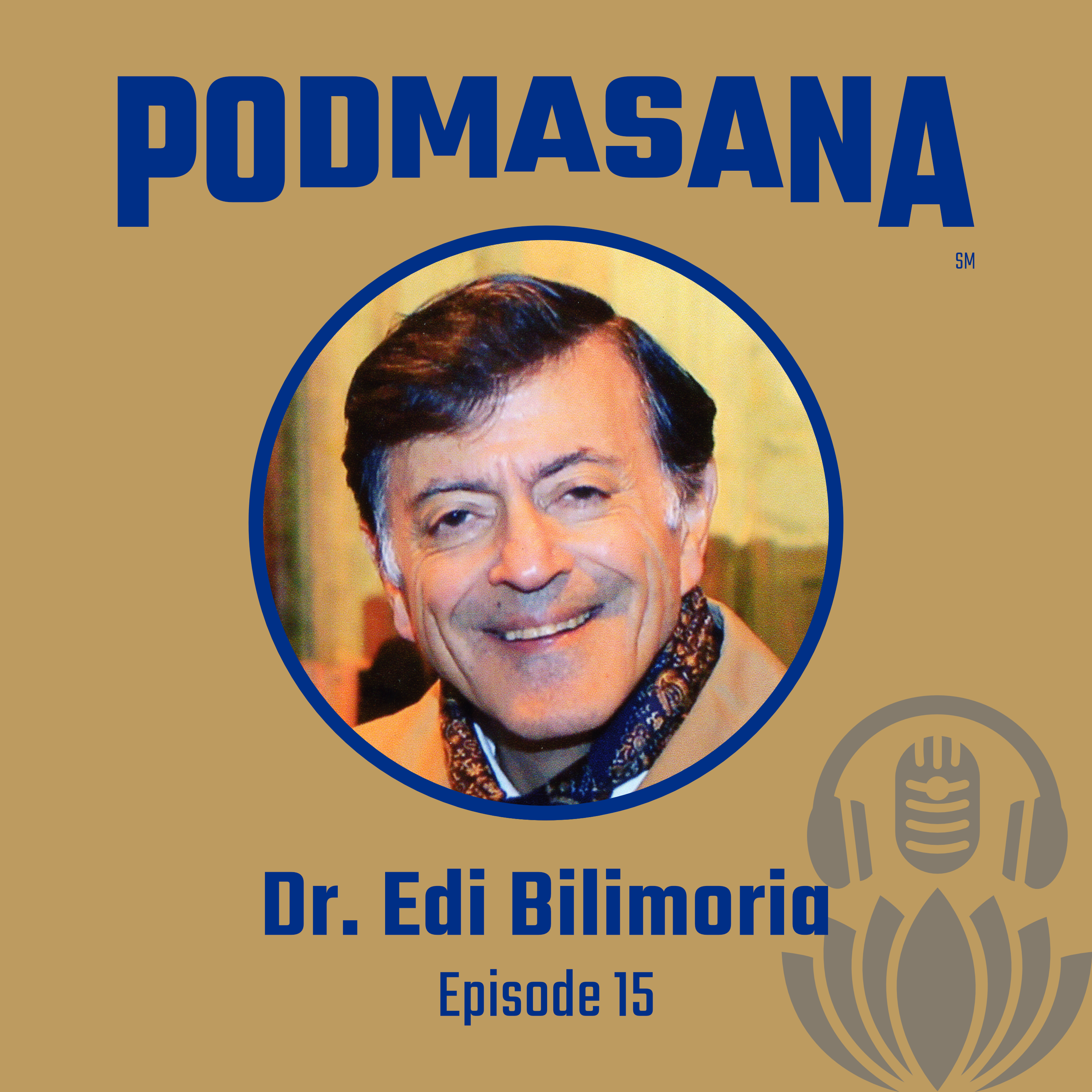
Today we're exploring these questions with Dr. Eddie Billy Moria, whose unique career path makes him ideally suited to bridge two seemingly incompatible worlds.
Born in India and educated at the Universities of London, Sussex and Oxford, Eddy spent his professional life as a consultant engineer on some of the world's most ambitious projects.
The Channel Tunnel, London underground systems, offshore oil and gas installations and the Royal Navy in the area of safety and
[00:01:29] Speaker D: environmental engineering and management.
[00:01:32] Speaker C: Across a number of projects.
His doctoral research on gas turbine thermofluids earned him the prestigious Thomas Lowe Gray Prize.
He knows how material reality works from the inside.
[00:01:48] Speaker D: But for more than half a century,
[00:01:51] Speaker A: running parallel to this distinguished engineering career,
[00:01:54] Speaker D: Eddy has been a devoted student of
[00:01:57] Speaker C: what he calls the perennial philosophy or ageless wisdom.
[00:02:03] Speaker A: The universal spiritual teachings found across cultures and epochs.
[00:02:10] Speaker C: Where most people separate their professional and
[00:02:13] Speaker D: spiritual lives into distinct compartments, Eddy has spent decades synthesizing them, applying the same rigorous analytical thinking he brought to engineering problems to the deepest questions of consciousness, mind and reality.
The result is his four volume magnum opus, Unfolding Consciousness, Exploring the Living Universe and Intelligent Powers in Nature and Humans, which received the Scientific and Medical Networks Grand Prize and the 2025 People's Book Prize for best achievement.
Reviewers have called it the most penetrating and all embracing work on consciousness written in decades and possibly ever.
His new book, Consciousness Came first.
Revealing evidence for universal intelligence and mind beyond the brain distills these insights for a wider audience, making a powerful case that modern science, materialistic paradigm.
The assumption that consciousness is merely a byproduct of brain activity is fundamentally mistaken.
Eddy argues that consciousness is primary and irreducible.
The brain doesn't produce consciousness.
It receives and transmits it like a radio receiving signals.
Drawing on quantum physics, neuroscience, parapsychology, near death experiences, ancient mystery school teachings and esoteric traditions from east and west, he presents evidence that the universe is a living evolving organism infused with intelligence at every point level.
His vision of the human being is radical.
We are not merely physical bodies with brains, but sevenfold beings ranging from the divine self, atma and spiritual intuition, Buddhi down through mind, desire, life force, subtle bodies to the physical form.
The heart, not the brain, is the true seat of consciousness and intelligence, a claim now supported by neurocardiology research showing the heart's electromagnetic field dwarfs the brains.
But Eddie isn't proposing we abandon science.
As a trustee of the Scientific and Medical Network and advisor to the Galileo Commission, a project working to expand science beyond materialism, he advocates for a new science of consciousness that integrates subjective experience, spiritual dimensions, and ancient wisdom with rigorous scientific methodology.
The timing feels urgent.
Eddy argues that our current materialistic worldview has led to spiritual poverty and alienation, ecological crises, and mental health epidemics.
The evolution of humanity requires moving beyond the ideology of scientism toward a worldview recognizing consciousness as fundamental, embracing humanity's spiritual nature and understanding our interconnection with all existence.
And this isn't just theoretical.
Eddie has served as education manager for the Theosophical Society in Australia, lectured internationally, organized conferences bridging science and spirituality, and worked to actuate eternal principles not just in quiet retreats but in daily working life, including engineering project management.
He's also an enthusiastic glider pilot, concert standard pianist, and choral singer, embodying the integration of scientific precision, artistic beauty, and spiritual wisdom, he advocates on this episode of Podmasana we explore consciousness as primary reality, why materialism fails to explain subjective experience, what the mystery schools taught about human nature, how the heart functions as our true center of intelligence, the evidence for reincarnation and karma, and why a new science embracing both matter and consciousness is essential for humanity's survival and evolution.
[00:07:01] Speaker B: Hey, listener.
Brendon here to quickly talk about my Mindful Moment Podmasana sibling podcast.
You know those moments when enlightenment, insight, and wisdom find us?
When the universe speaks to us during periods of adversity, joy, or stillness, and we feel more aware, mindful and present having listened to it.
What if we took the time to record those moments and share them with others?
This is the inspiration behind my Mindful Moment, where you are invited to listen to the mindful moments of others from around the world and share your own.
You can email your mindful moment to mymindfulmomentodmasana.com and for more information visit Podmasana mymindfulmoment thank you. Now enjoy this episode of Podmasana Part one.
The Engineer who Studies Consciousness.
[00:08:08] Speaker C: Eddie, thank you for being on Podmasana
[00:08:11] Speaker A: It's a great honor and a privilege. And if I may say so, Brendon we are both comrades in arms hoping to make this world a beautiful place with more truth and more integrity and more compassion.
[00:08:30] Speaker C: Absolutely, Eddie. Well, let's get that process started then, shall we?
So, eddie, for over 50 years, you've lived what most people would consider two incompatible lives.
Consultant engineer working on the Channel Tunnel, London Underground offshore installations, and the Royal Navy, while simultaneously studying consciousness, esoteric philosophy, and ancient wisdom traditions.
How did these two paths develop in parallel? And how has engineering, with its demand for precision, rigor and problem solving, under constraints, actually inform your approach to questions of consciousness and reality?
[00:09:20] Speaker A: It's a very, very fair question, Brendon Engineering engineers deal with how things work, and we make things that work.
How they work is what we deal with, dealing with objective physical matter.
But why? Why do they work in the way they do? Why is nature the way she is? Why is the cosmos the way she is? Are not questions that scientists and engineers within their discipline normally answer.
So what I'm saying very forcefully to start with, is there is a material dimension that is subsumed within a higher spiritual dimension.
So although physically, obviously, you work in a laboratory and you're not doing consciousness studies, they're parallel parts, but in principle they're not.
And I cannot give you a better example than the great Sir Isaac Newton, who I've studied, you know, most of my life, and especially his esoteric studies. So Newton, when he was in Cambridge, he wrote hundreds of papers on the Trinity, chronology, Bible, ancient readings of the Bible, hieroglyphs, at the same time contemporaneous with their studies in optics, mathematics, calculus and gravity. Now, why?
Because, as Newton's great pupil, Colin McLaren said, that when the great man wanted to understand the problem on Earth, he looked to the heavens, house above. So below is one of the axioms of all great scientists and all great esotericists and sages.
That which governs the wider movement of the cosmos also governs what happens on Earth.
That's why the material is subsumed in the higher spiritual. And the greatest of scientists had always pursued this. Not parallel, but two aspects of one path. Scientists and engineers, Thomas Edison, Einstein, Froedinger, Wolfgang Pauli. The list is long. But the tragedy, Brendon is that mainstream science, the science in nature, scientific American, new scientists, they completely ignore the wisdom of their elders, and they only cut out the spiritual dimension and deal only with the physical.
So, as I said, they're not two parallel paths.
Actually, there's not a dichotomy. That's what I mean.
As proven by the greatest of scientists and engineers.
[00:12:32] Speaker C: Yeah. And, Eddie, is there a specific moment, or a moment from your own career perhaps, where an engineering challenge and a question of consciousness unexpectedly aligned or maybe even illuminated each other?
[00:12:48] Speaker A: I wouldn't say unexpectedly. It was very expected If I can put it that way. You very kindly mentioned the Channel Tunnel. And, well, let's bear in mind, how do we construct a Channel tunnel from England to France, joining two countries that have always been at war and now the greatest of friends?
Well, everything starts in thought. The tunnel doesn't make itself. There is a vision.
Then that vision isn't going to dig the earth and start putting, you know, the spade on the ground, so to speak. Obviously, huge, boring machines. There has to be a management structure.
So the vision of the designer is flown down to the project managers and their initiative and management flows down to the workers.
So there is one line of communication. Without the vision of the chief executive, the designer with the workers don't know what am I digging, you know.
But on the other hand, the executive on his own can't dig the tunnel.
So everything starts with thought.
Now, having said that, let us recall what the great Schiller and many others, of course, the great Schiller, who Beethoven immortalized, of course, in his Ode to Joy.
But in the world of thinking beings, what did Schiller say?
The universe is a thought of deity.
And since this thought has overflowed, the world born thereof realizes the plan of its creator, creating the stupid anthropomorphic, dimorphic, you know, God with a white beard.
Well, Schiller said that. Arthur Eddington. The universe seems more like a great thought than a great machine. So James Jean said the very words exactly the same effect.
So it was this realization that I've always found the engineering enhances my understanding of the spiritual and the other way around, because we see common principles in each working at different levels.
Just one more example. Florence Nightingale. Now, Florence Nightingale, most people think obviously a very great compassionate lady and nurse.
Few people know she was a great statistician and her statistical diagrams. She was such a great statistician that she had a great intuition like one develops when one really goes into a subject.
And I only say this because she was a scientist as well as a great human being. And she said clearly in her manual for nursing, I think that the physical universe, like we, our bodies, are governed by the laws of physical science, but those laws were created by a higher intelligence.
[00:16:08] Speaker C: That's a good example. Thanks. Eddie, you were born in India and have been a student of the perennial philosophy for over a half a century.
What drew you to these teachings initially? Was there a moment or experience that made you realize the wisdom traditions were addressing something real and fundamental, that modern science was perhaps missing? And what is this perennial philosophy or ageless wisdom that appears across cultures.
What are its core insights about the nature of reality and human existence?
[00:16:46] Speaker A: Sure. Well, the three questions. First, was there a moment in my life born in India?
Well, some things are nurture other things on nature. It was always within my nature. But my education and schooling was wonderful in that it inculcated a universality of approach.
Now my parents, my mother particularly, you know the famous saying of Einstein, if you want your children to be intelligent, read them fairy stories and if you want them to be more intelligent, read them more fairy stories. Well, look, I'm not an Einstein, but I was brought up. My mother read Aesop's fables, Grimm's Tale, fable of Nadine, Tolan mythology, and this is very important.
So my babyhood childhood background was steeped in mythology, fairy stories and that kind of thing. At school, Roman Catholic school, we studied not only Christianity, but the great Hindu and Muslim literature.
The one awakening in school was when we studied the Ramayana, obviously the great epic in a cut down version. Bear in mind, I was age 10 then I realized, I wouldn't say it like that then of course, but then I realized the reality of the paranormal, that there were forces in nature that somehow couldn't be explained.
So let's fast forward to my school, wonderful school in England when I conducted a telepathy experiment in the science lab with a friend of mine. And you know, the skeptics are going to say coincidence, coincidence, but I remember four instances with my friend, he was great historian where we.
He was in the laboratory, I was in the gymnasium, half a kilometer apart and I was thinking of a battle and he would get it. And the famous example that still stays at me is when I thought of the Battle of Britain and he saw, I saw spitfires.
Well again, that was an awakening. And then I saw a stage hypnotist in India when I was age, going back a bit, age 12 I think.
And he started his show by saying, I want you to put your hands above your head like this.
And when I snap my fingers, your hands will lock.
And I thought, you stupid idiot, I'm not going to, my hands are not going to lock.
At least 20 people went up with their hands locked. And he obviously unlocked them.
And then he had them doing all sorts of things. Like tomorrow when he said on stage, when I stamp my feet, you will run out on the street and say, have you seen a green leprechaun? And I know people who did that.
And I realized that there were forces in the mind that were not so simply explained even at that Age. So what does perennialism mean?
Albert Schweitzer likened perennialism to a tree, an evergreen tree that always produces the same fruit, but never the same type of fruit, meaning that the eternal wisdom has got to be framed and expressed in the idiom of the age. So you always get apples from the tree or whatever. We're never the same kind of apples.
So that perennialism. The term goes back to Leibniz, the Philosophia perennis. Aldous Huxley used the word perennial philosophy. The great Newton used the word prisca sapientia, the ancient wisdom, Fitzhugh Schoen, the religio perennial. All of these terms have that common thread of the sacredness of. Of wisdom that is eternal, which is ineffable, but must be a part of it, must be expressed in the idiom and the language of the times.
Now what? He asked for the core beliefs.
The most wonderful word in Sanskrit is sutratma.
Sutratma means the sacred thread that binds together into an organic unity based on eternal verities, not beliefs. And those fundamental precepts are the absolute fundamental unity of existence which quantum physics has shown so beautifully and few scientists bother to take note of.
In David Bohm's terms, there is the cyclical movement from the implicate to, to the explicate, from the infolding to the unfolding that all life expresses through vehicles that have life at their level of expression. There is no such thing as dead matter.
So there is one life that assumes different vehicles at different levels, from the highest spiritual to the lowest germ and virus.
And man is the microcosm of the macrocosm. So as is the greater, so is the lesser.
And this constant cyclical movement is from being to becoming, the noun and the verb.
So however you cut that cake, you come back to three absolute three fundamentals. One is an absolute principle, whether you call it divine consciousness or God, which is a very unfortunate term, of course.
But this absolute ground of our being that then we see cyclicity in nature ebb and flow, whether in the oceans or in reincarnation and rebirth and death.
And the third most important point, which Florence Nightingale made as well, is that each one of us will eventually cycle back in order to unite with our source. And all beings want to find the source from where they came.
[00:23:40] Speaker C: Yeah, for sure. Eddie, how do we respond to someone who says that these are all just ancient myths when we present perennial wisdom as addressing fundamental reality?
[00:23:51] Speaker A: I would say that the very greatest of scientists have not only subscribed to that, but almost incorporated in their own writings.
Erwin Schrodinger, who so clearly said that he was a deep student of the Vedanta and he saw a great correlation between Vedanta and quantum physics.
So I would say to anyone who would pose that question is what is eternal can never be extinguished. And if great scientists have subscribed to these ideas, perhaps we should take them rather seriously.
[00:24:35] Speaker C: Yeah.
So Eddie, your work is fundamentally a critique of what you call materialism and scientism, the ideology that treats consciousness as merely an epiphenomenon of brain processes and rejects anything non material as unscientific.
As someone with deep scientific training, can you explain what's wrong with this materialistic paradigm?
And what does it fail to explain? And why has this ideology become so dominant in modern science that it actually perhaps hinders progress in understanding consciousness?
[00:25:19] Speaker A: You know something? There is nothing wrong with materialism anymore. There's anything wrong with eating food.
If you starve yourself or overeat, that's when problems occur.
So firstly, let's distinguish between the acres of scientific data and scientific knowledge from scientific training.
Now I put it to you, there is very little scientific training, by which I mean training the mind to question assumptions, to question presuppositions, to ask awkward questions and what is taken for granted.
Here's a presupposition.
How does the brain generate consciousness?
Which presupposes it does in the first place.
But as the great William James showed, this is a presupposition. I can go into William James of course course is three models. But just to come back to your question.
So scientific training is not the same as acres of data and knowledge.
And then the great Scottish scientist Arthur Thompson, Fellow of the Royal Society of Edinburgh, he put it very bluntly, I quote, the vulgar belief that science explains things is completely erroneous. It would be more truthful to explain that science explains nothing.
That doesn't mean we don't have science. But science describes it creates the conceptual map, but it does not explain
[00:27:16] Speaker C: related to this.
What would you say to a young scientist today who maybe senses the limitations of materialism, but perhaps fears professional consequences for questioning it?
[00:27:29] Speaker A: I would gently in his ear quote the great Ian McGilchrist, you know, who wrote Milestone. It's a misery in the matter of things that science is practiced these days factory fashion.
And many are young graduate who steps out a blind will find his career on the rocks. And many, even a seasoned scientist has much to fear.
So I would say that to him.
But I strongly emphasize there's nothing wrong with materialism in its place.
And if I give you a simple example of three levels, if I may.
I go running every day for about half an hour around my was on my local lake and there's a playground there. Now, with this playground of slide, suppose a little child comes down the slide and knocks a tooth out.
Now, why did that happen? Because the slide was too steep an angle. So the slide manufacturer is called, and as far as he is concerned, allies to design is mass coming down a slope.
I mean, whether it's a 15 kilogram child or a stone. From the point of view of translating potential energy to kinetic energy, it's mass down a slope. So he uses the laws of physical science to design the right slide. Now, say the child knocked his tooth out, goes to the dentist. The dentist, he's going to regard the tooth as an object.
It doesn't mean he thinks the child's an object. For his professional job, he's dealing with an object.
But now, say the child and the dentist isn't going to say, what's your weight, are you? Fifteen kilograms. That means a lot to this line manufacturer. Now, say when this little girl grows up and has nightmares about that injury and she goes to a psychiatrist. Now, is the psychiatrist going to say, how much do you weigh?
It's meaningless. It matters to the slide manufacturer. The psychiatrist is interested in the inner person.
So we have to ask the right questions at the right level.
So we have the materialistic framework, great for physical existence or physical health.
We had the intermediate the science of qualities, where we are joining qualities and quantities. And then we have the higher questions.
So materialism is indispensable.
[00:30:14] Speaker C: Yes, understood.
So, Eddie, the title of your forthcoming book makes a radical claim that inverts the standard scientific view.
Can you walk us through the core argument?
If consciousness didn't emerge from matter, but matter emerged from consciousness, what's the evidence? How does quantum physics support this view?
And what does it mean to say the universe is a living, evolving organism infused with intelligence at multiple levels?
[00:30:48] Speaker A: Yeah, sure, I alluded to it when I gave you the example of the Channel Tunnel. Everything starts with vision. With Schiller, the universe is a thought of creativity, a thought of deity, apart from the perennial philosophy that always is united in what it says, from any epoch in any culture. I again come back to what the great scientists say. If I quote philosophers and artists and musicians and poets, that's equally valid.
But unfortunately, these days people want to hear what science says. And if science says, it must be right.
But that is a prejudice.
It is a prejudice. But anyway, what does science Say I mentioned Eddington, who said that materialism in the literal sense is long since dead because the universe seems more to be a great thought than a great machine.
I didn't mention the great Sir Karl Popper, who in his book with the Nobel laureate John Eccles, the Nobel Laureate in Physiology, Sir Karl Popper, openly states the very program of science, the program of materialism has been to demolish the idea of, of matter.
It is ironical that science has demolished materialism.
So if we stand under an apple tree and shake the branches, certainly material apples will rain down on our head, we can be sure of that. But examine each apple and it's made of non material particles.
So there's the paradox. But materialism is a perception, it's our perception.
The ontology of it is quite different.
And finally you mentioned quantum physics. Well, how about Max Planck as a man, he says, who has devoted his life to the most clear headed thinking and science.
I can tell you this much. There's no such thing as matter.
What we call matter is the coming together.
It's the outer skin, so to speak. The coming together of forces and powers. And we must assume that behind these forces there exists an intelligent mind which is responsible, responsible for holding the cosmos in its place. Great minds think alike. Planck said that. Florence Nightingale said that, didn't she? I just quoted. Great minds have always.
How can I put it? They have dipped their pen into the universal inkwell of eternal wisdom.
But they write with their own hands.
So the scientist will write that eternal wisdom in his handwriting.
The artist, the nurse, the engineer will write in different handwriting. But it's the same ink.
It's the same ink.
[00:34:15] Speaker C: Thanks, Eddie.
So you argue that despite all advances in neuroscience science, science still cannot explain subjective experience, the hard problem of consciousness.
But you also document how evidence challenging materialism from parapsychology, near death experiences, remote viewing, has been systematically suppressed or dismissed.
Can you give examples of this suppression? What does this tell us about how scientific paradigms protect themselves even when contradictory evidence accumulates?
[00:34:55] Speaker A: The suppression mechanisms are pretty strong and it takes a lot to penetrate that impregnable fortress. What we have is a truth filter, so to speak, in materialistic mainstream science, Always mainstream science, not the higher levels of science.
A truth filter, where any piece of evidence that accords with the current paradigm and current theory goes through the filter that anything that is anonymous, even though it's anomalous and true, it's still dropped into the trash can.
So examples.
In 1628, William Harvey, the great English neurosurgeon it took him 20 years to to convince doctors that blood was pumped by the heart for 1,500 years, literally.
The prevailing theory was the heart was a convector of heat. It flowed to the brain, where it was cooled, and then down to the feet.
But when Harvey showed with his experiments and wrote the book De Motu, the leading physician, Emilio Parisano in Venice, wrote a letter saying Harvey might like to give us his hearing aid. But we write in Venice, if a horse drinks water, we hear the beat. But to say that Harvey says that the heart beats, this we cannot accept.
Now, just think of it, Brennan. Just think of it. In Venice, all mothers and fathers would hold an infant surely to their breast.
Surely you'd hear the heartbeat, wouldn't you?
But no, the paradigm says there is no heartbeat, so you don't hear it literally.
And the great Arthur Ellison conducted an experiment to show we see what we believe.
So 20 years it took William Harvey. Another wonderful example is Marie Curie, Pierre Curie and Charles Richet, four Nobel laureates. Marie Curie got two Nobel Prizes.
They meticulously investigated Ustapio, what is palladino? The medium. And Pierre Curie wrote about it as a scientific experiment. What he saw, what they saw and, and clearly said, there's no physics that can explain this. Have the science community taken this on board? No.
Classic example, the great Isaac Newton, who wrote far more on theology and alchemy than science.
Newton had 1,728 books in his library, 28% for science. The rest were theology, alchemy, literature, all the rest.
When Newton's chunk of esoteric alchemical papers was presented to Cambridge, William Horsley frs, by the way, opened the lid and slammed it in horror, of no use to science.
So how many more examples can I give you? There are many examples like that there is a prejudice that the greatest scientists have worked through.
Take David Bohm, the great quantum physicist. When the father of the atomic bomb, Oppenheimer, what did he say? If we cannot disprove David Bohm, we must ignore him.
So the deeper question is, why do prejudices stay with us? And I've worked out for myself the answer to that.
[00:38:54] Speaker C: And then what gives you hope, Eddie, that the scientific establishment might eventually become more open to investigating these phenomena?
[00:39:04] Speaker A: Most certainly, because they're getting.
The Vijay paradigm is grudgingly being eroded by science.
There is a wonderful book or a collection of articles by leading scientists produced by the Scientific Medical Network called Spiritual Awakenings.
So my hope is that the tide of evolution will eventually assert the truth and again, I'm not knocking materialism, I'm just pointing out that it has no place in explaining these higher realms.
You can't explain a Beethoven sonata by just examining the keys of a piano, but you need the piano.
So, as a great friend of mine, Peter Leggett and Vice Chancellor of Surrey University, said, by analogy with the piano and the pianist, if either is deficient, so will be the music.
But the brain is the instrument of expression.
[00:40:16] Speaker B: Hello listener, Brendon here.
If you're enjoying the show and would like to Support it, visit Podmasana to learn about all the great ways that you can contribute.
You can become a Podmasana plus partner at three different tiers with a variety of perks, and also make monthly and one time donations to help support the show. Any support is greatly appreciated.
Again, that page is Podmasana support thank you for listening and thank you for your support.
Part 2 the Sevenfold Human and the
[00:41:03] Speaker C: Heart's Intelligence Eddie Ancient esoteric teachings describe the human being as a sevenfold entity.
From the divine self, atma and spiritual intuition, Buddhi down through mind, manas, desire, life force, prana, subtle bodies to the physical form.
This is radically different from the scientific view of humans as sophisticated biological machines.
Can you take us through these seven principles? What does each one do?
And how does understanding ourselves as multilayered beings change how we approach questions of consciousness, purpose and spiritual development?
[00:41:55] Speaker A: Right, as a large question, As a general principle, whenever we see see seven principles mentioned, it is an unfolding from the unity towards multiplicity.
Now algebra teaches us that the unfolding whenever we have combinations, the simple formula is 2 to the N minus 1 from a unity to a duality.
And in this world we see unity, duality and their coming together or their opposition as triplicity.
How do we unfold a duality? 2 to the n minus 12 to the 2 minus 1 is 3 triplicity.
Now let's unfold the triplicity. 2 to the 3 minus 1 is 8 minus 11 which is 7.
And this isn't just playing with numbers.
So taking the familiar example of the seven colors of the rainbow, you have the primary colors and the three secondary colors.
So the primary colors in the human being would be the spirit, soul, and soul is not spirit, it's the intermediate spirit, soul and body which in their various combinations produce the sevenfold entity.
So the human being can be seen in many ways.
If we think of the number seven, even for the human body, we can consider, not divide. Consider human body as duality as head or. Yes, and torso.
But we can say, we can also think of head, trunk and limbs.
We can look at the head in terms of brain, nervous system and the sensory organs. These aren't separate bits and pieces.
So the sevenfold entities are not seven layers of an onion peeled off. That's very important. There are aspects of one unity presenting different levels at, you know, for different. Different vehicles, if you like.
So the. The sevenfold principle, starting with atma.
Atma is that spark, so to speak, that pervades all the other vehicles. But atma can't work on its own. It needs a transformer to step down its voltage, so to speak.
So the first transformer is the spiritual soul. Think of soul, generic term, soul as a transformer. So you have the spiritual soul that transforms atma into the intuitional principle.
And then the next transformer is the mind principle, manas, and the next transformer is the animal principle, karma.
So you have the individuality comprising what we refer to as the reincarnating principle.
And you have the personality. So you have the three and the fore.
So this is perfectly logical. The physical vehicle, the physical body doesn't just organize itself. It needs a template like a magnetic field needs, not needs, organizes, iron filings.
So the etheric double, the linga, sharira, all sorts of names is the model, the. The aura, so to speak, around which the physical is organized.
[00:46:05] Speaker C: Yeah. And so I'm wondering, Eddie, how does understanding ourselves as sevenfold change how we may approach something practical like mental health, relationships or decision making in our own lives?
[00:46:22] Speaker A: Well, generally, understanding ourselves as sevenfold may not be so useful for the example you gave. It is highly useful to understanding the reincarnation and things like that. But for practical purposes, I really think the threefold division is perfectly suitable. Understanding the soul, nature, soul as a generic term, which comprises the lower mind, thoughts and desires.
So in terms of mental health, it means understanding that problems, mental problems, where do they start from, other than a physical injury that causes these problems? But if it's a psychosomatic thing, it starts from the level of mind.
So understanding a little bit more on what we mean by mind, not just neurons and neurons express the mind, but understanding the mind principle would help definitely to try and understand mental health.
And that ties into the use of energies and prana and things like that.
[00:47:44] Speaker C: So one of your most striking claims is, is that the heart, not the brain, is the true seat of consciousness and intelligence. I like this one.
This contradicts a lot of what we're taught about the brain being the command center.
What's the evidence, Eddie, for the heart's primacy? How does neurocardiology research on the heart's electromagnetic field support this? And practically, what difference does it make whether we locate consciousness in the brain or the heart?
[00:48:18] Speaker A: Or the heart?
That's a question I love because I've thought about it a great deal.
Not just for this interview, but it's a very fair question.
It's incredible. We hear neurologists, neuroscientists only referring to the brain as the seat of consciousness.
First, think of our very language.
When we are jilted by our lovers, we are heartbroken. We are not brain broken.
And language isn't arbitrary. Language has evolved through the consciousness of the race.
Okay, we learn music by heart, we don't learn music by brain. Our heartfelt desire is to do whatever. Not our brain felt desire.
Our loved one is our sweet heart, not our sweet brain.
So the first thing we realize, our language points to the primacy of the heart.
But the brain is the command center. And I'll tell you why.
There is a wonderful, wonderful saying of Thomas Taylor, the great Neoplatonist.
And he said, light, when viewed or when considered subsisting in the fountain, the sun, that's primal light. Then there's the light rays from the sun.
And then the splendor communicated by the light to all creatures on earth.
This can directly be related to the three consciousness centers, the heart, the brain and the generative center.
So the heart, the spiritual center, is the superior center.
Now, the brain is the command center because it is the center by which to which, through rational intelligence, life and form, spirit and matter are united.
And the generative center is the center of least physical dignity. But the greatest physical importance.
Because it's the center by which we communicate splendor to other human beings. The brain is the center of greatest physical dignity. So the brain is the command center whereby life and form are united.
But now, if we relate everything to all thought, to brain work, it is only because in that mansion with many rooms and doors that mansion we refer to as the human body, the brain is the only door that looks outwards into the external world.
All other doors and passages are internal through which communicate the memory and the sensation.
So the brain is that command center in that sense.
But the heart is primal. And hence that great saying in King James.
As a man thinketh in his heart, so he is.
So my message to science is, feel with the brain, think with the heart.
[00:51:50] Speaker C: I like that.
[00:51:51] Speaker D: Yeah.
[00:51:52] Speaker B: Thanks, Eddie.
[00:51:54] Speaker C: So you discuss how ancient mystery schools In Egypt, India, Greece, Persia and pre Columbian America preserved esoteric wisdom through rituals, allegories and symbols rather than literal teachings.
Why was this knowledge protected and transmitted symbolically? Eddie, what gets lost when we interpret sacred texts and symbols literally rather than as multi layered teachings?
And what are some examples of symbols? Perhaps the third eye, the hermetic axiom as above. So below that you mentioned earlier.
Or even tarot. That reveal deeper truth. Yeah. That reveal the tree of life, that reveal deeper truths when properly understood.
[00:52:47] Speaker A: Well the, the beauty of symbols is they can be taken at any level depending on the perception and on the consciousness level of the person contemplating the symbol. Why were these truths withheld? For a very good reason.
The old saying, not casting pearls before swine.
Because these truths are highly dangerous when misused. The more sacred, the more dangerous. And that wonderful saying, Latin proverb, corruption of the best is the worst.
The more beautiful, the more refined. When corrupted, the results are far worse than if the thing never existed in the first place. And religion is a prime example of that.
So one can think of all kinds of symbols but or parables. Think of the famous one of the vine that illustrates the principle of constant renewal and regeneration, that if the branch is not rooted in the vine, it won't bear fruit.
Why? So if the physical being isn't taking the essence is not rooted in the Buddhi, in the atma, in that which feeds it, it's not going to bear fruit. You're not going to have a physical body.
That's a very simplistic way of putting it.
The lotus is a wonderful example, you know, with its roots in the mud and the flower pointing towards the heavens. Think of what mud does. It provides physical stability. Without the mud it would drift all over the place. So we need the physical body for stability.
And that's the whole purpose behind yoga. It's nothing to do with a beauty exercise. Obviously it's to ensure that when higher forces are evoked, if you, if your physical vehicle isn't robust, you'll be in dead trouble.
But the other thing that a lot of people don't realize is the lotus stalked through the water and the flower is on top.
Now water provides a different kind of stability, emotional stability. If you had roots in the mud and no water, the flower would keel over on a long stalk.
So the water provides a different kind of stability and the seed of the lotus will always renew and regenerate.
[00:55:32] Speaker C: Yeah, those are great examples.
[00:55:34] Speaker A: They're wonderful examples which evoke the intuition.
I quickly think of a nice mechanical analogy, a power Station, you have the. The power station, you have the consumers.
But without the intermediate transformers, you can't have the power station wherever you are, you know, illuminating the light, but blow it up.
So you need these intermediate transformers to transform the voltage down to a level that the consumer can handle.
So you have the atma, you have the spiritual soul, the human soul and the animal soul.
So this is how engineering helps.
[00:56:19] Speaker C: Yes, yes. And throughout the, throughout this discussion, I've always been seeing the two. Eddie's, the engineer and then the spiritual aspirant, essentially converging in one thread with each answer. So it's been a lovely thing to witness.
So Eddie, you write about three forces largely unknown to mainstream science, but central to occult physiology.
We have fohat, divine will and energy, prana, life force, and kundalini, spiritual energies.
[00:56:49] Speaker A: Kundalini, that's love. Yes.
[00:56:51] Speaker C: Can you explain what these forces are and how they operate in the human being? And why is it important for us to understand these subtle energies if we want a complete picture of human consciousness and potential?
[00:57:09] Speaker A: Well, in general, Brendon the more we understand something, the deeper our appreciation and the more aware we are of the miracle of nature.
I mean, the more we understand the subatomic particles, the deeper our understanding of physics. So, I mean, that's a bit of a loose answer. But the three forces, for any manifestation, you need a formative principle.
You need something to hold it together, to preserve it, and then you need something to regenerate.
So the creative principle, the Brahma, is to do that with creating the form.
The Vishnu principle pervades it with the life essence. And the mahesha, the kundalini regenerate provides that quality of regeneration.
And you see it in the human being. If a little baby cuts his finger, the healing is a couple of days.
So that Raman Vishnu is very much to the fore.
If that child at the age of 90 cuts his finger, it's going to take ages because the creative is still there. But it's very much dwindling as age progresses and regeneration has to take its place.
So understanding who we are, understanding the divinity in us, will definitely help us to understand and appreciate the divinity everyone else, because that which made the universe made us. The same divine forces that have fashioned the galaxies and the planets have also fashioned us.
So from a healing point of view, understanding prana and chi is vital. Tai Chi, obviously. But all these healing modalities that draw on the subtle energies.
[00:59:21] Speaker C: And I'm wondering, why do you think modern science has maybe been struggling or unable to detect or measure These subtle energies. Is there a limitation of the instruments, of the assumptions about what's measurable here?
[00:59:35] Speaker A: Eddie?
There have been, to the best of my knowledge, instruments that can detect these subtle energies at the, at the most coarse level of subtlety, if I can put it that way.
But it really comes down to the sensitivity of the individual, of the therapist, of the practitioner.
So one can only detect physically what is using a physical instrument.
For anything more, we need the higher instruments of consciousness.
So the proof or the endorsement of that is when independent researchers essentially come to the same conclusions and answers. That reinforces the argument.
[01:00:28] Speaker C: Suetti, your new book extensively discusses reincarnation and karma as fundamental to understanding human existence and consciousness evolution.
What's the evidence for reincarnation beyond ancient teachings, Eddie, whether from children's past life memories, near death experiences or other sources?
And how do karma and reincarnation fit into a coherent understanding of consciousness that persists beyond physical death?
What happens in the intermediate states between incarnations?
[01:01:07] Speaker A: You know, that is fundamental to start with. Misunderstandings occur and arise when people use the word reincarnation, because there is a confusion between exactly what is doing the reincarnating. It's not your physical body, of course.
Now it is your individuality, not your mortal personality, that is reincarnating.
It might help if I walk you through the process. It'd have to be a very fast chart.
Three stages, two transitions.
The first stage is the life on earth where we inhabit the physical body, the soul body, the psychic nature and the spiritual. 3.
Now regard the physical body as my coat.
When I cast off my coat, I don't die. I can burn my coat. I'm not burnt.
So the first stage in the death process is atrophy of the brain and the casting off of the body.
So physical memory is dislodged and gone forever.
But there is the memory of the soul as well. We'll come to that. So the first transition is from 3 to 2.
So we're still always the spiritual entity, but we now inhabit, it's not a nice word, but the psychic vehicle, the Sanskrit terms are much better. Now a psychic vehicle is, is really the body, so to speak, the entity that forms around our thoughts and desires when in life.
So if our thoughts and desires were very earthbound, so you are strongly drawn to drink and sexuality and violence, that psychic body is going to last a long time.
That if our thoughts were of an elevated nature, that desire nature, that earthbound clinging nature, is obviously going to have a much shorter life.
But in any case, just as the Physical energies dissipate. When we die, the psychic energies will dissipate.
And then, as it's beautifully put in the literature, the butterfly emerges from the caterpillar, the Katapala, the psychic nature is thrown off and disintegrates.
And then the individuality exists in what's known as Zevachan, the land of the gods, so called heaven. But not heaven in the Christian sense. It's not eternal. Everything has its allotted time.
So that's the third stage, second transition, butterfly, flower from Katabala before we are drawn back into incarnation. And what draws us back, the two words in Sanskrit are tanha, thirst for life.
But not only thirst for life, Krishna, thirst for the things we were familiar with.
So we find unexpected meetings with people. We find all sorts of so called coincidences, synchronicities, we find talents and capacities we never knew we had.
So all of that is underpinned by karma. And if I could give just one message out to scientists, politicians especially, karma is central. It is the law of laws.
So the four aspects to karma, there's Sanchita Karma, that's our total karma.
And if our total karma were dumped into one life, we wouldn't handle it.
So there is a certain amount of that Sanchita karma, the totality known as Prarabdha karma, karma allocated to life now.
And then there is the karma that moves the immediate karma we generate.
And then there is Agami, which goes on to future incarnations.
So one of the most beautiful sayings that encapsulate karma and these great poets, sages, and in this case Sir Edmund Arnold, the great Buddhist and literary scholar, in his book the Light of Asia, he said, who toils a slave may be born anew, a prince for gentle worthiness and merits won.
Now I hope someone in America is listening. Who ruled a king may wander earth in rags for deeds dumb and undone.
The sooner people take this on board, in my opinion, it would be the universal medicine.
When you die at the receiving end of what you did to others, it's the inner out experience.
So if these totalitarian dictators and malignant narcissists will would understand this, which they won't, of course, it would make our understanding and the general understanding of what's going on much easier to comprehend. We are seeing the effects of causes undone.
[01:07:11] Speaker B: Hello, listener, Brendon here.
Do you or someone you know have an article or book to share, a work to highlight or story to tell that would be a good fit for Podmasana If so, feel free to reach out via
[email protected].
that's ideasodmasana.com and we'll be sure to get back to you. Thank you.
Part three Toward a New Science and the Evolution of Humanity Eddie, you argue
[01:07:50] Speaker C: that the relationship between mind and brain is not one of production, but of transduction and expression.
[01:07:58] Speaker A: Yes.
[01:07:58] Speaker C: The brain doesn't create consciousness, but receives and transmits it. Can you explain this? What's the difference between saying the brain produces consciousness versus saying it's a receiver? And what evidence, perhaps from terminal lucidity, savant syndrome or other phenomena, supports this transduction model?
[01:08:23] Speaker A: I realized this, Brendon in all honesty and all humility.
Many, many, many years before I read William James when I reasoned that if I put on a CD of my favorite music, say Beethoven, Zempra Conchetto, the orchestra is not in the cd.
When I look at the tiger on a television. You haven't got a tiger in the television. So what's going on?
So there is a transducing.
So just as the invisible signals from the broadcasting station, they are invisible, but they are made visible by the television set or the CD player.
Similarly, as I said earlier, the brain unites life and form.
It's that open door into the objective world.
Now, William James Gifford Lectures on Immortality are gold nuggets.
He said, even then, in the 19th century, the mantra in psychology, the unsupported one, of course, as the brain generates consciousness or produces. But there are three productive functions.
There is production, like steam is produced by a kettle.
A hydroelectric. The waterfall produces the electricity.
But there is another productive function which is not producing, but releasing.
The fluid valve doesn't produce the water in the pipe. It releases it or it constrains it.
And counterintuitively, the more relaxed our brain state, the wider the valve is open. Which is exactly why meditation and contemplation practices will invoke much more creativity than hard intellectual thought, which is another thing.
But then William James said the third most important is after releasing, which he called permissive, is transmissive.
So the brain trans. You know, there is a transmissive function.
And he, if I can remember, yes, he quotes the great poet Shelley.
And I make the point that poetry, literature is as important as science. There is this snobbish prejudice that, oh, well, we only know real knowledge through science and poetry and all this entertainment, far from it.
And William James quotes Shelley, who said that life, like a dome of many colored glass, stains the white radiance of eternity.
So our brains are like many colored glass through which the white radiance of eternity, truth.
And like a Prism, depending on its refractive index, will bend the light.
So we see the colored light. We are not aware of the white light.
And the prism does not produce colors. The prism doesn't produce colors.
It refracts the colors.
So to say that the brain generates consciousness is the biggest taboo to get rid of. Not by being argumentative, but through example, through life, through experience.
[01:12:16] Speaker C: Thanks, Eddie.
Eddie, you argue that our materialistic worldview has created some profound problems. We've got spiritual poverty, alienation, mental health crises, ecological destruction.
How can we connect the dots here, Eddie? How does philosophical materialism, the belief that only matter is real, lead to or connect to these civilizational pathologies? And conversely, how would recognizing consciousness as primary and humanity's spiritual nature actually address these crises?
[01:12:57] Speaker A: Well, let's just consider how this excessive materialism known as scientism. The scientism is only the attitude that so materialistic science has all the answers. Of course, it's not science at all.
And science, let's always remember, comes from sciare to know, to discover, to explore.
So everything is a science in that sense.
But in the 19th century, there was an explosion in understanding science, the laws of physics and chemistry.
And as a result of that, there was increasing understanding and knowledge of the properties of matter.
And then knowing the properties of matter. There's technology and engineering because you can use matter.
But then from being able to use matter, the ideology then became materialism, which then became materialistic. Everything is nothing but matter, and anything else is mere superstitious.
And never mind, as I keep saying, what the great quantum physicists have said, there's no such thing as matter per se.
So the effects are absolutely deplorable. Because our central problem is not materialistic. It is a spiritual malaise.
And if we try and force the spiritual into a materialistic box, you've got category errors like that earlier example I gave you trying to, with the girl coming down the slide. The questions that need to be asked at the physical level don't apply to what the psychiatrist is saying.
[01:14:46] Speaker C: Yeah, and Eddie, you write about humanity evolving from the current fifth root race toward a more spiritual sixth root race, and about two evolutionary paths, the selfish materialistic path of the shadows and the altruistic path of light. Forgive me the moment of geeky levity, but I can't help but think, as a fan of some Star wars lore, the light side and the dark side, when it comes to this, to a certain degree. But what does this evolution entail, Eddie? Are we at an inflection point as a species? And what role does individual awakening and collective consciousness shift play in determining which path humanity is going to take? The light or the dark?
[01:15:40] Speaker A: Inflection is a very good term and it's a very good mathematical term.
So the two parts, the path of spirit and the path of matter, generic terms, or the path of light and the path of the shadows. And light casts shadow.
There are individuals, and you can see it in their behavior, and certainly amongst politicians, to put it mildly, their entire focus is on the path of matter.
Now, what do I mean by that? Matter is important.
Without matter, spirit would be an abstraction.
It is the expression, the vehicle.
But when matter becomes so rigid, spirit gets constipated, starved. There is a privation of spirit.
So what we are seeing now in terms of that inflection point, as I see it, is definitely a bifurcation of some individuals who are most certainly following the path of matter.
And the glowing example of that is the transhumanist movement.
There's only the physical body. There's nothing else. So I'm going to prolong my life so that I can have my palaces, my fast cars, my Ferraris, my private jets.
And you can see that complete attachment to matter.
And associated with transhumanism, there's cryonics, freezing the body in liquid nitrogen, so that when science advances, I might be revivified. And good luck to my consciousness.
Never mind that Sir Karl Popper referred to all of this as promissory materialism.
It's just a promise. There's no substances. So that's the path of matter, where the individual's path is so downwards towards matter that the spiritual element is starved. And there are others far more sensibly who are trying to release the butterfly from the caterpillar, the path of spirituality.
But that has to be done sensibly. And there are lots of accidents and unfortunate mental health problems you mentioned earlier when one tries to accelerate this process out of its legitimate time frame.
Because the wonderful story of the Greek sage Thales, he was discoursing with his disciples about the heavens, and he fell into a muddy ditch.
And he never forgot that. And he taught that man can discourse about the heavens and stars to his heart's content, but he must watch his feet as well, or accidents will surely befall him. So we must realize that we are so placed in the divine order of things that we have also a physical body vehicle that has its legitimate needs.
So the path of matter is important, but not to the exclusion of everything else. And those people who are sensibly releasing their spiritual potential are not trying to do the work of ages in a few short years and causing mental, emotional and nervous problems.
[01:19:21] Speaker C: I'm wondering, Eddie, what would someone actually do differently today if they were consciously aligning with this evolutionary shift?
[01:19:31] Speaker A: Well, depending on their life circumstances.
[01:19:34] Speaker C: Yes.
[01:19:35] Speaker A: How do you bring beauty into your life?
By all manner of means, as far as I'm concerned.
Go out into nature.
If you don't have nature. In a ghastly tower block surrounded by concrete, you could look at beautiful paintings.
You can look at scenes of nature and beauty in animals. Sir David Attenborough's wonderful work on the planet.
It is for me. What goes in through your mouth is the least important. I mean, food.
What goes in through the eyes and ears is the real food.
So ruthlessly discriminate what you watch and what you listen to.
Cut out rubbish on the Internet and social media.
So whatever your circumstances, you can do something to introduce more beauty and more refinement, and then the rest will take care of itself.
[01:20:43] Speaker C: I like that, Eddie. Thank you.
So, last question, Eddie, you've spent decades not just thinking about, but actualizing the integration of science, art and spirituality.
As an engineer, glider pilot, concert pianist, choral singer, philosopher and spiritual teacher, how do you hold all these dimensions together?
What does it look like to live from the understanding that consciousness is primary, that we're sevenfold beings, that the heart is our true center, that matter and spirit are one.
And what practical guidance would you offer to someone wanting to bridge their own spiritual understanding with their work in the material world?
[01:21:32] Speaker A: Well, one way of using your time wisely is. I've never had a television, Brenda,
[01:21:38] Speaker C: and
[01:21:39] Speaker A: I don't want one either. That's the only thing in life I boast about. Well, that's a personal question.
So I start the day with at least two hours of piano practice.
Great works of Bach, Beethoven, Chopin, List, Schubert. There was a time where I wasn't practicing for other reasons. But what would I say to someone?
Find what inspires you and what inspires you. The acid test is what would you do if money were no object? What would you do for the love of it? And there is a wonderful saying of the great Franz Liszt, philosopher as well as composer, pianist, that God has concealed more joy in an artist's might.
They need all the gold of a millionaire.
So that is why the artist is prepared to starve for his art.
And by the artist, I don't just mean the painter, the writer, I mean the scientist. Science is an art.
It is an art.
So whatever, find what inspires you. It's got to be something and go for it.
Look how miserable these billionaires look. They've got enough gold.
Have you seen a billionaire smiling?
And just make one more point, Brendon Orr sense of values now is topsy turvy. We value the so called powerful man. As far as I'm concerned, they are weak because they've got no power over themselves.
The really strong man there, thousands of them. The man or woman who is struggling to keep his job, has health problems, family issues, ailing parents, and who can still run his family ethically and keep the family together. He's a strong man and we don't give that any credence.
We give the tyrant a lot of our time. They are weak people.
[01:23:52] Speaker C: Well Eddie, I want to just thank you for everything that you are sir, and everything that you've done and are doing. And I hope people check out the book. And thank you very much for being on Podmasana
[01:24:08] Speaker A: It's been a great pleasure, Brendon And seriously, in all sincerity, what you are doing is spreading awareness and making people aware that all hope is not lost.
There is a way.
So thank you very much. It's been a great honor.
[01:24:31] Speaker C: We hope you enjoyed this episode. If you did, please share it with
[01:24:36] Speaker B: people you think would also enjoy it.
[01:24:38] Speaker C: Consider leaving a review or comment on your preferred podcast listening platform form, liking a video on YouTube or sending us an
[email protected] Also, be sure to follow or subscribe to the show wherever you get your podcasts.
You can also support the show by
[01:24:58] Speaker B: subscribing to Podmasana plus for access to
[01:25:01] Speaker C: Podmasana Live bonus content and other
[email protected] plus or Podmasana Media's YouTube channel.
In addition, you can make monthly or one time
[email protected] support or say thank you with a super thanks donation on Podmasana YouTube channel.
Thanks for listening and thank you very much for your support on the Socials. You can find the show on Bluesky,
[01:25:30] Speaker B: Mastodon loops, Instagram and YouTube.
[01:25:35] Speaker C: Catch you next time on Podmasana