[00:00:00] Speaker A: Foreign.
[00:00:14] Speaker B: This is Podmasana.
And I am Brendon Orr.
Some people discover spirituality through crisis.
Others inherited through birth and spend a lifetime discerning what to do with that inheritance.
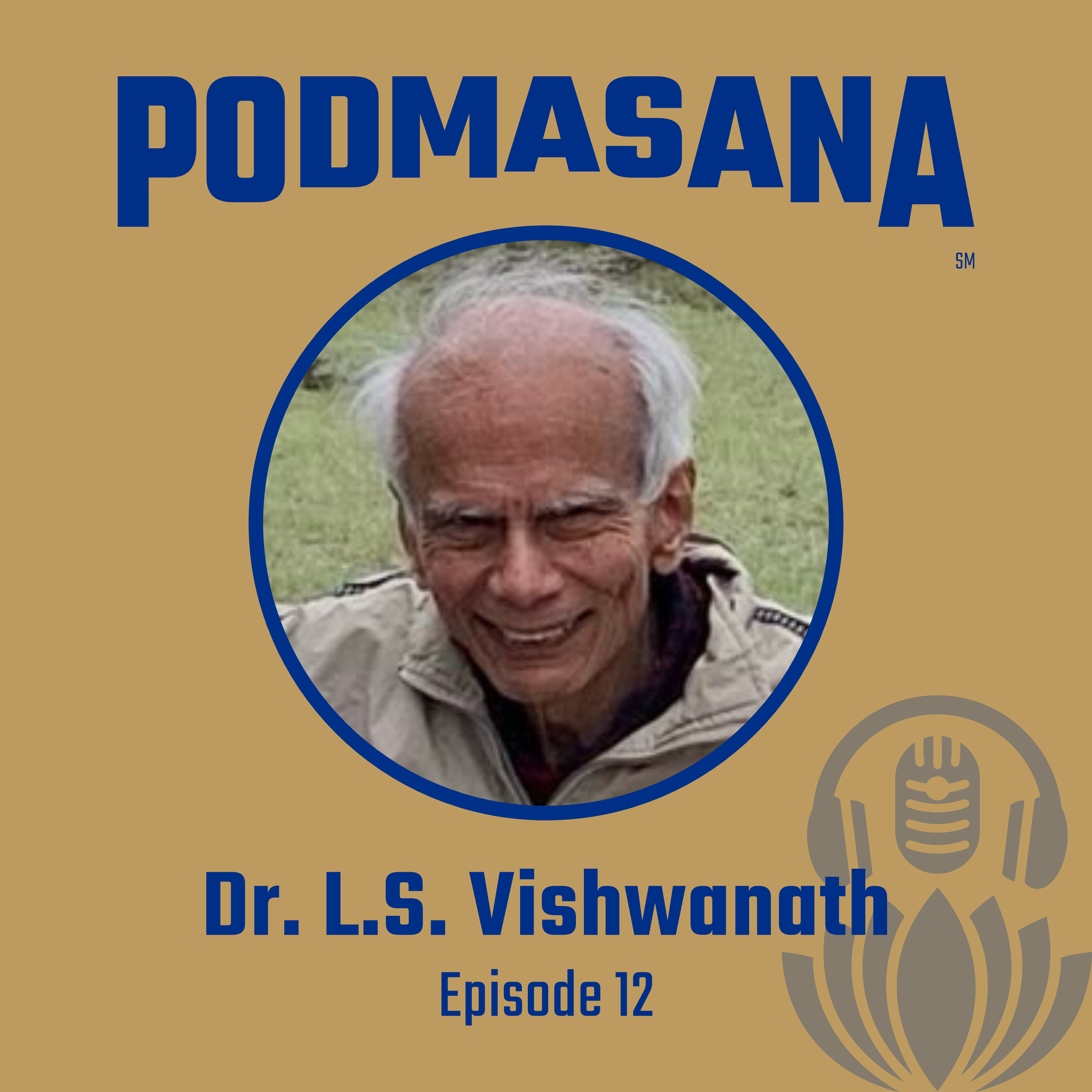
Today's guest LS Vishwanath represents the latter.
A man born into spiritual privilege who has spent 82 years wrestling with what that actually means.
Born on August 5, 1943, in the ancient city of Kashi, later known as Varanasi or Banaras, on the banks of the holy Ganges, Vishwanath was named after the city's presiding deity, Lord Shiva, whose name, Vishwanath means Lord of the Universe.
Born into a Tamil Brahmin family, he inherited what he calls a rich spiritual heritage and a tradition of Sanskrit learning.
But inheritance, as Vishwanath would learn, is not the same as realization.
His father, a devout Hindu and law professor at Delhi University, performed puja daily.
Young Vishwanath and his siblings plucked jasmine flowers and prepared sandalwood paste for the gods.
The rituals were there, the framework was there.
But what was he supposed to do with it all?
An unexpected answer came through English poetry.
Robert Suthi's the Battle of Blenheim, about a grandfather explaining a great war to his grandson who keeps asking, but what came of it planted a seed.
The futility of war, the waste of human life and resources that could help the poor and needy.
A moral questioning that would shape his consciousness.
As a history student at Delhi University, Vishwanath was more fascinated by cricket commentaries than European history exams.
His professor warned him he'd fail his crucial master's degree.
Worried, he turned not just to his books, but to Shirdi Sai Baba, the saint his mother prayed to daily, reciting his 108 names.
He began sitting beside her, repeating those names, staring at Baba's picture with its 11 assurances.
I take care of my devotees.
In May 1965, the results came first class marks in European history.
This was the beginning.
Then came the crisis that changed everything.
Over the next 40 plus years, Shirdi Sai Baba would appear again and again, Most dramatically in June 2009, when Vishwanath was hospitalized, passing blood with every bathroom visit, doctors baffled.
As death approached, Baba came vividly in a dream, assuring him in Hindi, you will recover.
He did.
But why?
Why would a saint who left his earthly body in 1918 continue conferring grace decades later on someone who wasn't even born yet?
When Baba died, Vishwanath found his answer in Baba's often quoted teaching.
I fulfill my devotees desires so they develop faith and want what I want to give them.
In Other words, Baba uses mundane miracles, passing an exam, surviving illness to develop faith that eventually transforms into higher seeking.
The goal isn't to keep getting your wishes granted.
It's to evolve into someone who wants what consciousness itself wants to give you.
Now, at 82, in what he calls the evening of my life, Vishwanath reflects on the central bringing the mind, that notorious wanderer and sensuous pleasure seeker, as Sri Aurobindo called it, like a dog's tail, into alignment with the Atma, the pure soul within.
The Bhagavad Gita teaches striving to make the mind sattvic, righteous, pure, noble, and seeking unity with the Atma as the higher goal.
Complete detachment from the worldly things is required.
Is he ready?
He's not sure.
On this episode of Padmasana, join us for a conversation about spiritual inheritance versus spiritual realization.
Why saints fulfill mundane desires to point toward transcendent ones, and what it means to wrestle with the ultimate question at 82 years old, am I ready to let go?
Part 1 Childhood Inheritance and Early Awakenings.
[00:06:03] Speaker A: Dr. Vishwanath, thank you for being on Padmasana.
[00:06:08] Speaker C: It's my pleasure to be on Padmasana.
[00:06:10] Speaker A: Yeah, thanks for being on the show.
So, Vishwanath, you were born in Kashi, the ancient city where Lord Shiva presides as Vishwanath, Lord of the universe, and you are named after him.
You write that being born in a Brahmin family, I was heir to a rich spiritual heritage.
But you also say you felt you shouldn't throw it away in frivolous pursuits.
What did that realization feel like?
When did you understand that spiritual inheritance isn't just cultural background, but something that demands something of you?
[00:06:50] Speaker C: This awareness develops over time.
It's difficult to be very specific how there is many errors, but it does.
And it was lot of reflection on not only my Brahmin birth, but also human birth as a human being in an ancient city of Kashi, now known as Benares, has been one of the most ancient cities in India, considered very holy because the river Ganges and the Vishnath.
So this kind of not as a boy I was quite playful. I liked game of cricket. But slowly it develops, it registers in one mind.
So I felt this important for me, the family, the place of birth, the holy city and so on. And I should not throw it away by taking to kind of realist pursuits because, you know, as a youth there are a lot of distractions.
So I told myself I should not be distracted my youthful pursuits and I should build on my Brahmin heritage.
So yeah. And why these things register in one's mind through reflection is probably because we don't live one lifetime from birth to death.
There is a previous, I believe in birth rebet. There's a previous birth which is part of one spiritual growth, you know.
So probably that's why I started reflecting on human birth, what it means to me, Brahman birth and my heritage.
And then what also leads to consciousness of Brahman birth is that I had three, three sibling sisters and it was part of.
Of the. They were unmarried and it, it was part of the qualifications for marriage to learn Karnatic music. So my father, my parents, they employed a music teacher, teach them Carnatic music as a young boy, I sit with them. And that also led to reflections is probably part of not only qualification for marriage but also in most Brahmanas houses that time things probably have changed. It was a requirement to learn either instrumental music, the ra, the violin, or vocal music my sister had learned. So I thought probably it's part of my South Indian Brahmin heritage for the girls to learn music. So that la awareness.
And then there was this Sandamadhan. There is initiation after wearing the Shakti trend, which was I. My parents arranged it for me, age 17, but usually recommended age is age 8 for this sacred thread ceremony. It's initiation into Brahmacharya.
Brahmacharya is part of the four stages of life for Hindus and it is prescribed or it is four stages of life for three varanas, namely Brahman, Kshatriya, Vaishya, Shudras.
It's not there. It's this kind of initiation into Brahmacharya. But those four stages of life, namely Brahmacharya, this married life. And then there's one more stage, Sannyasa is final.
And so these four stages are there.
So wearing sacred thread is part of the initiation into Brahmacharya, the unmarried stage of the life.
And then slowly again, this happens over a period of time which is difficult to specify is that the Sandhavan ritual has a lot of cosmic component to it. For example, I touch my forehead and speak out the names of the Rishis.
You know, in ancient India, like Atri, like Brighu, Gautama, Kashyapa, they're all realized souls, not ordinary humans.
So when I speak out their names day in, day out, it's supposed to have an impact on the Sahasara chakra. You know, there are human. We have several chakras in our body, starting with Muladhara to the heart chakra to the chakra between the Ajana between the eyebrows and the finally the head which Hasara chakra. So when I touch my head and decide name of this Rishis it is I think has a cosmic connect.
So also part of the ritual is when I utter the names of the different plants. Aditya for Sun, Soma for Moon for Jupiter, Shukra for Venus. You know.
So it has a cosmic connect which you know daily. If you do it, you become aware of your cosmic energy. We all have or cosmic connect. Astrology is not a useless science. It's there. So cosmic connect is established on arrival on this planet. And then many of us are unaware that there's a cosmic being within.
Atma is not the only one. There are all these chakras which have caused pain. So when you to Kundalini Yoga when reaches the ultimate Sahasra chakra then the whole cosmic universe opens out.
So one becomes aware that this ritual has a cosmic connect.
And also one should aspire towards the seeking the cosmic consciousness. This happens at a young age and at a formative stage.
[00:13:17] Speaker A: So speaking of consciousness of all the things that could have shaped your moral consciousness as a child. It was an English poem by Robert Suthi about war's futility.
Young paturkin finding a skull, asking his grandfather but what came of it? And getting no real answer beyond it was a great war.
Why did that poem strike you so deeply? And how did that early sense of war's wastefulness and connect to your spiritual development?
[00:13:49] Speaker C: As I said, probably the seeds of cosmic awareness consciousness were sown earlier. There are other poems and same. This was a book of poems.
There was a poem also by Lord Tennyson who on charge of light Brigade, you know, March 600, the guns volley thundered, the soldiers marched. But that didn't strike me as very appealing. But this one did.
But futility of war soldiers and the prime of life. They die on the battlefield, grieving mothers and families.
So it struck me as something very wasteful which can be stopped. Nations spend enormous amount on weapons. They still do on weaponry and in the name of nationalism protecting their borders. So it all seemed to be very wasteful to me because in my college days I read a book by Benitz Anderson which spoke about nation and nationhood as imagined community.
Which has very diverse people based on color, on religion, on creed and all that.
But somehow when the during wars their sense of nationhood so diverse people come together to fight wars, you know, so but it is. I agree with understand that it is imagined community.
People fight over base of Religion, their own color as happens in America.
Lot of lot of color, presid blacks and whites. They have serious differences. But somehow they are restricted to soldiers of course do their duty. For example, during the 1962 Indochina War my wife knitted sweaters for soldiers because they were the Indian soldiers fighting China in snowy mountains and they were ill prepared. They didn't have proper shoes, they didn't have proper clothing.
Nehru was probably Gandhi's influence. He never thought such a war will ever occur. He was very friendly to China, but China attacked us. It was a big surprise.
So it resonated.
Contributions came pouring in from many people. So people thought our nation, my nation is under threat from the Chinese.
So there was Circassian. But it's not that differences are forgotten. Differences are there, they still persist. Caste, creed, religion and so on. Some, you know the difference between Hindus and Muslims have been there for a long time.
But Muslim soldiers fought for India, sacrificed their lives. You know there was one soldier called Abdul, if I remember his name. He. He died fighting at the border.
So there were others.
So the Indian army doesn't only Hindus. It has Muslims, it has other Christians and so on.
So but anyway the sword is sent to nationhood. But still I thought wars were wasteful. We should. This is again God expects us to live as one family.
Hinduism has that concept of Vasudev Kutumbakam Vajikodingam translated means one human family. One human family is expected to live and let live and not fight. Wars kill each other.
[00:17:34] Speaker A: When you were a child, you plucked jasmine flowers and prepared sandalwood paste for your father's daily prayers.
You still perform daily puja today.
But there's a difference between doing rituals as a child because you're told to and continuing them as an adult because they mean something.
When did that shift happen for you, Vishwanath? What does puja mean to you now that it couldn't have meant when you were four years old picking flowers.
[00:18:06] Speaker C: I had a very strict, even dominating father and I just did what are the spect pluck for us Professor Andalpace for the puja and he used to.
I was very regular though he was a professor and dean of a law department in dale university. But I did. But later on as my spiritual experiences accumulated, particularly of Shiri Baba and so on, I felt that prayers have meaning.
If chakras are a cosmic connect, so are prayers. Prayers connect us.
Connect me to a cosmic God like for example Sridhi Barbara who years after he gave up his body came into my visions to which I Refer later.
So it's a kind of interaction between cosmic God and the Bhakta. Bhakta means a devotee and that matters because prayers and the interactive experience with the cosmic God whom you have experienced can ward off dangers which actually happen to which I refer later.
It's kind of a gut feeling that pujas is not just mere ritual. Offering flowers, for example, preparing sanal paste, uttering mantras, uttering his 108 names of God.
Because not only Baba but Lord Venkrishirpathi and other gods, they all have what is called Ashotra. Ashtra has unnate names of God. So reciting them matters because the living God, he is not a just stone image.
He is alive within you and in the temple, you know.
So once that understanding happens, then you know, you feel protected in your daily life because you don't know when I step out of my home, any kind of danger can happen.
Even when I am sleeping, any kind of thing can happen including silent heart attacks. But I feel protected guided by my daily round of puja. So that faith is very meaningful.
[00:20:26] Speaker A: Mm hmm.
In your younger days Viswath, you were fascinated by cricket. Listening to radio commentaries, watching inter college tournaments. While your European history grades suffered a little bit.
Your professor warned you you would do badly in your master's exam.
This seems like a classic moment. Spiritual inheritance versus worldly distraction.
Looking back, do you think your attraction to cricket was the mind being a notorious wanderer as you'd later learn, or was it just being young?
[00:21:04] Speaker C: Yeah, being young was one of the things. That's why I felt I shouldn't throw away my inheritance and so on. So there were a bit, you know, like you feel, days I was, I could even say madly interested in him of cricket. I don't know, I can't explain rationally but it was. Cricket was very popular game in India. It still is.
It was a British game which we inherited, an extremely popular game.
So I used to listen to any commentaries, go to cricket matches where my country played with UK or Pakistan and so on. Most of the former British colonies have this game and it was a popular game.
So I felt distracted, though I was not aware that I should be studying. My mother used to remind me sometime that why you're not studying and. But then I would. It was just that pull of youth probably. And these foreigners were gamific.
But then my history, European history professor noticed what I was doing sometimes missing classes, going to inter college tournaments, matches where my, my college, St. Stephen's College participated. So he noticed all this and said, look. He said, hello, you are missing classes, you're not serious and you're going to do badly. And that woke me. I could have dismissed it and still gone for Kickstarter. But then I took it seriously. Why took it seriously? I don't know.
My hindsight tells me that Sri Bramma was at work. He probably put in my mind that I should study seriously. Great saints like Baba operate at cosmic level. They can put a thought process into one's mind. Which I think he did. He probably told me stop being careless study work.
Which I did.
And then there's no guessing about Baba's role in my getting first class marks in the MA exam because he came vividly in my mother's dream. Those days in Delhi. We were in Delhi. The month of May is extremely hot. And interior of the house, though it is very spacious house, the heat was unbearable. So we used to sleep outside in the open.
Neemt is Marugosa tree. We had to sleep below in Charpais. Charpai is a sting cots and we. So my mother was in a separate string court me in a. But close to where she slept. She woke up. I don't know what the time she said Baba appeared in her dream and told her I will do well.
And so it was when the results came, I got first class marks.
And also not only that, in the question paper, in the European question paper, all the question I had the answers so. And the results. So it's not a coincidence about ba. BA coming in my mother's dream. Very context specific, situation specific. Because I was worried about the outcome of the exam. I didn't want to do badly. MA is a master's degree exam and it matters because the marks or grades you get are checked before you get a job because it's a. It's a qualifying exam. After that there's only research for the PhD or whatever. But Ma is a qualifying exam where marks matter. And I got worried. Who put that thought? I think it was Baba. And he comes and my mother's name says that your son will do well.
And.
And the outcome of the results, I'm of course very happy, delighted. But I know who's at work and getting me through.
So yeah.
[00:25:01] Speaker B: If you're a devoted listener of the show, becoming a Podmasana plus member is a great way to provide ongoing support of the show and get extra perks across three tiers, such as early access to ad free episodes from the growing Podmasana archive, discounts on merchandise and optional recognition in show notes. And on Padmasana's website.
Higher tiers also get access to bonus episodes, a private chat group, live video, Q&As with featured guests, a personal thank you, mention in episodes and more.
Listeners can support the show via monthly or yearly subscription starting at just $3.99 per month.
A 20% discount is applied to all yearly subscriptions.
Yearly Padmasana plus subscribers even get free merchandise.
Subscriptions automatically renew and there are no contracts.
For more information visit podmasana.com/.
You can also make a one time or monthly donation to support the show at podmasana.com/support.
One percent of all revenue from Podmasana+ memberships and donations are committed to carbon removal.
Thank you so much for considering a Podmasana plus membership.
Your support means a great deal and your subscription helps to cover the research, writing and audio production that go into every episode of Padmasana Part 2 Grace, Miracles and why me.
[00:26:50] Speaker A: Vishwanath in May 1965 you got first class marks in European history.
You credit Shirdi Sai Baba, but many people would say you simply studied harder after the professor's warning.
How do you distinguish between grace and your own effort?
Or is that distinction itself a western way of thinking that misses the point?
[00:27:18] Speaker C: Baba Shiri Baba, he wants to make me a spiritual seeker and that was the beginning when I was just 22 years old, got good marks in the master examination.
So Baba's way is of to catch people when they're young, still younger because he used to say that I bring the birds whom I want to come to me and so I tie, so to speak, you know, symbolically strings to their legs, you know, and pull them towards me.
So I think it's very possible that he's done that for me because 1965 was bening of my experience of Shilibaba and it has that developed my faith in him because I was anxious about the outcome of the exam which turned out to be very very good.
So as the experiences accumulated it only enormously strengthened my faith in Sri Sai Baba.
What he was aiming at for my soul because his aim is not just passing exam or recovery from illness. His aim is to inculcate in me spiritual seeking to reach the highest goal of universal consciousness, the 65 at age 22, a youth of 22 was the kind of beginning of my immense faith in Shiri Sai Baba. What he was aiming at not only for my body, for my soul because soul is long term, body perishes when the time comes through death, but the soul is a long term thing which transmits to another body. Because I said I believe in rebirth, birth and rebirth.
So if I develop spiritually in this birth and Baba's leelas, what's called miracles or leelas, you know, the miracles. What you call miracles are also called leelas in the local language. I think it's Sanskrit.
So then I would be born in Hyderabadi as an evolved soul.
So that's what Sri Baba, years after he gave up his body 1918 is aiming at now. Who puts this thought in my head? I think it's Baba.
It's not a brain wave, you know.
So this happens over time. So I became more and more aware. Because why are these experience accumulating for me and not for others?
Because Baba probably knows that some seeds have been sown earlier on which he has to work.
So Baba is trying to work.
My strong guess is on what he considers some fertile ground to. Whereas I am concerned, I can't say that for my family.
So Baba's game is very clear to me.
[00:30:49] Speaker A: Let's go to June 2009.
You're passing blood with every visit to the bathroom.
Doctors have no answers.
You're having a brush with death. Death. Vishwanath Shirdi. Sai Baba, who gave up his earthly body in 1918, 26 years before you were even born, comes vividly in your dream and assures you in Hindi you will recover.
Take us into that moment.
What did Baba look like?
How did his voice sound?
And when he woke up, how did you know it wasn't just your mind creating comfort?
[00:31:36] Speaker C: I was repeatedly passing pools of blood with every visit to the bathroom. And I was very weak. Feeling very weak and in fact dazed.
My daughter was running to blood banks in the middle of the night to get a positive blood for me. Though blood was injected but still there was no stopping of the blood. I was in a small nursing home at the time. This is June 2009.
And I was critical then.
The director of this nursing home told my daughter that she can't handle this. So I've shifted to a bigger hospital in Bangalore. And there the doctors tried to figure out where the blood was coming. They tried endoscopy, colonoscopy, colonoscopy, midnight surgery. But the blood was not just stopping but even before I was moved to a bigger hospital in the small nursing home in Jayanagar, Bangalore, where I live.
Baba came very vividly in my dream.
I don't know the time of the night. I was quite dazed and feeling very weak. He came very vividly. He's walking away from me and I am chasing him in the dream and then he disappears for I don't know how long, probably three seconds. I'm not keeping track of time because I'm very dazed, lying on a bed. And he turns around and his face looks quite old.
He gave up his body when he was about 80 years of age, if I remember this. Looks quite old. He's not young and has a dazzling face.
And he speaks to me in Hindi means, translated in English means, you will be all right, you will recover. And so though I was shifted to bigger hospital, doctors can't figure out the doctor, the gastroenterologist told my wife, we can't. We don't know where the blood is coming from. It's a slow ooze from somewhere.
We can't make out if it was a huge lot of blood gushing somewhere. We can stop it, but, sorry, we can't do it. So I was in out of ICU and then after shifted Delhi in a hospital where brother in law worked, suddenly the blood stopped.
So the important point here is Baba and two other saints about whom I speak later and this podcast.
They always speak the truth because they are cosmic beings.
And like the sun, the sun never fails to come out every day, which were part of the world, you know, and so they are cosmic beings.
Bob also said often he lived in a lept in mosque in Shirdi for 60 years before he gave up his body in 1918. He often said, I speak the truth, you know.
So he. So he had spoken much earlier that you will be all right. And so I did.
And since 2009, to this day, not a trace of blood whenever I visit the bathroom.
So I recovered and I've lived up too. I had a brush with that, no doubt about it. I could have died.
But I think Baba helped with his words, you will recover.
And I ascribed my being alive today at age 82 to Baba. I could have passed on.
When I was at that time, I was in my 60s, you know, 2009. I was born in 1943. I was probably age 64, 65, 64, I think.
And I could have passed on because the doctor could figure out my family was very worried about my condition. With condition, my wife spoke often morning and evening to her doctor brother who was in Delhi.
Then he. She said, you have to come. I can't. I don't know what's happening. The blood is not stopping. He came, took me to Delhi, and then it just suddenly stops, you see.
So that's it.
He did come. So there's no it's not imagination, it's not hallucination. He came as vividly as he did in mother's dream before my results of my MA exam were declared.
So that's how the faith in Baba as God builds up.
And I'm sure it is happening world over.
There is no doubt in my mind why so many Baba temples are coming up in many states in the United States, in the uk, the Caribbean and so on. So people have experienced Baba as I have had.
And they believe Baba is God whom they can trust, who helps them in time of need, be it an exam or a critical illness, and solves the problem. But there's no doubt about Ba Baba is doing it is a strategy.
He doesn't eat anything for himself.
He lived in a dilapidated mosque for 60 years, a crumbling mosque where here and there the stone was falling.
And then he used to beg for his food. He used to wore a torn kaphani. Some of the pictures of Baba with this kaphne is a tall tunic going up to the going beyond the knees. And obviously it is torn because in one side it is torn. So he wore it on tunic which is called, I think Urdu, a kafne. And he begged for his food from five houses.
Five houses in Shirdi.
It's now a small at that time, village is now a small town. It has grown because of thousands of Baba worshippers pour in. You know, it was in thousands, now it is in lakhs. There's a daily hotels have come up in that small village during Baba's time.
And it is their faith in Baba, what he can do for them that they come. Baba's strategy is not different. They come, they try to access samadhi, they pray to him for relief from whatever is bothering them.
But Brahma works on them their minds to be speakers. In my case it is absolutely true. But others, I don't know whether once their prayers are answered, they are they become spiritual speakers. I do not know. But in my case it is a very strong feeling that Baba wants make me a spiritual Sikkum.
[00:38:59] Speaker A: Vishwanath. You ask yourself, why would a saint who died decades before I was born keep conferring grace on me?
You find your answer in Baba's teaching. I fulfill my devotees desires, so they develop faith and want what I want to give them.
This is profound. Saints use mundane miracles to create faith that eventually transforms into higher seeking.
But it also raises a question.
Once you understand the game Baba is playing, using worldly fulfillment to point toward transcendence, does it still work or does the magic break once you see the mechanism.
[00:39:39] Speaker C: The magic doesn't break because the Baba's appearance in dreams and visions is 100% intended. Because he wants to help out. And it doesn't end there.
Because he wants to work on my mind and change the transform me from just seeker of the mundane to a seeker of the higher truth, which is universal consciousness.
So so far as I am concerned, Baba's strategy or game is not over because I have both the mundane and the spiritual seeking going on simultaneously in my mind.
So this, it's a kind of. It's a process. Transformation doesn't happen. Probably some individuals, it happens suddenly. You know, for example, the great sage called Ramana Maharishi in place called Tirunamalai in Tamil Nadu, he had, at age 10 or 10 or 12, had a huge spiritual experience.
And then he meditated deeply in the basement of a temple, Shiva temple.
And then his meditation was so hard that earthworms and or was all over his body then.
So. And he, he developed, I think, like the Buddha. He was enlightened. It happens. This is strong, but in my case it seems a slow process of transformation because I am in both domains, the mundane and the spiritual.
So. But I have no doubt that maybe, maybe not this birth or even next birth, Baba wants me to give up on the mundane and speak only the spiritual and seek that higher stage of universal consciousness. So the thing is, Baba doesn't work appearance in the dream.
Saying that you'll be okay, you'll recover is not the end.
It is part of a process where he makes you reflect on why me, why he came, why when I could have died. I recover. I'm still alive at age 82. Tells me a lot about what Baba is aiming at for me, for my soul.
[00:42:23] Speaker A: So we've discussed Shirdi Sai Baba and you've referred to two other saints I have experienced meaningfully. Who are these other saints? Vishwanath. What does it mean to experience a saint?
Are we talking about dreams, visions, synchronicities, answered prayers or something else entirely?
[00:42:46] Speaker C: We are talking of dreams, visions and experience and experience of Shirisai Baba and two other saints, namely Chad Sai Baba and the Kancha saints. It's a saint of Kanchi as we call them. Chandrasekara Saswati Swami have been important. Visions, dreams, they happen at different points of life. Of course, the Srija Baba was the earliest.
But the experience matters because there's a popular saying that only person who tastes the pudding knows its taste. You know, those who are not tested do not know. So as an experience of Srila Baba's grace and of these two other saints are very meaningful to me.
The other saint is Sathya Sai Baba. Who said to be reincarnation of Shira Sai Baba.
He was born in place Puttaparthi in Andhra Pradesh.
He grew up there. At that time it was just called an anthill. A very small tiny village.
Now it is a.
It's a small town.
And there's his Samadhis there.
So he was born in November 1926. Gave up his body on the 24th of April 2011.
And very meaningfully he just like Shilibaba he rescued me from what could have been malignant cancer. 2008 there was a huge polyp near my anus. I couldn't see it.
The huge polyp.
We consulted doctors, surgeons. They said this has to be removed. And so scan was done.
And the doctor say Manipal Hospital, the gastro hospital. He saw it, saw the huge polyp size of a tennis ball.
He told my daughter that it could be malignant.
She started crying. She said Appa, Appa for father. She told my wife what's happening.
So then one of my eldest sisters was already devotee of Sathsai Baba. Said let's go to Pattaparthi where Baba then this I am talking of 2008 when Sathsai Baba was still alive.
But he had taken to a wheelchair.
Simply I fell down in the bathroom. I took to a wheelchair.
So I wrote up a letter praying to Sasa Baba that Baba helped me. This is this polyp could be doctor said could be malignant.
My daughter is very worried and anxious.
So can you do something?
So I took that letter to Puttupati.
And we stayed in a hotel called Hotel Renaissance.
In the morning when he went morning Darshan.
He came very close to me in a wheelchair. But had forgotten the wheelchair in the hotel room.
So then I wanted this.
This Satsibaba going to come again close to me. So that I could give him that letter.
So in the afternoon there was lunch afternoon around 3 o'. Clock. Again he came very close to me. This time I didn't forget the letter. I put it, put it in his lap and he took it. He didn't look at it. Then he moved on. Because so many deportees were waiting for his Darshan. Big crowd.
So I went back.
And then at that time I was not sure of this gastroenterologist in Manipas hospital.
Because I was wondering how can we tell my daughter and she has a brain, she cries without doing a biopsy. By then though I'm not doctor, I knew that only a biopsy will show whether a piece of flesh after it is excised or removed is malignant or not. Which I knew.
So I said, how can this man, this doctor tell my daughter that it is malignant?
So I told my daughter, I don't trust this man. And my brother in law asked us to come from to Delhi where he was a doctor in a senior doctor in another hospital. And I was admitted to the for surgery. And surgically that huge tennis ball size polyp was removed.
And then I.
It was a biopsy was done.
My daughter was. Though she was at that time in studying or working in Bangalore, I don't remember, she was there and she told me that because it's so big, they had to do a section by section biopsy of each part.
And each part was reclaimed without any cancer cells.
That was it.
Till that happened, my impression of Sasha Baba was a person they call a saint who has lot of hair on his head.
Is he a saint or is he something else? Or is he pretending to be a saint?
But that was it.
Like the 2009 when I was passing blood.
This was it.
They found no cancer cells and a huge piece of flesh.
A bit biopsy was done. It was great relief by my daughter, my wife, my son, who was at that time in the US So that is it.
And then after he gave up his body and 24th April 2011, beginning of May 2011, he comes in my vision. And he usually wears a orange like kaphne or tunic, which sannyasis wear.
But in this vision he's wearing a white, spotless white tunic or caffeine.
And I am lying down, seated, and he asked a small child, very small kid, to rub my head. And then it ends.
So reflection or was it? He put it in my head to reflect and understand that my mind had. I think it still has a lot of garbage because it's still a very sensuous mind. You know, I like good food, I'm fond of sweets, you know, I like beautiful pictures and so on. So it's very sensuous mind.
And so the white, probably he's put it in my head to grasp the white. Coffining stands for purity.
The children are very innocent once they grow up, of course, probably they develop selfishness and so on. But that is a very small cage.
So what I am understanding or made to understand Sasha Baba is. It is no massage.
He is aiming at impurities in my mind.
So spiritual seeking involves purification internally.
[00:50:48] Speaker B: With.
[00:50:48] Speaker C: The gross chakras, the gross mind.
One cannot be, one cannot advance spiritually. That's very clear to me, you know.
So in the Kundalini, which is part of Vinaya, part of yoga since the time of Patanjali, the chakras are gross, right? From Vadhara to Dhar chakra to Ajna within the eyes, they have to be cleaned up.
So once they are cleaned up, the mind is open to the cosmic energy.
That's what I understand, you are into yoga, I'm sure you know about it. So Satse Baba wants that why me again is a. Probably the seeds were sown earlier. I don't know. I don't know about my previous life.
So Vaishirisai Baba then Sasta Vaibha wants me to be a seeker, to purify me internally.
I have no clue, but some understanding grasp of what they want is there, you know, it has registered.
So that's what makes me a seeker.
[00:52:17] Speaker A: So you write that as the experiences accumulated, you started understanding Baba's expectation that you evolve into a seeker of the higher truth or consciousness. But many people accumulate spiritual experiences without actually transforming.
What's the difference between collecting experiences and. And letting them transform you?
How do you know if you're doing the former or the latter?
[00:52:46] Speaker C: Yeah, the experiences as they accumulate, tell me or cosmic Babas tell me that opening my mind that I have to speak seek the higher truth, you know, because the you have a conditioned mind, a sensuous mind and notoriously wandering mind, which is true.
So whether this kind of experience transforms others, it matters to others. I do not know. I do not remember their mind, how their mind works.
For me, the inputs through spiritual experiences have had transportive, transformative experience. And because I have reflected on them, asked what they mean to me, this life, another life after I gave up this body.
And so they are not something which or something matter of chance, serendipitous. It's not that. So I'm pretty sure that these saints have been at work and want to purify me internally.
And they would not, I think also not stop. So I understand that I have to bother about Monday less do my pujas, do my rituals, stay connected to them. So.
And also it could be that Baba who satsaib all these cosmic beings, they knew that I would be indifferent to the experiences, probably would not have accumulated the way it has done. Probably they knew they gave. They have just given up their body, but they're still alive.
That picture in my prayer room is very much alive. That image is alive because I don't recall the image, but I have recorded it. Lai Baba has emerged from that image in my prayer room.
He has put his right hand on my head, so there's no guessing. And the way he arrived at his own will, that's also another story.
There may not be time to cover it in this podcast, but he arrived at his own will, emerges from that image at his own will.
So if I was indifferent to the earlier experiences, then probably they wouldn't have bothered to.
For the chemistry to be cumulative with their higher goal, their aim that I am good material or soul who can reach out, they have made these experiences happen with that end objective.
That's how I look at it.
Or, you know, actually the questions about whose I it is my soul I or my body I? You know, this is a question which the saint of Trinamalai made. People ask who came to me, ask, who am I? Are you the soul? Sit there, ask questions, are you the body which will eventually perish, inevitably perish, because you are mortal body, you're not the model body, you are the soul.
And so when I say I felt, I relaxed, I reflected.
Is it my body self? Is it my mind or is my atma?
These are things which I have to reflect on.
[00:56:58] Speaker B: Hello listener Brendan here.
[00:57:01] Speaker A: Do you or someone you know have.
[00:57:03] Speaker B: An article or book to share, a work to highlight or story to tell that would be a good fit for Padmasana?
If so, feel free to reach out via
[email protected] that's ideasodmasana.com and we'll be sure to get back to you.
Thank you.
Part 3 the mind, the Atma and.
[00:57:36] Speaker A: Evening of Life Vishwanath, you have referred to Sri Aurobindo comparing the mind to a dog's tail, a notorious wanderer and sensuous pleasure seeker, you acknowledge the persisting mismatch between my mind and pure atma.
After 82 years of spiritual practice, daily puja, multiple saint experiences, you still find the mind is still wandering.
Does that ever feel discouraging?
Or is the point that the mind will always wander and the practice noticing and returning, noticing and returning forever.
[00:58:22] Speaker C: I am given this so much of experience of the saints and what they want from my soul.
I am anxious or concerned about the distractions of my mind. You know, this mind is still not focused on anything that I would like to focus.
So for example, after I get up in the morning, after I have my morning cup of tea, I do some japa. I have always carry japa mala, which has sunnyde beads So I do Japa of the Gayatri. Gayatri is an important part of Sandhya ritual. It's considered very potent.
So I recite Gayatri, then the name of Shiva. Oh, no. Shiva.
So. But still the mind wanders off here and there.
It's not just the doorbell or the phone, but the mind just wanders off. And I'm concerned.
So I would.
And knowing that the saint like Baba, Satsai Baba and the saint of Kanchi, they want me to progress spiritually. That is the concern.
And so I have now decided, I don't know whether I can do it before I leave this world is that I should learn deep meditation, you know.
So my mind is. I was not much into yoga. Yoga practice, whatever reason, I can't say.
But this wandering mind, senseless mind bothers. So I agree with Sri Adam that the mind is like a dog's tail, which is notorious for its wandering.
But then the question is not just agreeing with the saint that Aurobindo was.
I should be doing something about it.
So I wrote to this person called M. Quite a great guru.
His first book is Apprentice to a Himalayan Master where he meets his guru, Mahindranath Babaji in the Himalayan mountains. He treks all the way from Hyrud Bharatu. And the guru teaches him about Upanishads, about Kundalini and so on.
Now, here is ashram in place called Madinapandli, not far from. It is in Andhra Pradesh, not far from Bangalore, where I live.
I wrote to him that I would like to come to your ashramline, learn deep meditation. But he has not responded.
So I would like to learn deeper medicine. But then lot of time is spent on what I call mundane pursuit. Like, you know, I have investments in banks after retirement. You know, I need that money to keep us going, whether it is groceries or milk or whatever. So I think I should find the time. I think the probably I don't still have the will to sit and do deep meditations. It was a very, very important part of yoga, as you know, so that I can focus. But normally, given my understanding, one of the most important chakras in my body, every human body, is between the eyebrows called Hanjana chakra.
So I meditated on Baba.
I regard Baba as my sadguru and as my teacher, parent, mother. There's a saying, Sanskrit, shloka, what's called saying. Tamiya mata pita tameva, tamiya bandhu sakata meva. That is, you are my father, you are my mother. Mata Pitta is Father Mata is pita Bandhu is friendly.
That you are everything.
So I said that daily as part of my prayer.
My strong feeling within is that I should develop the capacity or the inclination for deep meditation. Only that will help, not this. So I'm concerned right now. I'm concerned about my involvement in the mundane world, my wandering mind, the kind of senses, the way I like, good food, chocolates, all that. I think I should. If I'm going to be a spiritual seeker, which Baba wants, and other saints who have had experience, then I should be more serious into meditation, into yoga and that.
[01:03:39] Speaker A: Yeah, that's an honest answer. Thank you.
You write that complete detachment from worldly things is required. And you discussed that a little bit in the last answer to attain the higher goal of unity with Atma.
Then you ask yourself, at my age, I ask myself if I am ready for it.
I'm not sure is what you say.
This is refreshingly honest.
Most spiritual memoirs would claim readiness and claim arrival.
You're saying, I'm 82, I've had miraculous experiences and I'm still not sure I'm ready to let go.
Why do you think detachment is so difficult, even for someone with your background, your experiences and perhaps your head start?
[01:04:31] Speaker C: Yeah, that is because I'm kind of shifting between the mundane and the spiritual.
So. But I know the goal is future seeking, not the mundane.
The mundane has meaning so long as I'm alive.
My whatever property I own, whatever investments I have and so on. But it seems to have any meaning. Once the mortal body perishes with the inevitable will, that's it, inevitably will. So I know what I should be aspiring for.
But then I'm not sure because as I said, my mind is still not fully transformed.
Still I think probably half built. You know, this is somebody.
The experience which this man, he was born in Muslim family. But she talks about early births as a Hindu in his book.
Now he's from. He was born near Trivandrum in Kerala. So he went to some spiritual masters before he went to the Himalayas.
So they saw him, they touched him on the forehead and said, you are still heart baked.
So then this Maidanath Babaji, Maheshanath Babaji had strong urge. So he quit his home, didn't inform his parents, went to Somalia and there he had a over three years. He had a huge experience.
So I think beside whatever pujas I do, the other rituals I do, I still probably half of pradium got a baked spiritually transcending two domains, mundane and spiritual.
So I think beside Leading deep meditation.
I need a spiritual evolved guru who will help me reach the goal, who will help me and help me cleanse, cleanse internally.
So as long as my chakras are gross, as long as the mind is gross and wandering and senseless, then I'm not ready.
I'm not ready.
That's what. That's why I'm saying I'm not sure.
Because I'm not ready.
So I need a spiritual guru.
Where that guru is, I don't know.
Right now I regard Sri Sai Baba as my spiritual guru.
And it has been a long time since I had experience of mf, of other spiritual masters as well.
But the important completion of the transformation has not happened. I know I have to be very honest.
It does not happen.
So how long this transformation will take? Already 82, whether it will happen before this mortal body ends, Will it happen my next birth with the carryover? What has happened, this birth, I do not know. That is being very honest, I don't know.
But I also feel Baba is preparing me towards that goal.
And of that I am sure.
But still the transformation eventually completed.
Honestly, I don't know.
[01:08:39] Speaker A: So you're 82 and you refer to this as the evening of your life.
Looking back at your childhood, plucking jasmine flowers, the young adult years, worrying about exams, enjoying cricket, middle aged years, surviving illness.
What would you say to the younger Vishwanath?
And more importantly, what's your relationship with the inevitability that this body, this lifetime, will end?
Does your spiritual practice make death less frightening?
Or is fear of death also just the mind wandering, the dog's tail wagging?
And the practice is to notice and return to the atma that never dies.
[01:09:27] Speaker C: Yeah, I have got over in a way the fear of death, you can say. Because I feel that Baba who wants me to spirit, work, spiritually, develop, transform. And that is being his goal. And putting it in my mind that that should be my goal as well. Doesn't. That doesn't frighten me at all. Because I feel he's with me. I still have a desire to whenever the time comes.
At age 82, I don't know how long I'll live, how many more years.
But I have thanked Baba for being alive, given that brush to death. I thank him and I know he's not going to prolong my life indefinitely.
Death will come whenever it has to.
And so I have.
And he is with me, watching my spiritual progress.
Till my atma realizes its true self, you know, till the atmic realization happens. I know he'll see me through.
So why should I that worry about my body quitting this world? I'm not, you know, but I have anxiety about my family, you know, the house where I live now, if I leave, if she's alone, kind of dangers, she'll be exposed to that, that worries. But I'm not worried because a strong feeling that has developed over experiences, not one, but that he is watching my spiritual progress.
He will take care, you know.
So I think spiritual evolution, as I said before, happens suddenly for some.
But for others it's a process over births, over births. And for me, I think probably it's over births.
Others should have happened by now.
I would be an enlightened person, which has not happened.
So.
[01:11:41] Speaker A: Yeah, well, with all due respect, I respectfully disagree with that last statement. You know, I think you're a very enlightened being in Seoul and I really appreciate the honesty, humility and sincerity of your answers. Vishwanath and thank you very much for being on Padmasana.
[01:12:00] Speaker C: Thank you very much. I enjoyed this session.
I also want to say that unless I am sincere and honest, I would not be a spiritual seeker. Because the highest consciousness is all truth.
It's not kind of partial truth or after my teacher professional taught me sociology, you see what half truth and quoted truth.
But that is so far as mundane life is concerned. But then the ultimate is the truth, the eternal truth. Eternal truth is so an eternal seeker which Baba wants for my soul has put that strong feeling in me that I have to speak the truth.
Not something which is made up, not something which will impress an audience.
So this Padmasana is, I have understood, mainly a sharing of experience with a larger audience, very diverse audience, probably.
Whether they can relate to it or not, I don't know.
But the sharing has to be truthful, sincere, honest.
That's what I have understood.
Okay.
[01:13:32] Speaker B: If you enjoyed this episode, please share it with people you think would also enjoy it.
You can also leave a review or rating on your preferred podcast listening platform and be sure to follow the show to subscribe to future episodes.
You can also email us at feedbackodmod or reach out to us on the socials.
We're on Blue sky, mastodon, Instagram and YouTube. Catch you next time on Padmasana.