[00:00:00] Brendon Orr: Foreign.
[00:00:14] Brendon Orr: This is Podmasana and I am Brendon Orr.
What if a near death experience at 58 transformed your 60th birthday celebration into a spiritual pilgrimage that would become a message to a divided world?
What if 660 million people gathering at one sacred confluence could teach us something profound about unity, belonging and the infinite nature of consciousness?
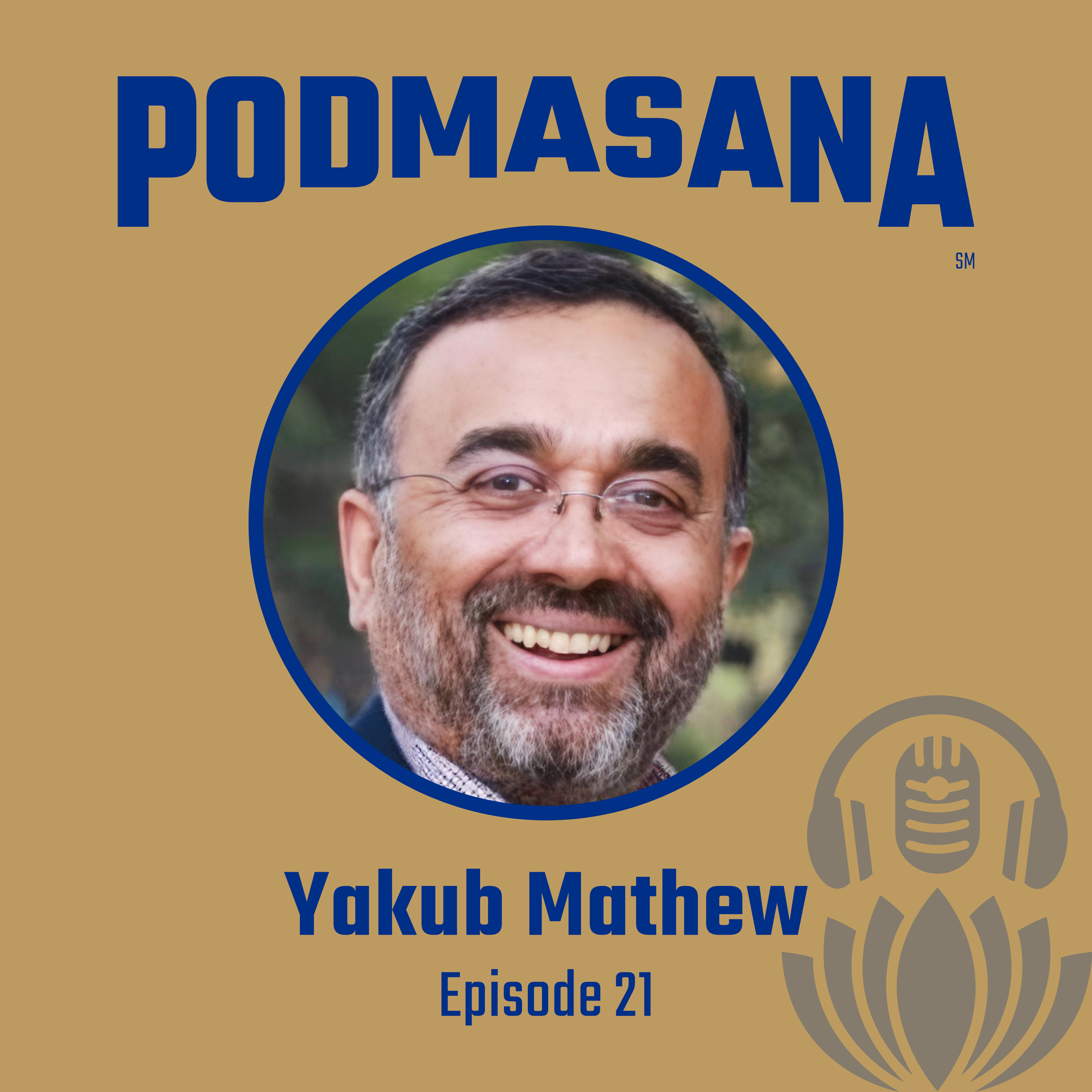
[00:01:03] Brendon Orr: Today we're speaking with Yaqub Matthew, a New York based financial leader turned accidental author whose debut book, Seeking the infinite Maha Kumbha 2025, has become an unlikely bridge between faiths, cultures and continents.
Yaqub holds a BA Honors in Economics from St. Stephen's College, Delhi, a Master's in Economics, and an MBA from the Asian Institute of Management, Manila.
[00:01:35] Brendon Orr: For over 35 years, he's navigated the
[00:01:38] Brendon Orr: upper echelons of global finance, Citibank, hsbc, Wells Fargo Advisors, currently serving as Managing Director at Wells Fargo in New York.
But despite roots in a politically influential Indian family, Yaqub charted his own path overseas, building a life grounded in purpose, professionalism and service.
In January 2025, Yaqub marked his 60th year by taking his wife Shilpa and 17 close friends from across the globe to Prayagraj for the Mahakumbha Mela, an extraordinary gathering that occurs once every 144 years when Jupiter completes 12 orbits of the sun.
What began as a birthday celebration evolved into something far more profound, a collective reckoning with life's timeless questions.
Who am I?
What is the nature of consciousness?
What is the purpose of existence?
As Yakub writes in his book, the story of the Maha Kumba ties all our existential questions together and gave us the seekers of the truth, an occasion and an opportunity to look harder for the answers that have eluded humankind since time immemorial.
But here's what makes this book remarkable.
Rather than just chronicling the spectacle of 660 million pilgrims, Yakub captured something most writers miss.
The power of faith itself.
The unifying message of ek oneness of divinity and what he calls India's soft power of multi faith diversity.
Sent into a divided world, the 250 page coffee table volume brings together insights from over 55 global thought leaders, spiritual masters, artists, politicians, royals, entrepreneurs, scholars, each offering reflections on the infinite.
Released by Sadhguru at the IAAC Literary Festival in New York before 600 people blessed by His Holiness the Dalai Lama, the book has since sparked interfaith panels featuring Diana Eck from Harvard's Pluralism Project, the Dean of St. John the Divine Cathedral, rabbis and spiritual masters.
But Yacub's journey to this moment began not in inspiration, but in crisis.
At 58, while visiting the Ajmer Sharif Dargah in India, he suffered a pancreatic attack.
After 11 days in a Delhi ICU, he faced death directly.
I didn't fight.
I accepted death, he says.
So now I live every day completely laughing, enjoying serving.
That acceptance transformed him.
When Mother Teresa, a family friend, told young Yaqub, God is love and love is God, and God stays in the eyes of the poorest of the poor, she planted seeds that would bloom decades later.
His spiritual influences span traditions from Jiddu Krishnamurti to Bishop Paulos Mar Gregorios, who became president of the World Council of Churches.
Now Yacub is sharing seeking the infinite at the Jaipur Literature Festival, New Delhi, Dubai, London, the Vatican and the U.S. house of Representatives.
All, he says, happening through the grace of God.
On this episode of Podmasana, we explore what 660 million seekers can teach us about unity, why an international banker became a spiritual messenger, how near death experiences reshape priorities, the intersection of finance and faith, interfaith dialogue in fractured times, and what it means to seek the infinite not as a destination, but as a truth.
To remember that within you lies a horizon without end.
[00:07:00] Voice: La.
[00:08:00] Brendon Orr: Foreigner Brendan here.
If you're enjoying the show and would like to Support it, visit podmasana.comsupport to learn about all the great ways that you can contribute.
You can become a Podmasana plus partner at three different tiers with a variety of perks and also make monthly and one time donations to help support the show. Any support is greatly appreciated.
Again, that page is podmasana.com support.
Thank you for listening and thank you for your support.
Part one the Journey to Maha Kumbha Yakub, welcome to Padmasana.
[00:08:57] Yakub Mathew: Thank you, Brendan.
Namaste.
Namaste. Good morning.
[00:09:04] Brendon Orr: So Yakub, you've spent 35 years in global finance at institutions like Citibank, HSBC and now Wells Fargo as Managing director.
Most people in your position celebrate turning 60 a little differently.
What called you to take 17 friends from around the world to Prayagraj for the Maha Kumbha instead of say, a luxury vacation or retirement planning?
[00:09:37] Yakub Mathew: Well, thank you Brendan. And yes, this is something very sort of different.
Most people who live in New York City who are in this world of money management would definitely think of some other place to celebrate a landmark birthday. And I have spent nearly 38 years working, as you said, 17 years at City and 17 at Wells Fargo has been as much as I think four years now, and HSBC was 17 years, so it's around 38 years.
So having said that, it's. I would say all these things are not planned, they're just happening. We usually have no celebrations in our house.
That means I have never celebrated a birthday in my life.
Neither do my children or my wife or my family celebrate anything specifically, like even a Father's Day or a Mother's Day or Easter or whatever. We look at every day as a celebration of life.
So Even celebrating the 60th was never something which was thought about. It so happened that because I had an episode with my health and I said, oh, you got a new life, you might as well celebrate it differently. So I mentioned it to my wife and said, what do you think? We can celebrate my birthday with the gods?
And usually my celebration is feeding the poor. So that is something which we do regularly when we go to India and other parts of the world. So this time I said, as a birthday, yes, that feeding of the poor would continue.
But I said, we must celebrate it with the gods. So she said, where do you think the gods are? I said, my Hindu friends, and they believe that it's at the Holy Sangam. And that's how this whole talk of going to the Kumbh happened. And my wife said, you're going to the Kumbh? I said, yes. And I said, would you like to join? She said, of course. So we took 17 additional people. So we were a group of 19 people who hardly knew of anything on the Kumb or India. And they were from far flung places like Sao Paulo in Brazil, Europe, London, Milan, New York, Los Angeles, San Francisco. And all I know is that it's quite a leap of faith to take people who really don't know India. And this is a vast, vast landscape in which there's a large, large function of called the Kumbh Mela. And in that Kumbh Mela, there are as many as 660 million people coming over 45 days. So it's a huge risk.
And there's lots of disease, there's lots of human beings, there's chaos. It's sort of a great sort of belief that all will be well. And that leap is what I took.
[00:12:27] Brendon Orr: Thanks, Yakub. I'm curious, and I imagine listeners are also curious, what were some of the experiences maybe that some people in your group had given that they weren't familiar with the event?
[00:12:39] Yakub Mathew: The group basically was very diverse in both faith, nationality, experiences, age. But one thing was common. They had a common sort of journey with Me, in some part of my life, I chose them as fellow seekers, but at the same time, they traveled with me. Whether it was in my business or in my childhood, in my school, in my college or somewhere. They were part of me, and in that part of me. We basically invited them and they grabbed the opportunity because one is who goes to the Kumbh, how many people get a chance and who organizes it? Who. Who will host you? These are actually things which are very difficult as far as logistics is also concerned. So, yes, that's how we chose the people.
Hmm.
[00:13:29] Brendon Orr: So you alluded to a health episode earlier, and at the age of 58, you suffered a pancreatic attack while visiting the Ajmer Sharif Dargah in India and spent 11 days, I believe, in a Delhi ICU.
You say you didn't fight death, that you accepted it. How did facing mortality at that moment change not just your relationship with death, but your understanding of what it means to truly live?
[00:14:01] Yakub Mathew: So I have been always thinking of things which are not obvious. So I'm an early riser, and I've been an early riser from my childhood. It's the 3am Wake up call, and in that time I think of first nothing. I empty my mind out and I just gaze at the walls and at the ceiling. And during these times, sometimes a question comes up.
So when this health episode happened, as I said, I go to India very regularly for feeding people who are hungry.
And the second thing which I like to do is education for people who can't afford it.
So this feeding has been going on for 40 years.
You take different places in India. Usually it's a cancer hospital in Delhi called Saptajang Hospital because that's convenient. It's in Delhi where I land. And that year, 2023, it was in March that I went to a holy place called the Ajmer Sharif Dargah, where there's a saint called Chishti, which is who's followed by all faiths, and he was a miraculous person. And in that basic story is that when you're feeding, first the food has to be prepared.
So they make it into big utensils, which is say, a couple of floors high.
So it's not a utensil. It is like a big building. And they make this very delicious biryani and lovely chola and a naan. So you can choose your menu. So I chose it and they said, is it okay for 800 people? I said, sure.
So I go with a group of sadhus and Sufis and I do the feeding with my hand and they're with me. And people throng for the food because they're hungry all day.
All I know is after one hour I got a tremendous pain in my chest which was going through my back. And I immediately told the main sadhu who always travels with me because she knows the scriptures very well, she's very religious. So it's an elderly person. She's around 76 years old and has spent her life in following the rituals. So she's very ritualistic. So I said, I'm getting such a deep pain, I think I'm having a heart attack. Can you have me seated?
So they got a chair. And then after 15 minutes, I thought the pain was a bit less and I continued feeding. And all I know is feeding 800 people takes maybe five hours or so. And after that I went to the hotel and I said, I must go back to Delhi soon. Get me back to Delhi. And I reached Delhi and I was admitted to a hospital.
It's called this, the Max Super Speciality Hospital in Delhi. And they immediately said, you've gone through a pancreatic episode and it's called pancreatitis. It's extremely painful and dangerous because if you get anything like an ulcer, pus, you have multiple organ failure.
So I only made one thing, is that once you bring it under control, somehow airlift me and bring it to America because I didn't want them to open me up because the aftercare can be very Dicey.
So, yeah, 11 days was in ICU, then came to United States. And all I know is I got a second life. I had three very major surgeries. The last one was eight hours. And somehow the great medical care and the surgeons who didn't have much hope of my surviving, they said a couple of months maybe. And I saw it through. In two months I lost £75. And today I'm. Well,
[00:18:08] Brendon Orr: that sounds like one of these other leases on life, would you say?
[00:18:12] Yakub Mathew: Yes.
[00:18:12] Brendon Orr: Yeah. It gave you a sense of gratitude for each day after.
[00:18:17] Yakub Mathew: Yeah, today I just leave one day at a time. Previously, I used to make very long plans, 50 year plans. I used to break it up into 10 year plans, 5 year plans, yearly plans, monthly plans, and of course, daily plans. Today I only have a daily plan. And that daily plan is how can it be impactful, fulfilled and joyous.
[00:18:38] Brendon Orr: Thanks, Yakub.
And so in Seeking the Infinite, you write that you didn't have to invent the book, but simply remembered it.
The book emerged organically from this journey with your wife, Shilpa. And your friends, can you take us into that moment or series of moments when you realized this wasn't just a birthday trip, it was becoming a book, a message or maybe even a calling.
[00:19:08] Yakub Mathew: So all I know is, first of all, like we discussed, even the choice of celebrating this birthday in a place like this place called Prayagraj or Allahabad, where the Kumbh is held at the Holy Triveni, is very, very unlikely for a Syrian Christian from New York who is in the financial world. And he has all the options to go wherever he wants rather than to a place of chaos unless he has a sort of strong devotion or a religious belief. So there was no religious belief, there was no compulsion. It was only curiosity.
So this curiosity was again something which was never planned. It just happened one morning and I mentioned it. In the meantime, they were making plans for other parts of having some very sort of interesting trip in Europe.
So having said all these things is the same thing happened with the book. So when you asked me this question, I not fully replied it. How do those people take that trip? When they did it, what was their reaction? So when we landed in Prayagraj airport and we were huddled into a bus and it was dedicated to us and all we knew is right from the airport it's a throng of humanity and this bus is just weaving its way, a journey which took 20 minutes, took us four hours.
So in that journey it was all sorts of confusion. People are coming here from New York and one of the doctor lady who's a doctor says, I want to go to the toilet. So I said, you go to the toilet, we'll be there for another four hours. You know, so people are even so sort of innovative. They said, here, take a plastic bag, you know. So having said all these things is that once we had the trip and once we reached the sort of river, it all became ethereal. There was an energy there. There was some sort of uniqueness or a sense of wow, what is this? The environment was we were staying in a very sort of comfortable, luxurious tents. And below us we were on a hill and below us was the city of tents lit up completely, millions of people. All you can see is lights and people's sort of chanting and a lot of prayer in the air. So the whole atmosphere was, is this heaven? What is this?
And we just stared and stared for a couple of hours till 2 in the morning.
And some of them went into chanting. I being a Christian, I don't know any chanting. I just looked inward and said, God, thank you for giving Me a chance to see the spectacle. The largest gathering on Earth. It's the Burning man of India.
And in that, as many as 660 million people come over 45 days, millions of people and millions of lights and tents, and everything in that chaos is organized.
It seemed to be at peace with itself. Nobody was in chaos. So the chaos led to a peace. Peace within and peace outside.
So, yes, the people, after they finished their two day, two nights and three days visit, who were our friends, the 19 of us came back with silence in our minds and soul and nothing but aghast, or you could say overwhelmed, that anything like this is there on Earth.
Fabulously organized, yes, things happen there. But in the end, considering the largeness of everything and the number of days and the 660 million people, it's just unfathomable.
[00:23:20] Brendon Orr: Yeah, thanks for that detailed description of what sounds like an amazing experience, Yakub. And you had mentioned your background as a Syrian Christian and you're from Kerala. And interestingly, you grew up knowing Mother Teresa and Bishop Paulo Mar Gregorios as family.
You've worked in Muslim countries like Saudi Arabia. And now you have put this book out about the largest Hindu pilgrimage on Earth.
How has your life across cultures and faiths prepared you to tell this particular story?
[00:23:57] Yakub Mathew: Yes, that's a very interesting question. Thank you, Brendan. So even completing the last question not spoke about by me completely, is that when we were on our. So I'm coming to the book. And this whole thing of me writing this book is that we were on our journey back, everything was silent in that same mini bus.
And one of the participants, who was a religious person, who was part of our group of 19 and who was with me when I got my pancreatic attack, she always travels with pilgrimages with me. Her name is Moksha Priya. So Moksha Priya, said Yaakob, that was ethereal. Shouldn't we capture this for our grandchildren and our children to know what experience we had?
So I said, yes, that sounds good, but I don't think I have the ability.
I'm not a movie maker. I'm not a writer. I'm just a banker and another person in that life in New York.
So I looked at all of them, I said, who all support this idea of a book, because I thought a book would be easier than a movie.
So everybody put their hands up and said, yeah, we would love it. We would love it. And then I said, oh, wow, this is something which is now going to be something very different.
So other than putting their hands up I requested all of them.
Please send me a small page, a page about what your experience was.
So the idea was just to have a scrapbook. It was not to have this sort of a.
A book of revelation. Actually, it was a scrapbook for the 19 of us to remember our journey with a few pictures and give it to each of our family members or friends. So there's no sort of a plan. This is total unplanned territory. So they forgot about it. They sent their bits and pieces.
I received it, I looked at it all, and as usual, getting up the 3am die, I sleep at 8:30 in the evening.
And I said, what is happening here? You know, now comes a question of this book. And when this book is something which needed to be done, there was no sort of compelling reason, there was no need of it from my side. As I said, I don't have time because the work I do sucks me dry during the day.
So in the end of it, all I know is this whole Kumbh is something which was in my subconscious. It's not something which came out suddenly going there. Something must have been in the subconscious. Now we'll come to this. Mother Teresa and Margaritas, the Archbishop. So it must have been fed as when I was a small child, that, you know, basic values. It was not a religious home.
It was a home where we were taught to be good children.
And it was a house of a lot of challenges and suffering.
That's why people like this were coming into the house to give us some sort of, you know, peace, some sort of healing.
Because When I was 2 years old, my father died. My mother was 35.
At 40, she becomes a widow. At 35, she becomes a widow. And my brother was 10 months, I was 2, my sister was 4. And then comes this very, very challenging situation where she gets non Hodgkin's lymphoma, fourth stage. And she's 40 years old, very early in her 40s.
So when you have this sort of a situation, it's a hopeless situation with three infants. And what do you do?
So then what do you go to? You go to the infinite, you go to the Almighty, you go to the Bhagavan, and you go to messengers, you go to interpreters, you go to people who are healers.
So since I lived and had access to people, not me, it was the family with access to very sort of enlightened souls.
So even people who are not that accessible, everybody was thronging to the house because this house was a.
It was a family which had Done lot for the country.
It was a powerhouse.
And all I know it started with one of the greatest philosophers in the last 200 years, Jiddu Krishnamurti. J. Krishnamurti of the Philosophical Society of India.
So he came in, then came in Mother Teresa. Mother was not known in the 70s.
She was the saint of the gutters in Calcutta. And she came in for some other favor. She came for help.
And when you do good work, lots of hindrances also come. So as I said, this house was an influential home. So she came for help. And at that time she was said, she was told that, yes, you know, we will handle all that. But we have an issue at home. And this is an issue of our family member having this challenge with health and these three children and being a widow and all these sort of very challenging situations. And she was invited. So all I know it is that from my childhood she was in our house. Or we were meeting her every two weeks for 15 years. I'll pick her from the airport, or we will meet her at some very odd hour. So she used to tell us to meet her at 4 o' clock in the morning.
So she also used to get up around early morning, have a bath, and then she goes immediately. So we'll sit outside her room, my mother and myself, and nobody else was interested. My brother, my sister, they didn't really dedicate their time to this. But I would hang around with my mom. And then either it's at home or is it in her.
Her Missionaries of Charity, she had a small grotto. And in that place we would sit outside her room and she'll come all freshly bathed and she'll smile at us and she'll just go inside. And for one hour she prays on her knees inside and we are not allowed inside. Then she'll come out around at 5, 5, 30, and then she will hold my mother's hand first and pray and deeply pray with my mother. My mother was a devout Christian.
But she wanted to go anywhere or anybody who will give her that peace and most importantly, some new life so that her children can go through this challenging life. So then she'll hold me. Mother was already very, very fond of me. And she will give us both.
She used to give us her medallions of Mother Mary and put it in our palm. And she says, baby Jesus will look after you. Baby Jesus will look after you.
So all I know is childhood was with all these spiritual people, whether it was Jiddu Krishnamurti, Mother Teresa, Nirmala Devi, Sai Baba, Dalai Lama, Amma, everybody came home or were there as part of our home. And it was not limited to one faith, though we were Christians, my mother was open to anybody. It was an open house.
So Gregorius the Archbishop, was one of the most intellectually profound people on earth in the field of divinity.
He started off as a priest, and he did his PhD at Harvard University and was a professor at Harvard, Yale and Princeton.
And before that, he became the chief advisor to the emperor of Ethiopia, Haile Selassie. So this man had this intrinsic intellect. And recently, I was with the head of the Harvard Divinity School, one of the most respected people in America who has studied Hinduism. Her name is Dinah Eck. If you know Diana Eck, you don't need another panelist or person in your book review. So she was a chair, and she's a friend of mine. And Diana, one week, she saw my book and she said, jacob, you know Gregorius Mahar Gregorius? I said, yeah. She says, he's one of the greatest men. I said, you knew Mother Teresa. These are two saints. So in those days in the world in the 70s and 80s, it was Dalai Lama, Mother Teresa, and Archbishop Gregorius. Ultimately, he became the president of the World Council of Churches in Geneva. And he was a famous economist, a PhD in economics. So he was an economic advisor to perestroika in Russia, which was a Soviet Union. He was a chief advisor to Haile Selassie, a brilliant economist and a man of the cloth. So, yes, these people, like Mother Teresa, was meeting every two weeks. Gregorius would meet me once in, I would say, six months. And they would instill values, nothing to do with religion.
They would interpret life as goodness, love, kindness, integrity, and how to be a good person.
So you can only do goodness if you're a good person. So they only built that thing called goodness in you, love in you, kindness in you, and they left it at that.
I never looked at Mother Teresa as somebody who was of a person who was special for me. She was another friend of mine, you know, Gregorius was another friend. I couldn't even pronounce his name, you know, And I used to say, father. My mother used to say, don't say, he's an archbishop.
What to say.
[00:33:35] Brendon Orr: Hey, it's Brendan.
If you've been enjoying the show, would you mind pressing pause and leaving a rating or review on your podcast listening platform or liking or commenting on an episode's YouTube video?
That's okay. I'll hang around.
Go ahead and hit pause.
The episode will still be here when you get back.
Still there.
[00:34:05] Yakub Mathew: Come on.
[00:34:06] Brendon Orr: Hit pause and write that quick review comment or leave that rating or like an episode. It's a quick and meaningful way that you can help the show reach others.
You can also email any feedback to the
[email protected] thanks for listening and leaving a comment like rating or review.
Now on to Padmasana Part 2, Interfaith Dialogue and Spiritual Inquiry.
Yaqub, you brought together insights from over 55 global thought leaders for this book.
Spiritual masters, scholars, politicians, royals, artists, each offering their understanding of the infinite.
What did you learn about the nature of the infinite from synthesizing all these different voices and traditions?
Were there surprising commonalities across the faiths?
[00:35:12] Yakub Mathew: First of all, to even try to understand a very complex subject like the Maha Kumbh which is largely based on Hindu belief and it's been there for thousands of years.
So it's a brilliant, brilliant sort of concept done by the early sort of religious spiritual leaders of the Indian civilization to have great events like the Maha Kumbh, the Kumbh and the Ardha Kumbh. There are three types of Kumbhs and they are able to create these events around these beliefs so that it continues as a subconscious travel into your life.
So when you say the Ardha Kumbh is once in six years, they are all based on planetary movements and mathematical calculations and it's some sort of a cosmic play also at play with their beliefs. So the Ardh Kumbh is when the Jupiter goes around the sun halfway through it takes six years for one.
Circulatory movement of the Jupiter around The sun takes 12 months. So it's the Purna Kumbh. Purnumb means the full womb. And then it does 12 circulations under the sun over around the sun. It is called the Maha Kumbh. The Mahakumbh happens once in 144 years. So neither has anybody seen it before, neither will anybody see it again. So 19 of us went there. We will never see another one after 144 years and neither any of us experienced it previously. So having said that, this is a very very complex subject which has been largely interpreted on the belief of the cosmic energies.
The place being a sanctuary of divinity and spiritual and the river being full of spiritual concoctions of energy.
So when you see all this thing, here comes the person who is not even a scholar on Hinduism, who is a Christian who left India 40 years ago, who's really not a religious person who interprets this as a multi faith. So when I started Thinking when these people told me that you must put it together for our children and grandchildren. As I said it was going to be a simple book and it continued to be simple. The thought idea was very simple.
Then I said, what are these people doing there? They are wanting salvation.
They are seekers and the power of their faith. It's called Bhakti Me Shakti. So all I know is I started bringing up questions and each question led to deeper questions. So in the end of it I said they are seekers, they're seeking something. And what is the salvation? The Abrahamic religions, when you see Islam, it has this thing called jannat. When you see Christianity is salvation. When you see Judaism, it's a sort of a faith based on a collective salvation for all Jews and the state of Israel and believers in the Judah faith. So I said what is the salvation?
So this thing is something beyond one person. So I said we must have perspectives of the infinite. And that itself was the brilliance of this book which brought in people of multi faith. It brought in people of Hindu culture, Islamic culture, Judaism culture, people who are billionaires, people who are artists, people who are painters, people who are journalists, people who are filmmakers, people who are sportsmen. And all of them were giving glimpses of the infinite. And all of them were my personal friends.
So they took time and they just didn't write. They thought and they gave us a perspective or a glimpse of the infinite. So every page in this book is a catalyst. It just gives you a glimpse and makes you think and ultimately nobody knows the full truth. So that is the beauty of this book. It is some sort of a process which makes you think that what is this infinite? So answering this question, the common thread between all these 55 people is that the infinite is not a destination to reach, it's not a place. But it is something of a inward journey. It is a place within you which lies a horizon without end. So that means you got to experience is not something which you get outside, it's within you.
[00:40:08] Brendon Orr: Yeah, thanks.
You say the book brings out the victory of India's spirituality and sends a message in the soft power way of a deep culture of multifaith and diversity into a divided world.
Right now the world feels increasingly fractured along religious, political and cultural lines.
What does the Mahakumbha in your book offer as an antidote to that division?
[00:40:41] Yakub Mathew: Look, when you look at this book, it's interpreting this complex subject.
How it does, it is, does it with simplicity. So if you go into this sort of cosmic calculations, mathematics, beliefs, and it is something which has been done by a hundred thousand writers over a thousand plus years. So what the book does is it tries to find the common bond binding humanity.
So when I saw these millions of people walking in complete unison and peace, millions are walking there into some, you know, the meeting of the rivers that means the Ganga, Jamuna, and there's a mythical liver called the Saraswati, which is not there anymore. So I'm observing these people. Nobody asks you your faith.
There is no faith of divisiveness there. There's only a faith of seeking the infinite. So when that faith was there and the only bond was this infinite or salvation or some sort of enhancement or a personal journey which is fulfilling, I understood the bond was not divisive. Faith was not divisive over there. Nobody asked you whether you're a Christian or a Hindu or you're a Muslim or you're a Jew. Nothing. You just were there as anybody else. And that was my whole gist of this book, is how to find the common bond of humanity amongst human beings once they realize that. So it was very simple. Once you brought this whole thing of faith and you build it into the power of faith, then you said, how can this build into something which binds people rather than divides people? So the whole book is all about how faith can be unifying rather than divisive.
So when you look at peace, what is peace?
Peace is when there is no conflict and injustice, when we remove all walls and boundaries. So what I found there, there was no walls, there was no boundaries. And people were there going and dipping in a river.
And it was literally. There was no noise. The sun was setting.
Millions of people were dipping. They're coming out with some sort of a enthusiasm on their faces as if they've achieved nirvana, a sort of a state of bliss.
So I'm observing all this. And then I understood that we have to build on this commonality. So that's when these different people who are thought leaders and intellectual leaders and spiritual leaders and in various walks of life and they're writing the whole thing is that this unity of humanity, how do we remove these boundaries? So that's when I said the infinite is not a place to reach, but a journey within where there's no horizon. So having said all these things is one found that this comes from a whole process of life.
So the Kumbh didn't create the aha moment. The Kumbh ignited something which was there subconsciously. It is something which you called how do you get to be a evolved person, A realized person and ultimately into consciousness. So the whole book is about, if this infinite is the ocean and you are the drop of the ocean, so you are part of the infinite. Do you need to harm another human being when all of us are part of this infinite? We all human beings, in spite of faith, let that be a way.
But in that, what binds us is humanity.
So that sort of a simplicity of thought process, of a complex subject led to this whole thing of consciousness. And once you're conscious, you are one. And that brings a sort of focus into unity, into peace and not having intolerance against each other, because you are there in others and others are there in you.
And that's what the whole sort of appeal of this book has been globally. So when you say it's a win of Indian spirituality across the globe, actually India's number one, the most popular writer in India today. I wouldn't mention his name, but he is the most popular. Like, his last book sold 6 million copies.
So he called me up two days ago. He said, jacob, do you realized that you have brought our Hindu faith globally through the simplicity that you've done it, which is globally appealing and based on universality? It's not based on just one belief.
You have really done a service which very few could have done it with such simplicity. So I would say that this is not me. I am not a writer. I'm not a philosopher.
I'm a person who was, I would say a seeker, definitely, who has become a messenger, is a vessel, is. In Hindi, we say sutra dhar. And all I can say, a womb, which carried this as a dharma, as a duty, and gave this message. All I can again reiterate is it's that human common bond of humanity, love, kindness, which binds us.
[00:46:28] Brendon Orr: And after the book launch in New York, you moderated an interfaith panel with Diana Eck, who we referred to earlier from Harvard, the Dean of St. John the Divine Cathedral, a rabbi, and a spiritual master, Sri Anish.
The discussion centered on religion versus spirituality.
Where do you land on that question, Yakub? And how did Mother Teresa's teaching, God is love and love is God shape your understanding?
[00:47:00] Yakub Mathew: Yes, it was a fantastic panel in New York, and there were many writers. And all I knew is that one must get good minds to talk in great diversity.
So even when I chose the people who would come for the Kumbh Mela with me, as I said, they were different parts of my life, we also had the LGTB sort of people with us. We had all sorts of religions, countries.
So I chose them based on diversity. So the panel too was very diverse. We had this great Indian mystic called Sadhguru. Sadhguru inaugurated the book. And Sadhguru is somebody who, you know, has been known for bringing this whole intellect and his wisdom in a very simple fashion to bind the world together. So Sadhguru and I have an old sort of acquaintance now, a relationship, and we've known each other for a long, long time. So when I requested him, he was kind enough to come.
Dina Ek, as I said, if you have Dynak, you don't need anybody else. So she said, I will try and come because, yes, people have their own challenges to make a journey from Boston to here, especially as they age.
Then, of course, we had one of the greatest sort of people of cloth over there, whether it is the Most Reverend Winnie Varghese, who is a Christian priest.
Then we had the rabbi who was Matus, who was brilliant.
Then we had Sri Anish, who talked of, you know, this whole thing called Kumbh and the Hindu faith and the understanding of its broadness. And we had Subhel Set as a moderator who with his piercing questions, was able to get the best. So he brought this question between religion and spirituality.
So he asked each one, say one yes or no, Are you religious or are you spiritual? So each one said what they had to say. And in the end he asked me, are you religious or spiritual? I said, spiritual. So he says, how do you describe religion and how do you describe spirituality to each of the panelists? So when it came to me, I just said, look, I'm not a man of the book as far as studying it upside down and knowing all my scriptures, etc. But all I understood is basic truths of life as a child, which was taught to me by great masters. And Mother Teresa had once I asked her, mother, Mother, she was extremely fond of me, and it was like I was a small shadow running around her. I was. I started with her probably the age of 10 till I left India 40 years ago at 21 or 20, 22.
So I say, ask her questions and anything and she'll always answer me. And I used to hold her hand and, you know, walk with her. So I asked her one day, mother, what is God? Who is God? She, Son, God is in the eyes of the poorest of the poor.
Then one day I asked her, how do you describe God? She said, God is love. Love is God.
So those things made me understood that our religion must be a living religion. It should not be just the books. It should be something which is practiced. And that's why I became a practitioner of what I felt I could touch lives who couldn't thank me, and I've been doing that from my childhood till today, is whether it's through education or food or acts of what I felt I can do in my little life.
So then when you grow up in a country like India, there's so many, it's a civilization. It's not something which happened 300 years ago. It's 5,000, 6,000 years. A land of Sufis, of saints, of mystics, of different religions have been born there. Whether you look at Buddhism, Hinduism, Vedas, Jews were never troubled in India. They lived peacefully there. The Parsis came from Iran, the Persians, they lived there. They, they're one of the most talented businessmen. As I said, the Jews were never, never, never ever troubled in that country for thousands of years. We Syrian Christians came during Jesus. One of the disciples, St. Thomas, came there in AD 52. And how we got into that fold, nobody troubled us. So having said that, when you grow up in such a sort of atmosphere of a nation which is very diverse, there were different groups. Like the newest religion in the world, at least in India, it is a Sikhism. So the Sikhism, when you see the Sikhs, they're a very disciplined warrior lot of people. And they are an offshoot which came out of Hinduism.
And they have their own sort of faith which is by the gurus. And they have a book called the Granth Sahib. The key cornerstone of their religion is service.
It's called Seva. So for me, service was godliness. And that is what made me understand two pillars in the sort of religious world was love and service. And all I understood as I went along is that you don't have to complicate it and say, mine is better than yours. Religion is not bad.
They all started with a very, very pure intention of how to create some sort of we all are animals, you know, how do we stop this animal behavior? By bringing some structure. And you know, whether it's a concept of sin created by the Catholics, you know, and whether it is God or whether it's heaven, all this is trying to get people to follow non barbaric sort of lifestyles. Otherwise we'll be like animals just eating each other.
So having said all these things is growing up in such a country, even our parents were looked as representative of God, their godliness, our gurus, our teachers. So when you look at Hinduism, there was a God for everything.
There's a snake God, there's a rat God. There's a God of prosperity, the creator, Brahma Vishnu. So when you see all these things, the destroyer, we understand these are just energies as far as my interpretation. But you take that energy and build yourself into a better person. So religion is per se, not bad. It's only when I say my religion is better than yours and that it becomes very dicey. And that's what you see today in the world. You're living this parochial sectarian lifestyle and we differentiate ourselves. So when I went to the Kumbh, there was no sort of divisive faith. It was one congregation just walking, walking. And there was this whole thing about seva. People were feeding, there were food kitchens, people were carrying old people who can't walk. 90 year old, 80 year old handicapped people are being carried on the shoulders. So when you see love in action, faith in action, that is where you see godliness. So I saw godliness in that. Huge congregations of human beings, the largest congregation on earth. And there something ignited subconsciously, which was always there. And that led to this book. So religion per se is not good. Religion is being hijacked by many people for power over people and resources. So if it is used to ignite spiritualism, it's fantastic. So either get directly into spiritualism is what I did. When I say something, I say, oh God, oh God. I will not deny there's nobody called God. I would say there's something bigger than me, there's an energy bigger than me, there's a cosmic energy. So if that God is the ocean, I'm a drop in that ocean. So I'm part of something bigger. And when you go into that consciousness and understand the common binding force of humanity and that spiritual way of living with service to people, with love in your deeds. Like they say that kindness is a language.
So once you understand that, you live a fulfilled life, like I said, your life is that moment. Life itself is an illusion, you know, but you can't say it's an illusion and just live an altered sort of spaced out life. In that life there's a moment, that moment is real because yesterday went by and tomorrow you've not seen. So that moment, how do you live it? Impactfully, joyfully and meaningfully.
That's what I understood of life.
[00:56:07] Brendon Orr: And the book confronts life's elemental questions. Who am I? What is the nature of consciousness? What is the purpose of existence?
After this journey of writing this book and putting it out into the world, and after all the conversations with masters and seekers, where are you with those questions now? Yaqub, and have any of them been answered or have they just deepened?
[00:56:34] Yakub Mathew: Look, these questions have no answer.
Like just that. The infinite, this infinite is a concept which has been a paradox for the greatest minds on earth, the greatest philosophers, the greatest mathematicians. You can look from Archimedes to any of the big thinkers of the world.
This paradox is something which has no full answer. It doesn't have a complete answer. So all you do is you try to experience it. So when I went through this whole thing, I always knew I was a zero. A zero is a number which has no beginning or no end. It is zero.
So and in Hindi we say shunya. Shunya is no beginning, no end. It's perpetual. So we are energies. This energy is a bottle. So today we are in this physical form. Tomorrow they may burn our body. We became part of the energy as part of the heat in the world. They bury us. We become part of the soil.
Whatever they do, we are immortal. That's why when you see Einstein, you did the E is equal to MC squared. Energy never ends. So how do you tap into your inner energy? So all I knew is after all this, that simple faith was reinforced. I am a zero.
And in this state of consciousness, how does that zero add to any number and makes it better and bigger? You take a number one and you add five zeros, 10 zeros you can add, keep adding zeros. That number gets enhanced. So you are an enhancer, you are a multiplier of how do you get a force of people who are part of that good club, who believe that there is something binding us all Humans, as a matter of reality, we are all one. Ekomkar means oneness.
[00:58:35] Brendon Orr: Hello listener. Brendan here.
Do you or someone you know have an article or book to share, a work to highlight or story to tell that would be a good fit, fit for Podmasana?
If so, feel free to reach out via email@ideas podmasana.com that's ideasodmasana.com and we'll
[00:59:00] Brendon Orr: be sure to get back to you.
[00:59:02] Brendon Orr: Thank you.
Part 3 Leadership, legacy and the Infinite Within.
Yakub, you're taking this book around the world.
New Delhi, Dubai, London, the Vatican and the U.S. house of Representatives.
That's an extraordinary and vast itinerary.
[00:59:31] Yakub Mathew: Now it's also going to Canada on the 14th of May.
It's going to be a very mega event in Toronto by the Canadian Literature Festival.
[00:59:42] Brendon Orr: What do you hope happens when a congressman in Washington or a Vatican official or a reader in London or Toronto encounters your message about the Maha Kumbh what seeds are you trying to plant?
[00:59:59] Yakub Mathew: The seed is of peace and tranquility.
That means there's nothing more important than that in anybody's life. We all want to basically be at peace with ourselves. How do we remove those boundaries? How do we remove those walls which have created divisiveness amongst us? And creating the sense of consciousness, a realization, an evolvement, and planting that seed through each page in this book, it's something which.
Each page is a revelation. It's like the book which reveals to you, look inside, there's a world inside.
Don't chase your tail, because in the end, you're just going in circles.
[01:00:43] Brendon Orr: So you write that the infinite is not a place to reach, and you've mentioned this earlier, but a truth to remember that within all of us lies a horizon without end.
That's a profound reframing. Most spiritual seekers think of enlightenment or union with the divine as maybe something to achieve. You're saying it's something to remember. Can you maybe unpack that distinction?
[01:01:10] Yakub Mathew: Look, the thing is, life is made up of experiences.
Nobody can teach you that. No book can teach you that. When I was in Delhi this time, and we had two events on the 1st of March and the 10th of March, all were full houses. That means the first one was, you know, people from all walks of life, they came in and there was standing room.
And in that, people were sort of curious, what is this? What's this guy talking about? And he's getting such fabulous sort of panels who are literally thought leaders of the world. And the press was there, some 20 channels. The second one was at a very. Sort of a conservative audience and very inquisitive. So I said, this panel matters because they give perspectives. For the second event, I invited the head of the Mormon Church in Utah, Salt Lake City, Elder Kelly. He came during this war from Utah, Salt Lake City, for this event in the morning and left the next morning. So in the end, all I can say is ultimately the message was very clear that no book will give you this answer.
Go and seek it.
So he talked from the Bible. Somebody talked from the Quran. Salman Shishti, who's the 26th, Gaddi Nishan. That means the inheritor of that 26th generation of that Shishti Dargah. And all I can say is that in this sort of journey, one person in the second event said, oh, America's got so many schools on religion and divinity and subject matters in universities. And she quoted. She was an intellectual writer. She wrote some 22 books. A famous lady and she said, in India, we don't teach our religion, we don't have universities, we don't have colleges. Subject matter. You know, look at America. They've got all these colleges which are, you know, having this like the divinity school in Harvard University. They mentioned something like 1200 or something, some large number. So then I said, okay, I'll try and answer your question. I said, look, we come from this country where these things don't need to be taught from birth only they're part of our life. Whether it's our parents, our gurus, they're all symbols of godliness on this earth. So why do I come to India every four months, 40 years? I said, because it's got a soul. I said, my motherland, India is something which has a structure called family and its soul.
My adopted country, which I love very much, which is America, has something called entrepreneurship and hard work. But it lacks the family structure and it lacks a soul. So as much as you may have universities and teachings, it is not going to get it unless they practice and experience it. That joy of looking after your parents when they are old instead of dumping them.
And that's happening in the modern world. It's also starting in India. I said, those are things which are godlike behavior.
So I don't think it's the number of schools you have practice what you have. You have a lot here. And we come seeking that to refresh and rejuvenate our soul.
[01:04:35] Brendon Orr: You say you now live every day completely, laughing, enjoying, serving. You're not planning too far in advance after you're brush with death.
That's a noble practice, but also incredibly challenging. When life throws obstacles, losses or suffering at us.
How do you maintain that completeness when things get a little difficult? What practices or principles help you stay present?
[01:05:01] Yakub Mathew: All the answers are all around us.
So at a very early age, at 40, at 40 to 50, I was studying happiness.
What is happiness? So I would go to all sorts of people, poor, rich, academics, intellectuals, gurus, noble laureates, and I would ask, what is happiness?
So Harvard School of Happiness, Yale School of Happiness, reading.
So I understood one dimension of happiness. Life is multi dimensional.
So then I said, what is the happiness? What is the opposite of happiness is what? Sorrow.
And it so happened. I saw a Netflix movie called Buddha.
This is not the Bertaluchi Little Buddha, this is a Buddha which was done in India by a producer called Dr. BK Modi. So people have been telling me for many years, watch Buddha, watch Buddha. It's a fantastic sort of series on Netflix. I think it's some 50 parts or something like that. I'm trying to get on Netflix. I could never get it because it was not available.
So many years went like that. And again, life bought me and I became a friend of this man called Dr. Modi, BK Modi. He's a very sort of interesting person who's larger than life. And he has put his hands into all sorts of pursuits. And in that he.
He is a prominent businessman, he's a billionaire. He is a person who is a seeker and many things. So he said, okay, I will get you a copy, an original, whatever. So he got me the Netflix production of his. He's a producer and the financial.
I watched it and then I found the answer.
It is like I said, the journey is there within us, the answers are in front of us. Very simple. And the answer was detachment.
Once you detached from everything, you didn't need anything.
So I detached first from what I liked most. What did I like most? As a child onwards, I was a foodie.
I would go all across the globe looking for the best food. I'll get Michelin chefs and the best chefs, and everything has to be the best. When I eat, has to be six courses.
And it was always like that from my childhood. The best of the food has to be given and then I'll eat a little bit.
So first I detached from food. I never drank in my pursuit of so called happiness. So I thought food gave me a little happiness. And I knew that life as I studied, happiness was more than food.
And drink was not a problem because I never enjoyed it.
And all I did was. Then I said, who am I attached most to? I said to my family, to my children, to my wife. So I detached from them also.
So I said, they come from me. They don't belong to me. They belong to tomorrow. I belong to yesterday. So we gave these two girls good education, good values, like what I was given by the masters. And they know all the masters, because most of these masters come to our house, whether it is Sadhguru or most of these spiritual people. We know monks and great minds, and so we give them their exposure. But we didn't own them. So I detached from them.
So then I found this happiness in very small things.
So when you have a great meal, it's good for a couple of hours before you let go, because it has to go from your body.
So I understood. When you want a sustained happiness, it comes from serving people, from doing sort of things beyond yourself, to going into things bigger than yourself, which is nothing to do with you. But you get the happiness. That means doing things for people who can't thank you.
Once I got that realization, that became my passion.
So then from 50 to 60. I had not reached 60. Like I said, it was 20, 23. So I was 59 years old.
I was studying death.
So I went to all the masters, I went to all the doctors, whoever. Big minds and simple people, dying people.
What is death? What is death?
So I'm trying to find an answer. What is death?
So one day I am told I'm going to die.
So then I said I must practice what I learnt.
So now when you get this pancreatitis or these sort of horrendously serious illnesses, the chances of your survival is very slim because all it takes is infection and you are gone, whoever you are, because your organs will all fail.
So they put me on morphine. I was deep on morphine and oxycontin.
And they are then letting my liver and my pancreas settle down. They were all inflamed. Then they had the surgeries. Many things were happening, leading to many, many new complications which I never knew existed.
And in that suffering, which is something which is difficult for your near and dear to see, you have become like as if you've come from the Auschwitz camp, losing 30kg or 75lb or so.
Seventy pounds is horrendous. There's nothing but bone left on your body. There's not even any fat. So I said, even the children should see me. Nobody should see me. I should just go peacefully.
So anyway, all I can say, this death is a reality. It's another phase of life.
So when I faced death, I said I must practice what I learned.
So I surrendered to death.
I accepted death.
When I accepted death, I had nothing to fear.
I had no fear. So I used to go to this, probably the greatest surgeon of America.
So everything is the best. Like I told you, my life was always choosing. Whatever I do, I do it very, very well. So even here, CEOs of Mayo Clinic, the CEOs of the best hospitals of Mount Sinai and the city, New York City, they're all my friends. Each one says, oh, Yaakob. Because I was kind to all of them when they were nobody.
So when you're good and never asked for anything, only gave them help when they are trying to build their lives, they never forget you.
So I learned that from Mother Teresa. Give without an agenda. The politics of love.
The power of love is to give till it hurts you. So one day I asked my wife, what is it that made me tick. She said, you had very good role models.
So one was Mother Teresa. The second was one of the most powerful businessmen in the subcontinent who came from a political dynasty. His grandfather founded Pakistan.
Muhammad Ali Jinnah's grandson, Nasli Wadia. He taught me the art of business and how to swim with the sharks and how to handle these sharks. So I mastered the game of love, mastered by business, because business is a very ruthless game. Third was this whole thing called relationships, politics. And there was a deputy prime minister in India called LK Advani. LK Advani and his daughter were spending time with me. And that gentleman, he taught me many things which he may not have realized. So he is a sort of a man who has seen life and he taught me politics and how to handle very dire situations. And that's where faith comes in.
Last was the person who I grew up with, who became my role model as far as my soul was my uncle.
He was a statesman.
And as I said, it was a house of power.
And he taught me integrity, never to sell your soul.
So people see me with all these enhanced minds and religious people and all sorts of rock stars of that world in different fields. Like when you look at those 55 people, they're all rock stars. How do you know them? Who is your guru?
I have no guru. Not even Mother Teresa or my dear friend Sadhguru. They are people who have come on a journey with me. My guru is my conscience. It's between Khud and Khuda. That is between me and my maker. And my truth is my conscience. My God is my conscience and that is my truth. So I should look in the mirror and say, I did my day well and the end of my life, I ran my marathon well, thank you. I'm ready to go.
So now when I got saved and they were fighting somehow to handle the situation, which was very dire. So the last surgery was 8 hours on 12th of June, 2023. He said the result will be out in 48 hours.
They never got a result.
So every day was fire. How do you just wait for a result?
So 28th of June, they called me up, the doctor, the surgeon.
So he says, well, Mr. Matthew, I have to talk to you about your results. So I said, doctor, one minute, I'll call my wife and put on a speakerphone. So then he says, well, we know what it is not, but we do not know what it is.
I said, doctor, I don't understand English very well, though I've been here 40 years, most of my life I've been in America. He says, what is it you're saying, Doctor? Can you say slowly and loudly, we know what it is not, but we do not know what it is said doctor, tell me one thing. Do I need treatment? Do I have to come to you? Do I have to see you tomorrow? He says, no, there is some divine force protecting you.
We had to send your body samples of your all your organs, many key organs.
We had to send it to 31 laboratories.
It was not. It was 31 laboratories and four international medical symposiums in America and Europe to study your case.
We have not been able to conclude anything. We see this once in a billion.
So somebody is protecting you. I knew that from my birth.
This thing, awareness was there for my birth. I was born on 1164, 1-01-64. Six plus four is one. The whole number is 1, 1, 1.
So I was already aware of this. That's why I said it was subconscious that ignited this whole. Because I have lived a very, very low key life. The book has made me some sort of a person who's come in the face of people which I don't enjoy actually.
But I'm doing it because people ask me questions like what you're doing. So ending this question of yours is that the doctor asked me.
You know, we get so many patients with such serious illnesses.
You never asked us a question. You were just stoic, you just sat. I used to talk. You never said anything. You never said what your options are, what sort of situation it is, what cause of consequences are there. You never said anything.
So I said, doctor, what can I say? I was studying this happiness. 40 to 50. Then I was studying death. And death came. I said I should practice it. So I surrendered to death. Once I surrendered to death, I had no fear. Once I had no fear of death, I was ready to go. So you were kind enough to give me morphine and all these oxycontins and tough painkillers. And in the end of it today you're saying, I live, I'm grateful. He says, go and do all the things you want to do, which you were thinking you will do, but weren't able to do. So today, again by some divine grace or it's a gift. I had never planned to write a book. I'm a very low key sort of person who doesn't actually. If I sleep at 7:30 or 8 every day and get up at 3 and I just now run to office, come back here, I have one meal a day. As I got out of the food story. And I basically eat that meal around at 5:30 or so. I go to sleep by 7:38 so I'm not interested in the noise around me. But having said that, yes, it's a divine gift this book. And all I say is it is something which is a catalyst. Each page is a revelation of your own inner journey which you can build yourself and experience the sort of infinite. Instead of trying to sort of learning it from sort of other people's experience, experience yourself, your own adventures, your life.
[01:18:12] Brendon Orr: Thanks Akub.
So you have written about your children.
May their quest for fulfillment lead inward to the infinite.
As a father who's walked the path from corporate success to spiritual inquiry, what do you most want to pass on to them? Not about achievement or career, but about meaning, purpose and how to seek the infinite in their own lives.
[01:18:45] Yakub Mathew: That's a very, very good question for the sort of parents and how we handle our children.
So both our children were interested in medicine and they went to medical school.
The elder one did her studies and whatever you call it is called residency at Yale University.
Then she went for a fellowship at Yale and today she's an associate professor at the Yale School of Medicine. And the other one went for it, pursued it, didn't enjoy it, then went to NYU and did a master's in global public health.
So all we told them was when you go for medicines, understand you're a healer first.
It's not something which is a simple career.
My mother was a teacher. She was a teacher in maths and biology. I said teaching, being a doctor, these are very, very sort of character building. And they are the people who build tomorrow through these young minds. And these young minds are the future. All I told them is that whatever you do, see that if you're a doctor, spend once you're established, go and spend one or two months in South America, in India or some Africa because you will then understand one very big sort of secret. My mother always told me, Yaqub, you must share your abundance.
Never try to negotiate with a poor man. You know in India there's a lot of poverty. So when they come to your house with vegetables and tomatoes and vegetables, he will say it is costing 10 cents. And you'll say oh can I have, I have a little bit buy more but can you give me a discount? He said never, never negotiate with the poor and share your abundance. So this journey, when I went for the Kumbh Mela, I could have gone on my own. When I did the bookings it was so easy and Now India's got very good infrastructure. The airlines, the staying I looked at in the online. I said, these fantastic tents and yes, it's not cheap, but the journey was not as tiresome. In the old days. If you went for a hajj or a kumbh mela, you're not sure you'll come back alive. Disease is there, danger to life is there. You're walking for months.
So today this pilgrimage as such has become very possible.
So then I remembered my mother's word when I said I did it for my wife and my sister. I said, oh, this is something which we must share.
God has given me abundance. I must share it with my friends. And we must all understand reaching the top of the mountain is fantastic. Why? You have a great view of everything around you. But if you're with your friends and your loved one or your chosen ones, the view becomes better.
[01:21:45] Brendon Orr: Well, Yakub, thank you very much for sharing the book with the world and your life story with the listeners. And thank you very much for being on Padmasana.
[01:21:56] Yakub Mathew: It's a pleasure. I thank you, Brendan, for giving me this time.
I hope that we make this better world. So people say all these tough questions to me and somehow I just give simple answers. I said, be the world you want to see.
Then people say, oh, around me there's all this sort of people, this thing, family, this chaos. I said, you can't change anybody but yourself, but you can do one more thing. Change the people around you, find new people.
So all these answers are there just for us to introspect. And do not overdo any one dimension of your life. The key word is balance.
Once you're balanced, you are able to enhance the average of many things, which leads to fulfillment, which leads to impact.
So try to be balanced. Try to be normal. Don't try to ape other people's success, rejoice in other people's success. And respect all humanity, including animals and all choices that human beings make. Everybody has a choice and we are victims of the choices we make make. So you can be the world you want to see.
And in that, if it's a good world you want to see, with tolerance, kindness, love, integrity and patience and all these good things, you will attract such people. When you attract such people, you will be always somebody who's always sort of happy. Most importantly, you'd be grateful, you'll be content and you rejoice.
[01:23:50] Brendon Orr: If you enjoyed this episode, please share it with people you think would also enjoy it.
[01:23:55] Brendon Orr: You can also leave a review or
[01:23:57] Brendon Orr: rating on your preferred podcast listening platform, and be sure to follow the show to subscribe to future episodes.
You can also email
[email protected] or reach out to us on the socials.
We're on Bluesky, Mastodon, Instagram and YouTube.
Catch you next time on Padmasana.