[00:00:00] Intro: Foreign.
[00:00:14] Brendon Orr: This is Podmasana and I am Brendon Orr.
What if the very performances that made you successful, the ballet career, the television roles, the ability to become anyone but yourself, were actually the escape mechanisms preventing you from discovering who you really are?
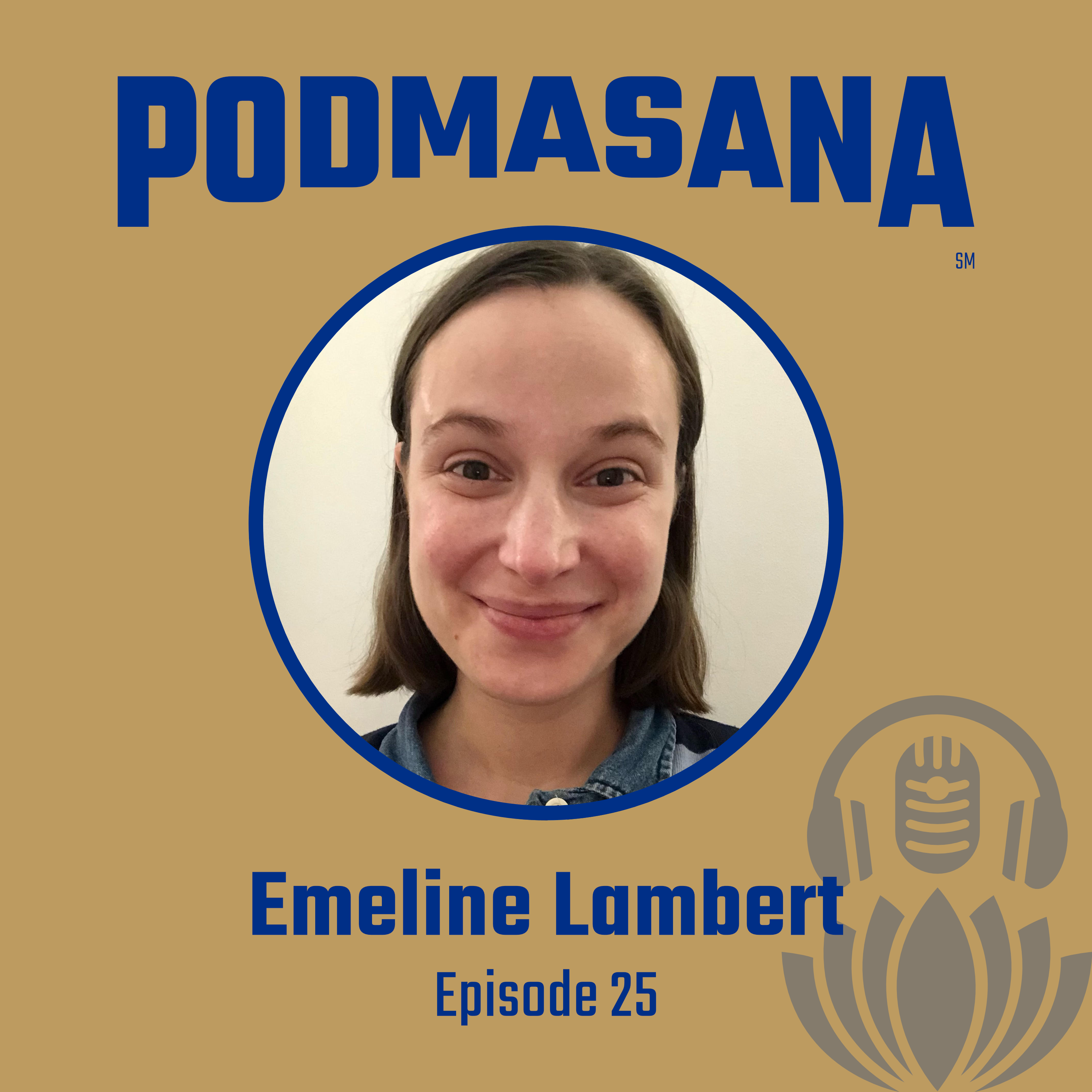
Today we're exploring that question with Emeline Lambert, a former professional ballet dancer and actress whose work you might recognize from House of the Dragon, where she played Alyssa Targaryen, or from other series such as Django and Invasion.
But Emeline's most dramatic role wasn't on screen.
It was the moment she stopped performing altogether and discovered what happens when you finally stop running from yourself.
From childhood, Emeline felt she wasn't from here.
She would tell her parents with absolute certainty, I'm not your child. I come from Mars.
That profound sense of displacement, of being stuck in a waiting room, not the main event, became the driving force behind decades of artistic pursuit.
If she was trapped here, she reasoned, she would be anyone but herself.
Performance became both her art and her survival strategy.
Ballet made her professional.
Acting brought recognition.
But beneath the achievements ran a current of depression and anxiety that eventually became unbearable.
The turning point came from an unlikely source.
An agent's assistant reviewing an audition tape said, we can hear you in the tape.
That simple observation triggered a collapse.
Emmeline realized she'd spent her entire life performing, always running from the real her that kept bleeding through.
Desperate, she signed up for a 10 day Goa style Vipassana meditation retreat.
What happened there changed everything.
Something, she says, dissolved like Velcro being pulled apart.
A permanent shift that didn't fade. When the retreat ended, the mental chatter that had plagued her for decades dropped away.
In its place, a stable background of peace.
The awakening was sudden and, as Emaline describes it, brutal.
But integrating it proved challenging.
She quit acting completely.
Friends and relationships fell away.
Her family struggled to understand what had happened to the daughter and sister they knew.
She retreated to a largely solitary life on her family's farm in France, making sense of a transformation that seemed to occur overnight.
But this isn't a story of withdrawal from the world.
Emily now volunteers as City Voices, a New York based nonprofit where she virtually co facilitates their Saturday spirituality group and leads regular meditations focused on mental health and addiction recovery. From her home in the rural countryside of France, she works with people dealing with loneliness and inner struggles, meeting them in their suffering with a perspective earned through her own.
Her teaching is radical in its simplicity.
You are it, she says.
There is nothing outside of you, right here, right now, that will add onto the realization of your True nature that you are seeking.
The spiritual path isn't about acquiring something new, but removing the layers, obscuring what's already present.
The onion needs to be peeled, the diamond revealed from within.
She emphasizes something crucial.
Suffering isn't a detour from awakening.
It's often the catalyst.
As she puts it, quoting playwright Edward Albee, sometimes it's necessary to travel a long distance out of your way in order to come back a short distance correctly.
Emaline believes we've reached a point where individual enlightenment isn't enough.
Collective awakening is now necessary.
Like a flock of birds moving together without a leader.
She suggests that perhaps only 1% or even less of humanity awakening could shift the trajectory of our entire civilization.
On this episode of Podmasana we explore what happens when performance ends and presence begins.
How suffering becomes the doorway to awakening, why surrender is essential to coming home to yourself.
What it means to be the destination rather than the journey.
And how someone who spent decades running from herself discovered it was perfectly safe, necessary even, just to be herself.
[00:05:56] Promo: Foreign.
[00:06:01] Brendon Orr: Hey, listener. Brendon here to quickly talk about my Mindful Moment Podmasana sibling podcast.
You know those moments when enlightenment, insight, and wisdom find us, when the universe speaks to us during periods of adversity, joy, or stillness, and we feel more aware, mindful and present having listened to it.
What if we took the time to record those moments and share them with others?
This is the inspiration behind my Mindful Moment, where you are invited to listen to the mindful moments of others from around the world and share your own.
You can email your mindful moment to mymindfulmomentodmasana.com and for more information, visit Podmasana mymindfulmoment thank you. Now enjoy this episode of Podmasana Part one.
From Performance to Collapse and Retreat.
Emmaline, thank you very much for being on Podmasana Thank you.
So, Emeline, you told your parents from a very young age that you weren't their child, that you came from Mars, that this world was just a waiting room and not the main event.
Can you take us into that early experience of profound displacement? And what did it feel like to be a child who perhaps fundamentally knew, not just suspected, but knew that she didn't belong here? And how did that knowing shape the entire trajectory of your life, particularly your turn toward performance as a survival strategy?
[00:07:55] Emeline Lambert: Yes. Beautiful.
Well, first of all, I'd like to, because if my parents do listen to this one day, I would like to emphasize the fact that they are wonderful parents.
So this is not a sort of traumatic Escape from a family structure that wasn't functioning. I was quite lucky, in fact, to have landed in this very family. I think I was grappling with concepts that 4, 5, 6 year olds would struggle with. And so what I was feeling, and it's one of my earliest memories, was just this sense of, you use the right word very skillfully, this profound displacement.
There was a deep intuitive knowing that seemed to be the tapestry and the sort of undercurrent of every single one of my experiences, of reality, of this cannot be it, whatever it is, whatever this is, this can't be. And so the, the sense of not belonging was not just clustered to the family unit and, and my brother and my parents, although my brother relished in that and said, yes, we found you in a bin, as every old brother does when, when their sister tells them that, you know, they don't belong to the family.
It was, it was much wider. It was a sense of alienation from the rules of this game that somehow everyone had been told, everyone had been briefed at some point or another, pre or post birth, what this was, what the purpose of this realm was and how they were supposed to navigate it.
And I felt this deep sense of, yes, we can call it alienation, we can call it displacement. The sense of simply, you know, the interpretive state would be not belonging to what, to all, all that is here, to this realm. And so I think two things sort of were coexisting at once all the time with, with that deep state of, of misunderstanding, which, by the way, sort of reminds me of, you know, the original sin in the Bible, that the, the Latin word for sin, peccare, doesn't mean, you know, you've, you've done something bad. Peccare is the mark, you know, the bow and arrow, the target. You've missed the mark. Right? So there is an original, what Bism call ignorance. There is an original misunderstanding is what it means to be here, what, what this mind, body, incarnation, vessel actually represents. And so I felt that very powerfully. And so I think two things were coexisting at once. And one of them was all right, there is this otherness that I sense deeply. Let me go and try and find it obviously outside of myself, because I was convinced that the answer, whatever that was, lied outside of myself. So let me go and seek for this, for this otherness, this other realm, this other state that will feel more real than this. And at the same time, there was this sort of silent contractual understanding with the universe, which was, well, seems like I'M stuck here, right? So what do we do then?
If there's no escape, if there's no coming back home, traveling back, then who can I be in this realm? And so then the coping mechanism and all of this is, of course, interpretive work that comes much later, Right. This was subconscious. But the. The. The sort of solution arose as, okay, well, let me be anyone but me, then, because being me is too hard. Because being me, the real deep self, means facing this deep misconception and disalignment with. With truth and. And what I'm doing here and asking myself profound questions to which I don't have the answer.
So let me look for this otherness, and let me be anyone but me. And those were the two sort of impulses fueled by a desire to both escape and find something outside of myself that would make sense, more sen.
And so those are two brilliant ingredients for performance and becoming an artist.
Anyone but me. Let me play characters. Let me put on the mask, right? Let me be Lady Macbeth instead of Emmeline and pretend. I identify with her so much, I become her. I feel like her. Right?
And that the sort of almost mystical dimension that there is to art, but also performance itself. You know, artists talk of this state of flow. There is a sort of deepening of presence, and it feels like you're traveling to another realm when you're putting on a costume, putting to someone else. You're on a stage, it's naked. But if you say it's the moon, it becomes the moon, right? The suspension of disbelief, storytelling. So those were the two ingredients that fueled, on a deep, deep, subconscious level, this.
This trajectory that later became, I guess, my work or career or aspirations, whatever you want to call them.
[00:12:52] Brendon Orr: Yeah. Thanks, Emmeline. And so you discovered that if you were stuck here, you would be anyone but me. And that defense mechanism translated into decades of professional performance, first as a ballet dancer in France, then as an actress.
Can you explore this a little bit? How does performance become both art and escape? And what was it like living a life where your greatest skill, inhabiting other identities, was actually the very thing perhaps keeping you from meeting yourself?
[00:13:27] Emeline Lambert: Yes, it's a great question, and it's something that actually would be worth a TED Talk with artists themselves because they. They contemplate that massively. Right. What is this liminal space of artistic creation that is authentic and true and pure and isn't an escape because one can be confused with the other very easily. And if. If I had to sum it up, it would be, you know, I wasn't Running towards something. I was running away from something. So I was approaching performance, this container of art and exploration, as from a place rather of lack of and a fear. And I've essentially not enoughness. And that's probably a concept we can circle back to later. But essentially, if it had to be summed up, I was approaching art and being an artist and identifying with the profession as from a state of ego, a state of mind, right? I needed to stamp an identity onto myself that felt safe, reassuring, concrete and absolute.
And so I derived a sense of self from doing.
The being was an extension of the doing, which is the other way around. It should not be this way, in my opinion. And so I wasn't allowing art and performance to be extensions and manifestations and expressions of a deep container of presence.
I was running away from presence, from the truth that inevitably will be found in it. And I just added, right, I added piles of stuff onto the truth instead of removing. And I think it. You know, I'm not the only one that the. The process of being an artist, and especially an actor, because it's a. It's a job that really interrogates the nature of identity quite strongly when you are the vessel itself of expression, of the art.
That is. That is a conversation that a lot of actors sort of circle around. You know, why am I doing this?
Why do I feel the need to embody someone else's reality, thoughts, body, story, right? And if. If that is a movement that is prompted by a deep feeling of not enoughness, being me is not enough as it is, which is the seed of ego, not enoughness, right? So let me go and look for this and that and this and that and the house and the husband and the kids and the wife and the car and the mortgage and the money, and I'll be happy when.
Insert whatever you want at the end of that sentence, and then you personalize it by calling it me and mine, and believe that when this thing becomes an extension of your identity, you will finally be enough, right? And so when that's the original impulse of any sort of artistic endeavor, yes, indeed, there is a real profound misconception. And so I was approaching it from a place of lack and from a place of validation, of course, because that's what the ego needs as well, a lot of external validation, right?
So, yeah, for sure.
[00:16:28] Brendon Orr: And so there was this moment, Emmaline, where an agent's assistant once said something that triggered a complete collapse of your lifelong coping mechanism.
I believe they said we could. They said something to the effect we can Hear you in the tape. So what did that mean, Emily? And what were they hearing? And why did that observation, which might seem a little innocuous, become the catalyst that finally broke open decades of running? And what happened in the moment you realized you could no longer escape yourself, even through performance?
[00:17:03] Emeline Lambert: Yeah, it's funny, isn't it, that this completely mundane little snippet of life somehow became the cornerstone and the catalyst for a big egoic crumbling of the inherent architecture that was keeping, you know, the separate sense of self and identity alive.
Any actor that, that works in the industry will constantly be faced with having to work on different accents.
It's the most normal, accepted, widespread sort of tool that an actor has in their toolbox. And I'm not English, I'm French and Swedish, and so I had an extra sort of layer because English is my third language. So there was an extra sort of exercise for me to, to get into the groove of accents. And so your, your agent is going to tell you when an accent goes better than another's or not, and the vowels and little sounds and the tidbits that give things away. So it's something that's extremely normal, non critical. There's nothing exotic to that type of convers yet. And again, maybe there's a divine timing to these encounters and, and you're being primed to receive these moments in different ways, but something happened in the way she formulated it, and I believe she thought in her great empathy and compassion, that she was actually being quite gentle and generous in the way she was presenting it. Right. It's not. Your American accent is bad. No, it's just we can hear a little bit of you. Right. It's wonderfully put when you think about it.
And yet that, that statement, that that turn of phrase was the sort of mirror that was brought retroactively back right onto myself. And as you said, you know, it wasn't intellectual, it wasn't filtered through the perception of mind. There was a visceral, experiential sort of crumbling of sorts. And it was both abrupt and very subtle. And there was just a, a thing that happened which, you know, really sort of manifested along the lines of, ugh, oh, I really can't hide anymore, can't I? Or rather not anymore. Damn. Whatever I do to hide, it will never fully 100% work, will it? There will always be a little bit of myself, whatever that is. This thing we don't want to approach left.
And so it was interesting because that really sort of, I believe, retrospectively primed me for what Sort of unfolded later in terms of deeper encounter with pure presence in this wider container of truth.
[00:19:52] Brendon Orr: So coming out of that Emmaline, for years you struggled with depression and anxiety that became, at times, suicidal. Plenty of spiritual seekers maybe sanitize this part of their story, but you speak about it openly. Can you talk about what that suffering was like, the actual lived experience of it? And looking back now, how do you understand the relationship between that profound psychological pain and the spiritual awakening that eventually came?
Do you think the intensity of the suffering was necessary, or could there have been easier way?
[00:20:30] Emeline Lambert: Well, my hope is that we move past the collective level of consciousness whereby we don't need to go through the chapter of suffering in order to wake up. That would be a wonderful sort of collective evolutionary impulse, wouldn't it? I don't think we're quite there yet, and we can talk about the collective aspects later. To go back to your statement, so this was before the agent's comment and all of that. It was, I would say, most of my 20s, well, if not my teenage years as well, you know, were ripe with this profound sense of dissatisfaction that in a way, was perfectly nurtured and fed by my constant desires, endeavors, running away from the truth, from myself. I was. Was feeding this cycle of not enoughness, of dissatisfaction, of real displeasure of the present moment through whatever I was doing and. And whatever my dreams were, right? So acting, ballet, whatever that was, that was the initial fuel that was feeding the suffering.
I. I think the suffering, the psychological suffering that I experienced was. Was twofold. One part was an expression and a result of trauma, of tangible events that take place that really scarred me or who I was at the time, and me not knowing how to cope with that and becoming very much identified with the quality of my trauma and simply sort of lingering in that energetic space for as long as possible. And the other part of the psychological suffering was sort of the quieter again, a quieter buzz, a quieter hum of simply never being satisfied with what was.
I mean, you can, if you can sum up a lot of. A lot of psychological ailments or dissatisfactions by, you know, understanding that there is a deep dissatisfaction with the present moment, treating the present moment as a means to an end. I'm here, but I so wish I was there. There is so much better than here, and I will never get there. And that's why I'm so unhappy, because here is never going to be enough.
It's there I want to go. And so if we go. Go deeper into the sort of spiritual understanding of that retrospectively, yes, There was a constant battle, constant resistance with what was with reality, which I perceived hollow.
Again, not enough. We go back to the concept that the egoic mind feeds of and that I was completely at loss how to, to navigate it. And so that paired with substantial tangible moments, events that resulted in PTSD and more ongoing lingering trauma, led me to sort of point of, oh, you know, again, a question we hear quite a lot with people who suffer from clinical depression. What's the point?
What's the point of.
It's not worth it, right? Being alive, being here, playing this game, it's not worth it.
And so you start seeing with that question the sort of double sided aspect of it.
What's the point can have a miserable and negative quality to it. If you approach it again from a place of lack of mind and of a depressive state. What's the point is also a much deeper transversal and universal invitation to the question that underlines all spiritual traditions, which is, who am I?
Right? They're very similar. What is the point? Why are we here?
It's just that the emotion attached to it is very different. The sort of spiritual inquiry and spiritual curiosity versus the deep, aimless, alienated depressive state. But the question in itself holds within its container a deep nugget of truth, which is a sort of deeper opening towards the, the truth of reality, the purpose of us, why we're here, what is this? And so that's why we see a lot of people, a lot of God. I hate that word, spiritual seeker. I think it's terrible.
[00:24:46] Brendon Orr: Problematic perhaps.
[00:24:47] Emeline Lambert: Yes, it's, it's problematic and people still use it, you know, and it implies a distance and a separation between you and what you are seeking. I mean it's, it's, it's full of really unhealthy paradoxes and I don't think it's helpful or skillful at all. But a lot of people who end up deepening their spiritual life, their inner landscape, the real profound self inquiry, have been doing so through the catalyst of suffering and using suffering as a way of alchemizing the wisdom that hides beneath suffering, which is a deep questioning regarding the universe and themselves and their true, true nature.
So it doesn't take much to, I mean it does to some extent, you know, safety and well being. But just in the theoretical lapse between what's the point of it all and what is the point of it all, right? The openness that transitions one one state to the other, it doesn't take much to, to, to get there. And so Suffering invites, essentially, and that's the point, and that's why it's an invitation. When looked at it this way, suffering invites the end of a paradigm.
There's something someone has tried for decades, if not lifetimes.
We've been sold a certain reality, a certain model of not only society, but structure of ourselves. We've been sold a certain story, we've believed it and we've tried to go along with it and it's not working.
Right, yeah, little separate being, navigating reality with the illusion of separation. And so suffering invites the death of that paradigm and it forces and encourages the creation or rather the discovery of something deeper, another one, another model of reality.
So again, the leap is not that big, which is why many people move from deep psychological suffering to profound self inquiry and spiritual curiosity.
Yes.
[00:26:45] Brendon Orr: And it seems like that exploration for you involved signing up to attend a 10 day Goinka style vipassana retreat.
And were you seeking spiritual awakening or were you just desperate for relief? And as someone who had spent your whole life in motion, performing, escaping, becoming, what was it like to sit still for 10 days and finally confront the self you've been running from your entire life?
[00:27:11] Emeline Lambert: Perhaps, yes.
I'm laughing because I was so far from the state of mind which booked this retreat, was so far removed from the actual truth of what takes place in these spaces that. Yes, no, I had no idea what I was signing up for. It was yet again something to sort of fill the void. I just quit acting. I didn't know what I was going to do, who I was going to become next. I was in what people would call a, a transitional state, professionally speaking. And there was of course this itch and this deep inability to not only be still, but welcome the, the, the unknown and whatever, whatever byproduct that brings with itself.
And so there was an email that popped on one day inviting me to participate in a two year mindfulness program.
Oh, two years. Two years of being busy. Yes. Let's sign, sign up to that. Fantastic mindfulness. I like that. I don't really know what it is, but it sounds good, it'll do me good. And I did a little bit of meditation before. I was actually quite interested in different techniques when I was, when I was acting because it was a type of meditation that was sort of geared towards law of attraction manifesting. And so I wanted to manifest a role. And so meditation was really just a means to an end and a tool to, to get what I wanted again outside of me and bring it back in. Right. And so it was just yet another, another thing, this two year mindfulness program.
And one of the prerequisites, I believe, once you had signed up, was to complete within the first six months of the, the, the start of the program, what they call insight meditation because it's based in America. And in America it seems like they call it insight a bit more than Vipassana. And so, and so anyway, it was a prerequisite, so there I was, I booked it.
Did I Google what Vipassanara insight mean? No.
Did I Google who Goenka was? No. Did I know I was going to meditate 10 hours a day for 10 days? No, I, I didn't.
It's not that I didn't care, but it was not out of my own volition. I was told to do it, it was part of the requirement, so I did. So yes, it was very much an expression of this sort of continuous wheel of action, the good student that signs up and does it and it'll take time and that's wonderful and let's just go for it. And I think if it hadn't been for these sets of circumstances, the sort of shift in consciousness that operated wouldn't have taken place because I was essentially, without knowing it myself, co creating the perfect circumstances for a complete surrender to take place.
So it was helpful to not know what this was, to not attach any concept, to have zero expectations whatsoever, because I didn't really care.
And so then the sort of blast that came my way was obviously much more powerful and impersonal.
[00:30:22] Brendon Orr: Yes, hello, listener Brendon here.
Do you or someone you know have an article or book to share, a work to highlight or story to tell that would be a good fit for Podmasana If so, feel free to reach out via email at
[email protected] that's ideasodmasana.com and we'll be sure to get back to you. Thank you.
Part 2 the Awakening and Its Aftermath Emeline, during that Vipassana retreat, something happened that you describe as dissolving, like Velcro being pulled apart, a permanent shift that didn't fade when the retreat ended.
Can you take us into that moment and as much as words allow, what dissolved, what remained? And how did you know immediately that this wasn't just a temporary meditative state, but something fundamental that had perhaps shifted permanently?
[00:31:32] Emeline Lambert: Yes, it's funny because I almost, I don't. But I almost regret talking about the event itself because I find it so essential to emphasize the fact that the event, or whatever people want to call event, actually because it felt more like the end of all events than an event in particular is not the sort of.
Is not only the end, all, be all. There is a deepening in an integrative state that takes place later.
But it again reaffirms this sometimes thing where people seek, want and yearn and desire an event to take place as well, and believe that that event is the only way for them to sort of, you know, access a deeper understanding of their true nature. Right. So I'm always very careful not to dramatize it or speak of it as something extraordinary, because it really wasn't. And thank God it wasn't, right? It wasn't an LSD trip or anything like that. There was just an abso.
Complete.
You know, it's like you drop an ice cube in the ocean and it just melts and you are left with nothing to point at, hold on, to, keep isolate as a separate vessel, entity called the self.
There was. There was just an absolute dissolution.
And I sometimes refer to it as a death because it also is what it felt like and transpired to be.
Right. There was a sort of. When everything dies, what remains sort of experience.
And what I experienced or felt like I was left. Left with was no I.
So even see the phrasing, the languaging around this doesn't work, right? It shortens the truth of what we are trying to point at.
There was just emptiness and an emptiness. Emptiness might not be the. I mean, it's a Buddhist term, right?
Anatta Sunyata. No self, the emptiness. But there was.
It wasn't nothing. This emptiness was all there was. It was impersonal and it was.
It's hard to speak of it because I want to do justice.
There was just an all that isness. There was just the visceral encounter, or rather the experiential encounter of the thing that cannot be touched, cannot die, because. Because it was never born, cannot be altered, cannot be wounded, cannot be spoken of. The sort of, the. The. The nothing out of which everything arises. The absolute with a capital A.
Yes, I'm. I'm probably not doing this justice. It's. It's not bad. And I also don't remember quite. I mean, it requires sort of remembering the past and activating that sense of memory and don't really.
And that's also one of the reasons why I don't want to glamorize it. I never think about it. I mean, I never think about, you know, I. I don't believe something incredible happened to me, whoever me is. And I Don't sort of refer to that moment as a.
You know. Yes, there was a clear before and after. It wasn't the I've arrived. No, everything was removed. Right. Everything was stripped away.
That the layers got peeled off. And I just.
There was an impossibility to ignore the truth that contains everything. And I very much did not know that that was going to stay. To answer the second part of your question, I just thought, oh, okay.
There was an incapacity and a non. Willingness to verbalize and formulate into words what had occurred. I didn't feel that pull and that need at all, but I didn't have them matching knowledge to sort of understand that this state was somehow going to become a trait. And so I just thought, oh, I feel absolute peace. This is incredible.
Oh, that's. That's pretty impressive, isn't it? Well, great. If it lasts for a couple of days, wonderful. Right? Jolly good.
But I. Then. And then there was just the sort of slow realization that this. This thing.
I believe Rupert Spira uses this example, and I think it's a really skillful one, the idea that. Imagine you've walked around for weeks with a huge backpack around your back. Right. And then you take the train and you go back home and you unlock the door, and then you drop the backpack.
Yes. There is. There is a moment of release of, ah, oh, my back is light.
But then you go about the day and you wash your hands and you cook dinner, and you don't think about the back being light. Then it just becomes. That just becomes it. That just becomes life. Right. And so this unshakable peace just became the foundation upon which everything arose from just an absolute sense of impersonal, loving, empty business. Yeah. And it just so happened that it stayed and deepened after. Yes.
[00:37:09] Brendon Orr: Yeah. I really appreciate all that language. I think it does a good job of describing the experience and diving into the experience a little bit more. Emmaline, you describe the awakening as sudden and brutal, but the integration as challenging, the mental chatter dropping away dramatically, and a stable background of peace appearing.
But you quit acting completely.
Some relationships fell away. Your family was a little confused, and how you needed to retreat to your family's farm in France to make sense of what happened. Can you walk us through those months after the retreat? What's it like when your inner reality shifts overnight, but the outer world and the people in it haven't changed at all?
[00:37:57] Emeline Lambert: Yeah.
Yes. Well, that's. That's pretty much the answer. You just pointed it right there.
The discrepancy between the internal Shift and how the external reality responds to it. I just to clarify, I had quit acting before that.
There was of course, no possibility of returning to it afterwards. That was pretty self evident.
And I was already living in this barn where I live at the moment. And it just so happened that I lived there on my own. So that the solitary, or rather not solitary because it doesn't feel solitary, but the aloneness and silence and stillness were an absolute gift of allowing more space to move around the understanding of what had shifted.
Again, I never use the word awakening. I prefer to use the word shift in consciousness just because it has less zeitgeisty marks imprinted on it. Right. It's a bit more.
And it sounds less exotic because it isn't. Right. It's in everyone. And so it lives as a potential constantly, all the time. When it comes to family and friendships and all these relationships. I think it was sort of wonderful to have this mirror occur which is they, you know, if you have an actor on stage who believes to be Lady Macbeth for their entire life, again, I think Rupert Spira speaks of this. If Jane Doe has identified with Lady Macbeth to the extent that she's forgotten she's Jane Doe and she really believes she's Lady Macbeth, well, then she's going to behave like Lady Macbeth. She's going to adopt these characteristics, these personality traits. She's going to remember the past of Lady Macbeth and predict the future accordingly.
And she's going to move around the world like Lady Macbeth. And then the shift occurs and the realization of one's deepest nature is born out of that shift. And Jane Doe realizes she's in fact Jane Doe.
And so the personality, the mask state them sort of playing the game, acting like Lady Macbeth falls away. It dissolves. There is no need, yearning, desire to navigate the world like Lady Macbeth. And so to the outside eye, that feels like, I don't recognize this person.
My friend is in Jane Doe. My friend is Lady Macbeth. With her idiosyncrasies in her past and her personal preferences and her tastes and what she believes in and her opinions and her values. I don't know this Jane Doe. Who is she? And so, yes, there was a real sense of almost estrangement from people who were closest to me and, and they said it, you know, through, through these exact words, we sort of, we don't really recognize you.
And it was completely both valid and sort of legitimate on their end because I didn't recognize me either, because the little me had massively dissolved and effaced itself.
And so there was just a more impersonal state of deep presence that felt like it didn't need to reassert the contours of this architecture, called the self, by behaving in specific ways. And what's interesting is that to a lot of people, that feels like, oh, this person has placed incredible amounts of boundaries around herself and she's. Now she feels further away, right? She feels, like, unattainable. She feels like we can't quite reach her. There's nothing to speak about. We can't hold on to these structures that we shared previously.
Again, that is a. That is a completely valid interpretation from my end.
This boundary that people described was simply the spaciousness that the divine needed to flow, the spaciousness that is needed, that is welcome for love to exist. Not possession, love.
Love needs space to express itself.
There's freedom in love, possession. It's. Yes, me, mine, mine. Let us merge. Be so close that we are called soul mates and we become one. Right?
The mind loves that. Love is free. It's vast, it's wide. And so I think what happened in time is that they sort of realized that there was. There was just love on my end. There was no desire to move away, to retreat, to lose friendships, to prune them. There was just absolute love. It just felt more impersonal because love is.
And so. And so time allowed us to sort of reconfigure the structure of them, our friendships or family dynamics. And because they're all so incredibly open and generous, it worked. And then some friendship died, of course. But that, you know, that was the way of.
That was the way of it. Yeah.
[00:43:08] Brendon Orr: So your core teaching seems to be this. You have previously said you are it. There is nothing outside of you that will add onto the realization of your true nature.
The work isn't about acquiring something, but removing layers to reveal the diamond within.
This maybe runs a little counter to the conditioning of many people who say we need to get somewhere, become someone, achieve something.
How can we help people understand that the spiritual path is subtraction rather than addition?
And what are these layers that need to be removed?
[00:43:50] Emeline Lambert: Wonderful question.
I can only. I can only alchemize my own personal experience, right? And. And share that with people. And so what I.
What. What I offer or present is just a series of pointers. And if it works, wonderful. If it doesn't, there are others. We are all pointing out the same thing. We are all attempting in the best possible way or in the most authentic way, to translate truth through language. What I've come to realize through this shift is that we.
Again, there is this deep conditioning that runs where we live and operate on what I sometimes refer to as this horizontal plane of existence, right? So there is a little object A over here, a little object B over there, and A wants to get to B. And so we'll move in space, through time, in order to get to object B. And so we believe that once we get to object B, we will be happier than when we were at object A. And so this horizontal plane of existence welcomes and emphasizes that, the belief that there are separate objects, separate vessels, separate entities that are seeking something outside of themselves.
When. When people sometimes say, you are it, that's. That's all there is. There is nothing to add. Some minds will react to. Well, okay, well, then that's a bit lazy, isn't it? Well, okay, so then I'm not supposed to do anything. I'm not supposed to practice. I'm not supposed to, I don't know, pursue some sort of spiritual inquiry and unfolding into that. I say, no, that you are, but that the quality of the commitment is different. Why? Because you move from a horizontal plane of existence to a vertical.
And so the paradigm shifts. It's not, you know, I'm it, so I don't have to do anything. I'm a vegetable. Cut me open, I don't care, because I'm already it. No, the quality of the commitment changes. Then the question becomes, you know, like a stone dropped in a lake, it won't move.
It will keep on sinking in the same spot, but deeper and deeper and deeper and deeper and deeper. And so the quality of this vertical commitment is what we are talking about, and that is the peeling away of the layers of the onion. What is standing in the way of this stone reaching the bedrock, the bottom of the lake or the ocean?
And so what I find most skillful is again, you know, you look at every single spiritual tradition, and they all seem to share this deep, deep question which sort of works around the lines of, who am I? Who is this I that we believe to be?
We can call it the Buddha nature, kingdom of heaven within the Dao Brahmin, Atman. The Brahmin. It doesn't, you know, again, pointers, various language and words to look at the same thing through different angles and perspectives. We are all. Every single tradition is. Is pointing at the exploration of the deeper, the deeper dimension within the deepest I, the thing that cannot disappear.
And so one of the ways of peeling away and without resisting, without inducing frustration and just in the most natural and organic way, sinking into the deep layers of vertical presence, is by understanding experientially everything that you are not.
The question, who am I? Can't be answered through words. The answer is not intellectual, it's not verbal, it's experiential. Right? It's beyond all experiences. So to look at everything that you are not becomes the most direct and skillful way of accessing that reality in that deepest truth. And so then again, in the most perennial way, what are we not? Well, that's fairly easy to look out, right? Okay, let's have a look at it. What is reality made of? What is my experience of reality? What are the ingredients that constitute my experience of reality?
Well, we've got the mind. What is the mind made of? Mostly of thoughts. You know, we've got the default brain network. We've got how the mind operates. Metacognition. The way we interact with mind is very often with thinking. We've got the thinking box. What else do we have? We've got the body. What happens in the body? Well, we've got five sense doors that allows us to filter and experience reality outside.
It is through the five senses that the brain also interacts and interprets reality all the time. What is the body made of? Well, the body is made of sensations, right? Okay, so what are these sensations and what are emotions? And you look at all the components of reality and it's. It's very logical, accessible to every single person to very quickly come to the realization of, well, am I my thoughts, right?
How can I be? We think about 30,000, I believe, thoughts a day. More or less between 16 and 30,000 a day. Okay, so which one are you?
Are you all of them?
Well, you only think one thought at a time. So which thought are you? Are you? Do you exist prior to thought? Or do you die and reincarnate after each thought? Or is there, because you are aware that you are thinking, is there a sense of awareness prior to thinking, during thinking and after thinking? Once the thought is replaced, right, A new thought, it lingers, it dissolves, gets replaced by a new thought. Where are you in this process? Are you always here? Or do you vanish between each thought?
You've been you, Brendon from the moment you were born.
From from the moment you were born to now, you've been you.
Where is this you?
Is it in thinking? Can we spot it in mind? No. How can we? Because this you again, cannot be held, cannot be grasped by one singular thought. There is an awareness of you, not only prior to Thinking. But between thoughts, between the silence of each thought, there is. You are still you.
You don't stop being yourself because you stop thinking.
So where is Brendon Is it in the body?
Well, how can Brendon be in the body? How can Brendon be the body?
You don't have the same body than you had when you were five. Every single cell has died and regenerated.
The cells of your stomach lining regenerate something like every six weeks, I believe.
So there's nothing there that remains of Brendon when Brendon was five. And yet you were you at five years old, and you are you now.
Okay, so Brendon is not in the body. Brendon is not in the mind.
What are emotions? Well, again, emotions take place in the body, right? Thoughts are for the mind, emotions are for the body.
And if we look at the nature of emotions, what are they? Sensations we call anger. Anger. But anger if we decipher in the very impersonal way. Anger is simply a series of uncomfortable, which is why the mind calls it anger. Uncomfortable sensations.
Warm, cold, prickling, tingling, clutching, contraction, tension.
These sensations change all the time and are replaced by another sensation, another sensation. You're full of sensations everywhere, which is a very basic, again, Buddhist teaching and understanding. Sensations everywhere, operating all the time. Impermanence.
So Brendon cannot be located in thoughts. Brendon cannot be located in body, cannot be located in emotions. Where is Brendon Because from the moment you were born to now, you've been you.
And yet you know that. You think, you know that, you feel, you know that you sense.
There is a prior knowing to experience. There is a prior awareness that encompasses every single interaction, every single encounter with experience without, without being aware of that you were thinking. You wouldn't know, you would be thinking. There would just be thoughts happening. There is a prior container of awareness prior to experience, whatever experience. There is a container of absolute awareness that was there from the moment you were born to now.
[00:52:06] Brendon Orr: Yeah, there seems like there could be somewhat of a paradox here though, right? So we still have to do things to remove the layers, go on retreats, sit in meditation, study, practice.
So while this path is subtraction, don't we still need addition either? Through practices, teachers, communities to facilitate that subtraction? I'm wondering how we hold both. Or do we hold both? Well, I don't know what you think, Emily. Do we, do we have to learn about being before we can just be?
[00:52:45] Emeline Lambert: Um, it's a, it's a great question.
Again, the, the model changes the way we, we, we look at it. When we realize that surrender is the practice, or rather that the, you know, call it the end of all practice or the practice, but surrender is the practice. And what I would emphasize is it's not really what you do, because doing, there's nothing wrong with doing, doing in. In the best possible way, simply, and a manifestation of a deep state of being.
So action can be incredibly skillful and generative.
What matters is the intention behind it.
Am I doing from a place of lack, from a place of fear, from a place of deep belief that the doing will bring me closer to this thing that exists outside of me, that once I get it, I will finally be free, liberated, at peace, happier, whatever you want to name it? Or is the doing a way of sinking deeper and deeper into the realization of what is already there, but at the moment is failed?
Truth cannot be sought outside of yourself, but at the moment it is. It is buried under a pile of clutter, right? Layers of illusions and veils of misunderstandings. And so the practice becomes, you know, removing and peeling away the layers to come in contact with light of truth is the practice. That's the doing.
When you fold away your clothes and put them in your cupboard and clean the room and declutter, you are doing, but you're not adding anything to the room. You are removing everything that isn't needed.
That's is a form of, if you want to call it doing, but it is. It is coming from a standpoint. It is coming from a dimension that understands that there is nothing that can be added to who you are.
And so then the intention shifts and the intention becomes, okay, well, if that really. That. If that really is the truth and you only, you need to experience it to believe it, right? Jesus's truth is Jesus truth. If it's not true for you because you haven't experienced it, it's all well and good, I've heard about it, but it doesn't matter. The Buddha's reality is the Buddha's reality. If you've not experienced it, it's not yours. You need to experience it. But it's the approach of understanding that there is nothing that can be added to. To what already is. And so then the inquiry, the openness and the curiosity becomes, okay, what is still standing in the way?
What is still veiling? My. My direct encounter with truth, my direct encounter with oneness, with. With the deepest capital s self, that becomes the practice that requires a tremendous amount of observation, an authenticity, an integrity.
Observation, observation, observation. I can assure you and anyone I speak with, if you spent your life practicing that level of metacognition and Observing every single thought that comes into the frame of your experience, every single way you react to something that happens outside of you, how you attach a thinking pattern to that in an emotion that ensues because you believe it to be real, so it lands in the body energetically so somewhere. And then how you keep on reminding yourself of the past in order to predict the future and what your relationship with the present moment is. Observation.
If you observed yourself like a scientific experiment every day with such precision, you would become very well acquainted with what is standing in the way.
And you would come to realize that the reason why the light of direct truth isn't shining and as bright as it could potentially, is because there are things on top of it, not because it's hidden in another room.
[00:56:32] Brendon Orr: So, Emmaline, you emphasize repeatedly that suffering comes not from events themselves, but from what the mind says about events, from the mental commentary.
And the fundamental shift is recognizing you are the witness, not the thinker.
Can you maybe break this down a little bit? We've touched on a little bit, but I'm wondering if we can break it down a little bit. How does someone who's completely identified with their thoughts begin to create that space between awareness and thinking?
And what happens when that space opens up? How does it change one's relationship with suffering?
[00:57:11] Emeline Lambert: That is, when we. We.
It would be skillful to circle back, back to the. The concept of not enoughness that we brought up earlier. So, you know, spiritual traditions speak of ego, right? Ego is this sort of been. It's been portrayed as almost an entity, a separate entity that lives in mind and has a mind of its own, funnily enough. Right. Um, and so ego obviously derives from the Greek and Latin. It means I, the self, and emphasizes this experience that there is somehow, through that, the energetic movement of mind, activity, a sense of separate self that has desires, wishes, that wants things out of life, and that if it gets them, it's happy. If it doesn't, it's unhappy. It has personal preferences. It interacts with reality by remembering and recognizing the past, using the past to have a specific relationship to the present moment and as well as the future.
Mind, first and foremost, is a survival mechanism. It's a survival tool. It's an evolutionary impulse that allowed us to climb at the very top of the food chain.
Mind is the survivalist container that has allowed us to navigate space, time, and reality as separate objects in space and time, separate objects of consciousness in order to survive space and time and reality and threats outside of ourselves.
If you look at this energetic Movement of mind again through pure observation, and you start dissecting what it's really made of, you will come to realize that the seed, the original component, the original ingredient of mind is somewhat of a sense, an experience of not enoughness.
What does that mean? It means that me, here, right now, not enough.
The mind has this impulse, this gnawing, this desire to add.
Add onto the experience of the present moment. Add things to this moment that once I add it, what? Once I put these filters, these, these objects, these items onto this experience. What Once I include these things into this experience of the present moment, I will feel better.
And so mind goes to looking for these things outside of itself to add to the experience of now. In the hope that once it's added to the experience of now, we will finally feel happy, we will finally feel harmonious, we will finally feel full, complete. However, whatever objective you pick, essentially enough for this moment, meaning myself, because we're not separate. We are the present moment for it to feel like it's enough.
And so again, then it goes, and the car and the partner and the kids and the mortgage and the this and the that and the hopes and the dreams and the projects and the job, and you name it. Let's bring it all back into the experience of my present moment. So we call it mine. It's part of me now. I identify with it. It becomes part of who I am. And then we bring it inside. And now it's part of my experience. How do I feel?
And what happens if it goes right? What happens if it goes wrong?
And so if. If you start seeing the dance of mind and this movement of not enoughness, always acting upon and interacting with the present moment through this filter, this deep belief that there is something to be added to this moment, then the question becomes, okay, well, if the original seed of. Of mind, of this impulse, this need to essentially incarnate more form, to not be able to dwell in the formless, but to constantly have to create, generate and interact with more form.
If that's the seed, then how do we transcend that? How do we move beyond not enoughness?
And so to that I would invite or suggest that, you know, the only thing that can allow you to move beyond not enoughness is drum.
Enoughness.
[01:01:24] Brendon Orr: Yeah.
[01:01:26] Emeline Lambert: What does enoughness feel like? Experientially, Enoughness feels like acceptance, unconditional acceptance of what is of the present moment as it is.
Can I accept this present reality as it is?
Even if what it is is not what I would like it to be?
Can I come in contact with the the only truth there is, which is that there is just this moment, there is just now, outside of mind. Past and future do not exist. They are objects of mind.
And so can I land into the experiential truth of the only state that is actually real, which is the present moment, which is now? And can I see it as enough? Can I accept what is suffering comes from the inability to accept what is suffering is a result, as we said earlier, of from treating the present moment as a means to an end. I want something out of this moment and I'm not getting it.
So I am now at war with this moment. This moment is not how it should be, but it's all there is.
And of course, to the mind, that also is a form of death. Why? Because if the mind is this evolutionary tool that allowed us to, I mean, look around, create this, you know, societal ecosystem we've created for ourselves, we have done so by using the past in order to curate the future.
When you look at again, when you keep on observing how mind functions, how mind interact with reality, we are constantly remembering the past, putting some sort of a veil on top of the events of the past. Dissatisfaction, grievance, regret, sadness, whatever you want to call it. There is an emotion attached to an event in the past, and it becomes an emotional snapshot. You keep it in the archive of the little self, and sometimes you pull it back up and you remember it and it makes you feel a certain way. And sometimes you use the past in order to expect, predict or analyze events in the future. Oh, what if this happens again? What if I. What if someone else breaks up with me? I can't have that happen again because last time it was horrendous. So this. Therefore I'm going to act and make decisions according to this emotional snapshot that I've created that represents the story of me lodged in the past. And I will use the past in order to interact with the present moment and create a future.
Mind uses past in order to inform future.
The only place where mind has no validity is the present moment.
Why? Because it's already happening. It can't do anything about it. It can't change something that is continuously unfolding all the time. That is, that already is.
And so the present moment represents the unknown, represents a place of surrender, a place of letting go, where mind doesn't have the space or the energetic ability to curate, to make decisions, to rule.
Right?
And so sometimes I play this game with people and I say, you know, imagine for them to really understand that Their sense of self lives in their mind. They say, let's, let's pretend that I'm a witch and I've got this magic wand.
And there is a room, four white walls, no windows, no mirror, nothing for you to sort of self reference anything. And I place you in this room and I simply extract with my magic wand all of your memories.
I take away your memories.
So if I take away your memories, you don't know that you're Brendon You don't know where you're from. You don't know if you're married. You don't know if you have siblings. You don't know what your favorite color is. You don't know who, who hurt you 10 years ago. You don't know what you're looking for forward. That's going to happen in a week. You don't know you're going to India. You don't know that you like this. You don't know that you hate that. You don't know that you're vegetarian. You don't know any of it.
And so if I were to ask you once I've taken away your memories, who are you?
You'd say I don't know or probably wouldn't be able to answer.
You wouldn't be able to to verbalize a separate sense of self called Brendon Because you no way of referring back to the idea of Brendon through mind and through memories and through past.
You don't know who you are, you don't know where you are, you don't know why you are here. But you would go inside and you would check in with what it means to be.
You would know yourself to be.
You are, you aren't this or that you're on Brendon Orr someone else. But you would be able to experience an impersonal state of being.
Taken away your memories doesn't mean that I've taken away your ability to be.
I've just taken away the personal identity attached to that state of being.
When you remove that personal state of being there, sorry, that personal identity there is still an undercurrent of being.
If you say no, it means that between your thoughts, do you stop being?
[01:06:52] Brendon Orr: Yeah, I think it's an interesting question because there's, I mean this discussion is making me think of dualism and non dualism and you can get into this really never ending debate. It seems about, you know, what is the nature of the universe and how does it all work? Is it just matter, you know, and soul? Is it all the same thing? I think, you know, in my Life. I've just thought that the depends on the day. Sometimes it feels like I'm non dualist and then some days maybe dualism. Sometimes it's all one. Sometimes it's, you know, is, you know, somewhat separate. But what you said absolutely resonates where, you know, you are just, you know, you are everything, right? It's, it's all connected.
[01:07:30] Emeline Lambert: And I mean it's something that again, it can only be real for you if you experience it.
And so then the invitation for anyone becomes, let's find containers where you can experience it so that it becomes, there are no doubts anymore. And again that becomes the practice. So there is, as you, as you say, an invitation to practice. But the quality of the practice with the intention feeding it is that it's all here. All the pieces of the puzzles are there. Now we just need to figure out how to put them together so that this whole thing makes sense. But we don't need to add anything to the jigsaw puzzle. All the pieces are already there. They're just not in the right complex, perfect, divine order.
And so that, that changes from person to person. But there are moments throughout the day for you and for anyone where for some reason I don't have one at the top of my head, but very, very often sometimes, you know, let's say it happens quite a lot with, you know, some people use the example of the. The cat at the entrance of the mouse hall, right, Waiting for the mouse to come out.
The cat is not thinking about dinner, where it parked its car, when it needs to reply to this email or what's going to happen next week. The cat is intense.
It's putting all of its conscious attention on the mouse hole.
Same with us. Sometimes we hear a sound and all the attention goes to what was that? And in that moment, thought stops.
You are still, your attention is clearly invited onto, onto a sort of stillness for you to absorb what comes.
And so my invitation to you would be, when somehow in these pockets of opportunities during your day where you for some reason aren't thinking, aren't moving, aren't overly stimulated by your five senses, do you stop being?
Have you ever stopped being from the moment you were born to now, or have you always been, the undercurrent of being is fundamental and prior to anything else that is added onto your experience of the present moment in reality.
And it is, it is the container versus the contents of experience, the fruit bowl that holds all the fruits.
The nature of the container, the nature of the fruit bowl is that it's Empty.
It's empty, and it's always there. And it will remain empty, and it will fulfill its function, and it will always be the same, whether there's a banana, a pineapple, couple of pears, a few apples in it or not. The container doesn't change. The container always is.
And then the contents of experience change. Yes, of course.
One thought, one emotion, a sensation, another thought, another emotion. You know, the shape of the clouds change, the sky doesn't.
And so can you keep on falling back into the experience of container, which is the experience of being throughout the day?
[01:10:53] Brendon Orr: Yeah, you had. You had mentioned the cat metaphor earlier, and I don't normally share these personal anecdotes, but one of, you know, as we move through life, certain visual memories seem like they stay imprinted, like, on our consciousness, you know, as we continue to move through. And my first pet was a cat. His name was Achilles. Really, really great, really great spirit. We were very. We were very close.
And, you know, he could be a little full of himself sometimes, but he knew how to embody the present moment. And there was this one moment in the backyard where we were just hanging out. I looked over and he was looking all regal, and the. The sun was just shining on him. And he just kind of. He just. He just kind of turned to me and just kind of like. He kind of smiled with his eyes, like a blink. And then that was this embodiment of the present moment. But thanks for allowing me to share that. But that's what I was thinking of as we were engaging in this discourse. And another thing I was think of, Emeline, was we're talking about acceptance. And maybe the other side of that acceptance coin is maybe a synonym. Surrender. And you have mentioned that understanding surrender earlier might have reduced your suffering, even though you needed to go through what you went through.
What is surrender in your understanding, Emmaline? It's such an overused word, perhaps in spiritual circles, but what does it actually mean practically? Is it passive acceptance? Active allowing, something else entirely?
How does surrender function in the process of awakening and coming home to yourself, like we've been talking about?
[01:12:31] Emeline Lambert: It's a great question, and I suspect that my. My attempt at an answer will probably change throughout the years. It would be. Be foolish of me to think that it's something that I understand entirely, because I don't. And that's why I use acceptance more than surrender. And I'll explain why.
To me, acceptance is the gateway to surrender. But I don't see surrender as something that we can control and orchestrate.
I see surrender a little bit like attached to, sort of higher, dare I say it, divine timing. There is something of a transcendent nature to it. And, and that's why I often equate surrender to healing when I talk about it. And what I mean by that is, you know, if someone needs surgery, let's say they've got a cyst or a tumor or something that needs to be removed. The surgeon removes that. It's great. It goes well. The surgeon doesn't heal.
That's not the surgeon's function. The surgeon removes the thing that is allowing the body to heal itself.
It is the body that heals.
It's the same with surrender.
Surrender isn't something you can trigger and initiate.
You prime the space in which surrender will occur by decluttering, removing the things standing in the way, the peeling away the veils and the layers. And when, when enough of that priming, when enough of that declutter nurturing has taken place through the practice, because there is one of pure observation and acceptance of presence and present moment, reality as it is, then something happens of a higher nature that I. I would tend to believe we cannot be controlled or cannot be entirely of our own volition.
There is. There is a different type of timing and quality to the wave of surrender that seems to take over.
And so the. The practice becomes to prime, to get the space ready first surrender to flow in it when. When there is enough space for it to flow, for surrender to take over. When. When the prime. When the primed space is ready for the surrender to take over.
Right? And so the practice becomes acceptance and priming and come in contact with all the things that we are not in. That are veiling the. The. The truth of our deepest nature. By definition, surrender is not a doing.
By definition, it is the end of all doing.
So to approach surrender as something else, like a box to be ticked or just something to be done, I think would be reductive of what this actual energetic movement of surrender is. And sometimes you hear it in. In. I don't have any sort of conversation or interview in mind, but people sort of speak of this thing that came over them and they just, you know, a lot of people describe surrender as this something of a higher nature, high intelligence that just seems to take over them and they had no choice but to surrender to it.
And so there is. There is a receivership quality in. In the relationship with surrender. So then the work becomes, or rather the inquiry becomes, how can I. How can I declutter and create more space, spaciousness, in that space.
So that when surrender occurs, you know it's free to flow with as as much beauty and intelligence as it can.
[01:16:07] Brendon Orr: Hello listener Brendon here.
If you're enjoying the show and would like to Support it, visit Podmasana to learn about all the great ways that you can contribute.
You can become a Podmasana plus partner at three different tiers with a variety of perks and also make monthly and one time donations to help support the show. Any support is greatly appreciated.
Again, that page is Podmasana support.
Thank you for listening and thank you for your support.
Part three Living from Awakening and Serving Others Emmaline, you make an important distinction.
Being awake doesn't require moving slowly or withdrawing from life.
You describe entering flow states at high speed while serving in a meditation center kitchen.
Meeting the moment with whatever it demands without the mental commentary that creates stress.
Can we explore this a little bit? How do you maintain presence, witnessing awareness and inner stillness while engaging fully with life's demands?
What's the difference between the stillness you're describing and the common misconception that awakening means becoming passive or detached?
[01:17:39] Emeline Lambert: Hmm, beautiful.
I'm contemplating the best angle or the most skillful angle through which approach this question because it's, it's layered.
And again, just as a, as a caveat, I, I'm. I'm always a little bit wary of the, the word awake. So I will simply use the word present. Yeah.
In contact with this, this deeper capital S. Self truth.
The way presence and a deep state of being can be expressed in the world, thank God, is varied.
But the fact is, and that is sort of the, the. Both the misconception slash misunderstanding and, and also the difference between, you know, a state of disconnection, of stress. Essentially, whatever pace one moves at in life, it is always connected to a deep state of being.
So, you know, the bottom of the sea is always still.
It's always there. It's always still. And sometimes it's. It's holding the, the waves, the tsunamis at the top of it.
The. However this deep state of presence expresses itself in the world, it is always anchored in a deep state of being. There is never a disconnection from being.
Being becomes the place from which things arise.
And this world and its infinite creativity allows us to experience various states.
And so I think it's Eckhart Tolle who mentions the word and enthusiasm. And I love that word. You know, you can be enthusiastic, you can be inspired, you can be overjoyed, you can be blissful. These are very active Energetic, generative states of being. They are prime for, for actioning, for allowing the doing to become an extension of the being.
In other words, in these states of creativity and creative intelligence, doing becomes a direct expression of that deep intelligent state of being.
And so the way you wash the dishes, the way you express yourself, the way you move around an overwhelming environment with absolute ease, is because you are connected to that deeper state. In fact, enthusiasm means in Greek entheos, meaning inside of God.
So you are, you are moving within the circular movement of divine intelligence with ease because there is no mind activity. There is no self commenting on the present moment. There is no disruptive egoic movement of thinking that is telling you that there is something wrong with now. There is just an absolute impersonal energy expressing itself through you as the mind, body, vessel that you are in order to get things done in the tangible 3D. It is using you as a vessel of creation. And so the doing becomes an active creation itself that comes from this deep state of being.
And so then it's, it's the dance and it changes according to every single person. You know, some people are really good at that enthusiastic state, I would say, I don't know, 60% of the time and only need a very little bit of sort of landing in gentle stillness and silence and very little doing and just pure being and resting and in a state of stillness. And some people need a bit more stillness and a little bit less enthusiastic. Creation and generation, it depends. But both emanate from the same deep dimension of connection with this deeper state of reality inside of you.
[01:21:30] Brendon Orr: Yeah.
And so Emmaline, I won't call it awakening, but after your present, your present ing.
Yeah, you could have remained in solitary retreat on the farm in France, but you are volunteering for a non profit city Voices in New York City and you're co facilitating a Saturday spirituality group and you're helping lead meditations for people dealing with mental health struggles, addiction and loneliness.
I'm wondering what drew you to this work and what's it like to sit with people who are in the depths of suffering of their own that is maybe similar to the suffering that you also experienced. And how does your own journey through depression and suicidal thoughts inform how you hold space for others?
[01:22:20] Emeline Lambert: Great question. I'd like to preface regarding them, you know, staying on my own at the farm, I did do quite a lot of that at the beginning, which, you know, there's nothing wrong with. If anything it was perfectly, it was blissful. And I sometimes look at it as, you know, you've got this huge rug and you sort of, you flick it, right? And all the dust flies off the rug and you see all the dust sort of arise in the air, floating. It needs space to land. The landing needs to occur. There needs to be a settling into this, what feels very much like a new model of reality. And so if that means doing very little, which I did for a while, then yes, so be it. That's perfectly fine. And I think again, if one listens intently to the sort of ineffable, unspoken, and yet ever permanent language of the universe, then at the right time, anyone has their own timing. There will be, post landing or during landing, something that of course isn't you, that is higher than you, that transcends just this vessel, body, mind, entity that will start to want to express itself through you.
There is, there will be at some point a very potent impersonal volition moving through you and wanting to, in the most loving way, use you as, as a vessel of its own creation.
And, and that's very easily perceived because there is no sort of personal preference or desires in what needs to be achieved. You know, things are brought your way, call it serendipity, call it timing, call it whatever, opportunities, luck, things are presented your way, whether it's event, people, jobs, whatever. There is, there is no sort of personal self attached to these things. There are none of the things you, the little self would have ever wanted before.
But there is an understanding that, ah, yes, yes, this is what needs to be done. Ah, wonderful. Okay. That's how love is expressing itself today. Okay, great. And so there is an activation of this intelligence force moving through you and using you to create.
This is the realm of experience.
This is the realm of creation. This is what we are here for. This vessel is a liminal space of translation from the invisible to the visible.
We have an idea. It becomes a table, an idea becomes a book, an idea becomes a baby. It's all happening through these things, through this vessel, through this, this, this door, this gateway, right? And so we are here to express something higher than us into matter.
And when the personal self dissolves enough for, for all this series of very cute personal preferences to dictate your relationship with the present moment in reality in the future, then there is an enormous amount of space of inner spaciousness where something can arise that is of, again, I keep on using the word higher. It's probably not the most skillful world that is of a, of a more impersonal and truthful and authentic nature that will use you to express itself. And so that's sort of what's been happening, you know, Was it based on my own timing of things? No. I would have happily stayed in the farm, silent on my own for much longer. But it became very clear that there was something that wanted, or was wanting to express itself through me. And by the way, it's the same for everyone. There's no uniqueness in that. We are all.
We are all these vessels of creative intelligence. And so then the whole invitation becomes, what are you going to let express itself through you?
What is going to be the primal ingredient with which you will infuse every single one of your creation?
Right. What will these creation be made out of?
What will be the essence of the primal component that they all contain?
Will it be a deep alignment with source, a deep understanding of reality? Or will it be something of a more separate, illusory nature?
Something where there is a personal agenda attached to it? Right. There is grievances, anger, frustration, lack, whatever you want to call it. And so, yes, to answer the second part of your question, I volunteer with City Voices. It's been a little bit over a year now. And the gift of these conversations and these gatherings is how, in their uniqueness, how incredibly universal suffering is.
You meet people from various backgrounds, various circumstances, under very, very different conditions, and yet there is a universality to the component of their suffering.
And what's the most. Probably the most humbling dimension is that.
And that's also what. When one is in the midst of suffering, one doesn't believe. And fair enough, it's very hard to believe it, but it takes so very little to flick the light of something, something else on.
It takes so very little to scratch the surface enough for someone to recognize or remember or for one word, one turn of the phrase, one quotation, one idea, one practice, to suddenly, you know, like a chink in the wall, like, open just a little bit, enough of space for light to come through.
It takes very little, even though we are the first ones sometimes to believe we are miles away from the inner peace we are seeking.
It's. It's actually, I would suggest it's microscopic. When the invitation is wide enough, universal enough, and feel safe enough for people to sort of allow it to land.
And so that's what's been incredibly enriching and inspiring in these conversations. Yes, to continuously encounter the universal quality of all these various paths and walks of life and see how the slightest sort of shift can somehow wake someone up from the spell and introduce them to a deeper dimension that felt like it was unexplored, but that was always there. How easy.
Yeah.
[01:28:54] Brendon Orr: So you've said something that could be seen as maybe spiritually revolutionary that I've picked up on.
We can't get by with one Jesus, one Buddha anymore. Oh, you believe a collective awakening or presenting is now necessary, like a flock of birds moving together without a leader. And you suggest that maybe only 1% of humanity, or even less, actually needs to awaken for the dynamic of our entire civilization to shift.
Can you unpack this with me a little bit? And for listeners, how do you believe individual enlightenment is not no longer sufficient? And what gives you hope that this collective awakening is either happening or actually possible?
[01:29:43] Emeline Lambert: Yes. I don't know about the science. I said 1%, but I have no idea.
In fact, if I remember correctly, I read somewhere or heard somewhere, I would have to find that again. But someone did mention a percentage somewhere in some sort of scientific conversation, but I don't know. But yes, I think I do maintain that I believe it's a smaller percentage than what we believe it is. Which is sort of the crux of the comment, really. I never believed that it was enough to have one Jesus or one Buddha. It was never enough.
And Jesus and Buddha would tell you the same thing. It was never the point. The point was never to have a sort of hierarchical triangular leadership kind of pyramid.
Their invitation was always incredibly transversal and universal. You know, the Buddha came out of the Bodhi tree and the weeks of isolation after that, where he was sort of creating his paradigm and his model of understanding. And then he taught all of his Bhikkhus, the people that essentially became the monks following him. And then, you know, a lot of them got to use the Buddhist term enlightened. And he said, go, go.
Go as far and wide as life will take you and spread, Spread the message, spread. Right. So the point was never to have a sort of leadership paradigm of this model of enlightenment. What's interesting now is that we have reached.
We are near a civilizational collapse.
So we are now encountering a different quality of timing, where this volition, this generosity of spirit that these enlightened pure beings have spread becomes essential. And so now more than ever, we are, I don't like this, this term, but fighting against a timing that we have created, that mind has created collective mind to, to allow us to live in this, the civilization, the society that we've curated for ourselves. We are fighting against a timing that is. Is bigger than us and where it is definitely certain that one person will not be enough. And shouldn't be enough, because what trace of collective wisdom will be left when that person departs and transitions?
It has to be a transversal awakening. And I think, you know, we spoke about the necessities, suffering in the individual realm for a person to come to the end of a belief system, a structure, an architecture that is not working. There was. It was fallacious from the start. It's the same. Collectively, we have reached a point of collective suffering, of collective friction, of collective contrast that is so acute that there is no way out of the realization that this is not working. We are on the brink of collapse.
And if we do collapse, we will be the sixth mass extinction. You know, that will be what it will be. It's very different from life ending. Life never ends. Life reinvents itself.
It just won't reinvent itself as Homo sapiens or whatever we are, right? Simulationally speaking, it will. The laptop will reboot and it will create something different in its infinite intelligence. But as a civilization, we have reached the point of no return.
And again, the same way that that suffering is such a profound invitation on an individual level, it's also an incredibly profound invitation on a collective one. What it does on a collective level is face us with the sharpness and pain of experiencing contrasts, contrasts of such potent nature.
That's. That's what contrast does. And we are still gravitating at a level of consciousness where we need contrast.
We need to understand what we don't want in order to realize what we do want. We need to understand what we aren't in order to come in contact with what we are, what isn't working in order to move towards what's working. And so that's the gift of contrast on a collective level. There is at the same time, it seems, from my own personal experience, and of course it's subjective, but that's the only thing I can speak from.
There is a real current movement taking place of this can't be it, right? There is a this can't be it ness occurring. And people might not necessarily name it collective awakening or realization or truth or whatever you want to call it, but they are faced with such acute contrast.
And in the experience of contrast and in the experience, experience of the wrong, they are feeling a pull.
I call it a truth compass. They are feeling a closeness, they are feeling a pull towards what is actually right and what is true.
In other words, civilizationally, collectively, we. We are needing to be shown what's wrong, what doesn't work, what isn't aligned with source in order to move closer to it. It's like you've got an elastic band attached right around a.
A pole or a wrist or something. And you know, the further you stretch it away from it, from the spine to which it's attached, the more it's going to resist and harden and resist and resist until it snaps.
Why? Because it has moved as far as possible out of alignment to Source.
And we are now reaping the rewards of all these arrows, all these karmic movements and actions and choices we have thrown that have been completely misaligned with Source, completely created out of alignment with it. And we see its repercussions energetically in reality. And something deep inside of us wakes up and goes, no, no, this isn't the truth. This isn't right. I may not know what is, but this isn't it.
It's the famous, you know, Neti. Neti Neti by Adiya Shankara.
It's not this, not this, this, not this, not this, this is. Whatever this is, is not right. And somehow this recognition of what isn't right, what isn't true, what isn't aligned, what isn't authentic, is collective, is universal, is shared.
And so that tells me that this truth compass that we somehow are embedded with is of these similar qualities.
Impersonal, universal, authenticity, authentic, shared, transversal. Right.
And so that is the realization that we.
That it would be an illusion to believe in a pyramidal model of a leader who has the answer and will save humanity. Because again, that means that there is something or someone outside of you that will save. Save you. There is something or someone outside of you that is the answer. No, you are the answer.
Everyone is the answer. There is nothing. We go back to the same thing. There is nothing outside of you that is more true than whatever lives within. The truth is inside.
If you believe that there is someone, a spiritual figure that will save reality, then that you believe that there is. Is something truer that lives outside of you. And so that to me, is outdated and was never the point of these awakened being anyway.
They. They weren't safeguarding or, you know, holding secret.
They were spreading the message.
Right?
[01:37:21] Brendon Orr: Yeah. And as you were laying all that out, Emmaline, there was this powerful visual in my mind, and it's been there before. And thinking about this idea of collective awakening where, if you can imagine, I mean, the universe, of course, but in this example, humanity, there's an intricate net that's become a little frayed, you know, and throughout this net network, there's all these little Nodes that maybe have become a little bit dim, or the lights have just fully gone out, or some bulbs have been utterly, utterly crashed. And there's some maintenance that needs to occur in some of these nodes in order to fix or replace the light bulb or to brighten the luminescence from certain nodes. But as that happens, like over time, the light becomes more and more powerful and that the energy from that light also begins to strengthen the previously strayed thran. So that's just. That's just the visual that was playing out in my mind as you were going over all that. But yeah, thanks for your answer.
So I'm wondering, Emmaline, if you could speak to yourself from 10 years ago, during that dark period before your present in not awakening, what would you tell her? What would you want her to understand about what was coming and why it was all necessary?
[01:38:48] Emeline Lambert: It's interesting because it almost feels like.
It almost does feel a little bit like a dream that I sometimes I wouldn't say that I struggle remembering, because I do, but it feels so far away that it requires a tremendous amount of energy to try to pull myself into the mind, you know, the mindset and the framework of this specific state of being.
The truth is that whatever I would have told her, she wouldn't have been ready to hear, which is why she didn't.
If she was ready to hear it, she would have heard it and it would have shifted her relationship to reality.
I think.
I think one of the main reasons why there was such deep dissatisfaction, and it may sound like a paradox, but when you think about it actually isn't. It's quite logical. One of the main reason why there was so much suffering is precisely because I knew there was something, and at the time I called it something else, but there was something deeper that I was missing.
You know, it's a little bit like, oh, well, all the scientists are going to come for me now, but that's fine. It's a little bit like, you know, the people who want to study science want to study science because they assume there is a law that is underlying nature, that can justify, illuminate and make sense of nature. There is a law underlying all of that, all of the experience of nature and the natural phenomenon.
And so they are geared towards studying science because they want to explore the law, you know, underlying the foundational truth of scientific reality of nature.
And so they are assuming there is a law, they want to study it.
But then when it comes to calling this law God, of course, no, but there is an inherent assumption that There is something holding reality together.
There is some sort of complex order holding reality.
And then you can call this order whatever you want, it doesn't matter. But there is the assumption that there is an order that in the first place, otherwise why would you want to study it?
And so it was the same, I think, with me, it's this catch 22 of there was profound suffering and dissatisfaction because there was, you know, again, you go back to this truth compass. There was something that I knew was deeper, that I knew was more true and more real. And I also knew I was missing that I wasn't getting.
And so then the misconception was that I simply spent all my life looking for it outside of myself, right? And so if someone had told me at the time, it's, it's within you are what you're looking for, it would have probably been too, too simple of a message because it's, it's a message that needs to be accompanied by a tremendous amount of deepening language, communication, explanation as to what. It's the tip of the iceberg, right? It's, it's the end all, be all, but it's also the invitation. It's the, the door open. Then you need to step into the room and actually see what this message is made of, what the practice, what the arrows and the pointers are that are pointing out what that means, that the you are it, but we are the truth that we are seeking.
And the illusion, the magnificent, ridiculous, absurd game is that whatever we're seeking, we believe it's hiding outside of ourselves when it's actually in plain sight.
And so, yes, she would have probably laughed at my face.
So again, we go back to the timing of things.
Right.
I often sort of contemplate this. It probably will mean nothing to you because it's a bit esoteric, but you know what came first time or timing.
Right?
Yeah. So there is something that I can't explain to the way things get orchestrated.
Intelligence of timing. Yes.
[01:43:16] Brendon Orr: Yeah.
Well, Emmaline, I want to just say that I'm very grateful for you and what you're doing and thank you very much for being on Podmasana and being present with me and listeners.
[01:43:32] Emeline Lambert: My pleasure. Thank you for having me.
[01:43:36] Brendon Orr: We hope you enjoyed this episode. If you did, please share it with people you think would also enjoy it.
Consider leaving a review or comment on your preferred podcast listening platform, liking a video on YouTube, or sending us an
[email protected].
also, be sure to follow or subscribe to the show wherever you get your podcasts.
You can also support the show by subscribing to Podmasana plus for access to Podmasana Live bonus content and other
[email protected] plus or Podmasana Media's YouTube channel.
In addition, you can make monthly or one time
[email protected] support or say thank you with a super thanks donation on Podmasana YouTube channel.
Thanks for listening and thank you very much for your support.
On the socials, you can you can find the show on Blue Sky, Mastodon loops, Instagram and YouTube.
Catch you next time on Podmasana