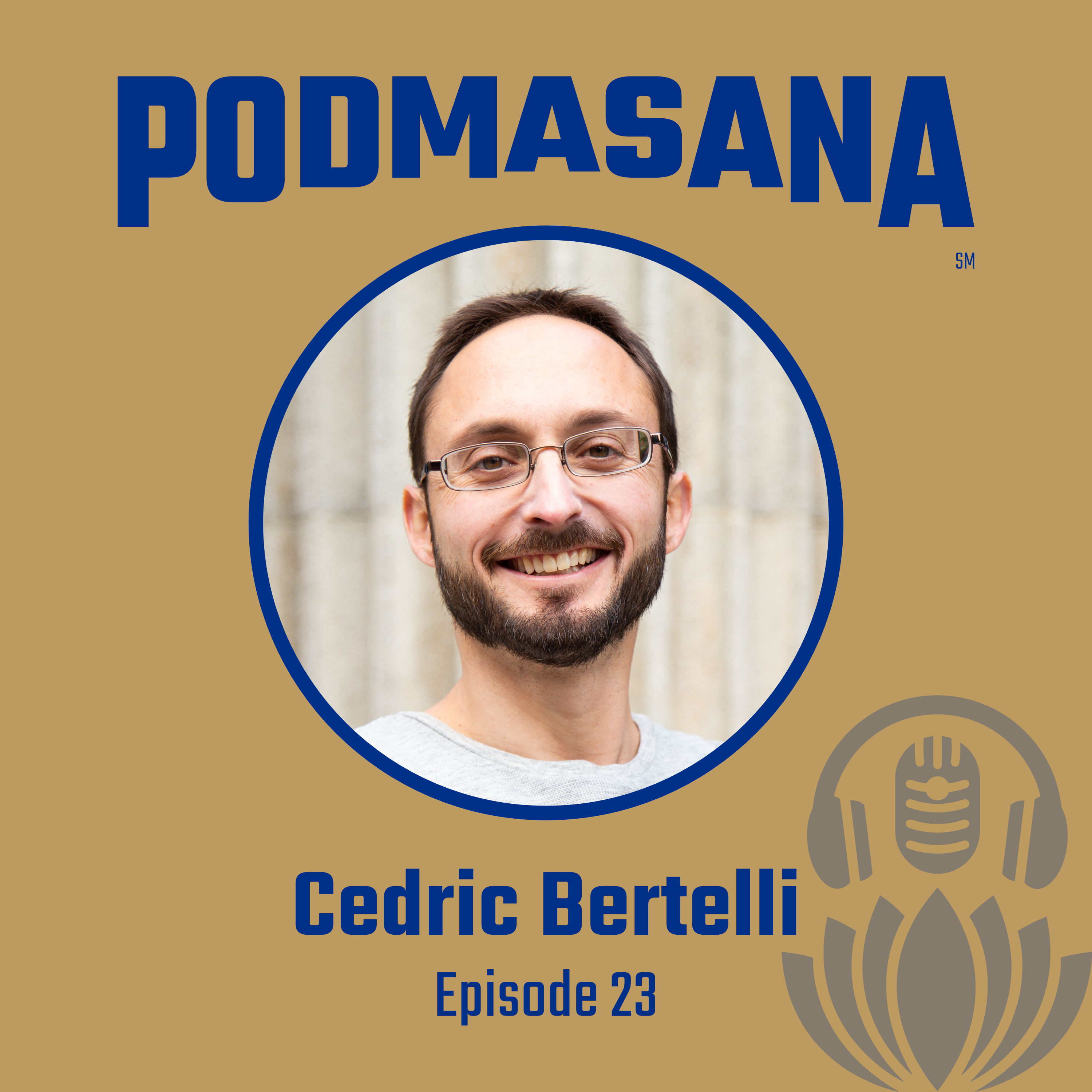
[00:00:00] Brendon Orr: Foreign.
This is Podmasana and I am Brendon Orr
What if the emotional patterns that have haunted you for years, the anxiety, the anger, the fear could be resolved, not managed, but actually dissolved at their physiological root.
Today we're exploring that radical possibility with Cedric Bertelli, co developer of Emotional Resolution, otherwise known as MREs, and founder of the Emotional Health Institute.
His work represents a paradigm shift in emotional healing, moving beyond coping strategies to something far more fundamental.
The body's innate capacity to complete unfinished emotional responses from the past.
Born in a small French village of 80 people, Cedric grew up as an anxious child carrying self directed anger, fascinated by a question that would shape his life's work.
Why do human beings repeat the same emotional patterns? Despite insight, intention and effort, his path was anything but linear.
Working in hospitality and eventually as food and beverage director at the Ritz Carlton, he developed deep appreciation for presence and and the invisible emotional dynamics between people.
But personal encounters with anxiety and suffering, his own and those of others, became the catalyst for deeper inquiry.
Why do emotions persist?
Why does understanding not dissolve them?
This search led him through embodied practices, contemplative traditions and collaboration with French physician Dr. Jacques Fumex.
Together they co developed Emotional Resolution, a method grounded in physiology, centered on interoception and informed by Predictive processing. Neuroscience.
MRes helps people complete emotional responses that remained frozen during past traumatic experiences.
While scientifically rigorous, he's collaborating with UCLA researchers and was selected as an audience choice speaker at the 2025 Super Trauma Conference.
Sedgwick's approach is deeply influenced by spiritual and philosophical wisdom.
The writings of Spinoza, Bergson and Marlo Ponty shaped his understanding that body and consciousness are inseparable.
For him, spirituality is not an escape from embodiment, but a deeper inhabiting of it.
Rather than teaching coping strategies, MREs invites people into direct, non judgmental awareness of their internal sensations.
In that space, something profound occurs.
Emotional patterns complete themselves.
Fear softens, reactivity dissolves.
Clarity emerges naturally.
Over the past decade, Cedric has trained practitioners internationally and worked with entrepreneurs, leaders, parents and trauma survivors.
His conviction is simple yet radical.
When individuals resolve their own fear and reactivity, the ripple extends outward into relationships, into parenting, into culture.
Spirituality, he believes, is expressed through presence, responsibility and emotional maturity.
Not transcendence, but nervous system regulation.
The Emotional Health Institute operates as a nonprofit across the United States, France and Japan.
But Cedric's vision extends further.
MREs integrated into schools, workplaces and healthcare systems worldwide, addressing what he sees as fear at the root of toxic societal dynamics.
On this episode of Podmasana we Explore what it means to resolve emotions at their physiological route, how interoception and predictive processing unlock lasting change, why the body, not the mind, holds the key to emotional freedom, and how one man's search for answers became a method helping people worldwide reclaim their nervous systems and their lives.
Whether you've tried therapy, meditation, or countless modalities without lasting relief, this conversation offers something genuinely different.
A path from management to resolution, from insight to embodied freedom.
Hey listener.
Brendon here to quickly talk about my Mindful Moment, Podmasana sibling podcast.
You know those moments when enlightenment, insight and wisdom find us?
When the universe speaks to us during periods of adversity, joy or stillness and we feel more aware, mindful and present having listened to it.
What if we took the time to record those moments and share them with others?
This is the inspiration behind my Mindful Moment, where you are invited to listen to the mindful moments of others from around the world and share your own.
You can email your mindful moment to mymindfulmomentodmasana.com and for more information visit Podmasana mymindfulmoment thank you.
[00:06:42] Cedric Bertelli: Thank you.
[00:06:42] Brendon Orr: Now enjoy this episode of Podmasana Part one, the Journey from Anxiety to Emotional Resolution.
Cedric, thanks for being on Podmasana Thank
[00:07:04] Cedric Bertelli: you Brendon Thank you for having me.
[00:07:06] Brendon Orr: You interestingly went from being a food and beverage director at the Ritz Carlton to co developing a neuroscience informed method for resolving emotional patterns.
That's not a typical career trajectory, right? Can you take us back to that anxious child in a small French village and trace how your personal struggle with anxiety and self directed anger became the foundation for MREs? And what were you observing about yourself and others that maybe mainstream approaches couldn't answer?
[00:07:43] Cedric Bertelli: Thank you. Yes, as you said, I was born in a tiny village where 80 people in the south of France in the middle of the forest. Really? And for quote, unquote, no good reason at all. I was very anxious, very early on, very, very anxious.
Anxiety crisis. Anyway, that's the way that I was as a young child growing up. I had the influence of my parents, of course, and my grandfather.
That was a major figure for me. That would be relevant for the rest of the question. What I will say now is my grandfather was a World War II resistance fighter.
He passed away a couple of years ago. He was 101.
And as I grew up as a teenager and a young man, I realized how him and men from his generation, I've been dealt what we call today resilience. You know, it became very clear than him and men of his generation. Most men of this generation that were around me were very well regulated.
And I go that would be an influence after for my work, but that's just to put there. And well, I grew up in that village, went to school, didn't do well in school at all.
So I decided to do something else, which is I learned to be a chef, I went to culinary school and there I found a community that made me feel happy. And I love cooking for people and make others happy. The stress and anxiety was still there, but it was a better part of my life. And later on, at the end of these studies, I had an opportunity to come to the United States and work for the Ritz Carlton. So first as a chef and then I went on the other side and became a banquet director, restaurant director and all that. I became very, very skilled at hiding my anxieties. And people around me would have had absolutely no idea what was going on inside. Outside I was funny and outgoing, but inside it was a storm constantly and a lot of self directed anger. But sometimes the anger was exploding as well. They used to call me Napoleon at the Ritz because I'm quite short and I'm used to fruit tantrum, I guess. But I was regulating and mostly with, with, with wine. It was not unusual for, you know, I was stopping work at like 2am, coming home and downing a whole bottle of wine to go to bed and wake up in the morning at 6:37am and having a bunch of espressos and back at work and again and again and again.
And it was fine for a while. It could have been gone for this way for a long while actually. In the meantime though, I was going through psychotherapy. I'm in California, so I was doing all the workshop you can find under the sun, you know, dancing naked around a fire and screaming, beating pillows and all that, trying to find a way to feel better because I was conscious of what's going on for me. And again I learned many things that would allow me to release emotion for a while, but they were coming back. I found many things that helped me to regulate emotion, but they were coming back.
So it was always going on inside.
And also working at the Reits at the end of my career with them, I had a very large team. I had about 200 people that used to work with me or for me.
And you could see very clearly that when you have a large team or a small team, you don't manage people, you manage their emotions.
You've got to understand where they're coming from at least a little bit what's happening a little bit in their family. As much as they want to share, you have to understand with what colleagues, they really thrive, what kind of tasks they like to do. It's like a chess game with emotions. So you don't manage people, you manage the emotion constantly. And that was fascinating to me. So this mix between trying to find way to get better for myself and trying to create a work environment where people actually thrive and are happy to come and are happy to work and are happy to serve really was on the top of my mind. Long story short, in 2008 the economy went down and the company was asking us to take decisions that were not that aligned with my integrity. And I saw it as an opportunity to maybe do a career change. I quit my job at the Ritz. I was, it was great company, by the way. I enjoyed every day working with them. And I went back to France to study somatic therapy. I went there for two years and studied and started to have an understanding and came back in the US and started a practice. So first I started a practice and I used to work in a wine bar, you know, to, to keep on making money and don't put too much pressure on my practice. And little by little the practice grew and I started researching the neuroscience of emotion. Took different classes and little by little I really saw how important physical sensations are when it comes to emotion. Everybody knows that, everybody knows that physical sensations are important when it comes down to emotional regulation, so to speak. But what was really crucial for me was to discover the work of Lisa Feldman Barrett out of Boston, and, and the theory of the prediction. You know, how the brain constantly predict and understanding that debilitating emotional pattern are nothing else but outdated prediction from the brain.
So anyway, I hope I answer the questions the right way for you.
[00:13:16] Brendon Orr: That's great, Cedric, thank you. And so you've said the central question that drove you was why do human beings repeat the same emotional patterns despite insight, intention and effort?
This resonates deeply for anyone who's been in therapy or read self help books or practice mindfulness and still found themselves reacting the same way.
What did you discover about why insight alone isn't enough? And what were you seeing in your village elders or maybe in mammals in the wild that suggested a different possibility.
[00:13:56] Cedric Bertelli: So you're right on point here. Two main things. Let's go back to my grandfather for a little bit. People from his generation after the war had nothing like my grandfather came from Italy, settled in France and had literally Nothing like a lot of other people at that time. So the question is, how can these people who went through major trauma and didn't have access to psychotherapy, self help books, workshops, none of this, how were they able to come out of the state of mind they were and thrive in some way?
And to.
[00:14:33] Brendon Orr: To.
[00:14:34] Cedric Bertelli: To make the. The answer short for me, the recipe was that after they settled in France with absolutely nothing, they worked outside in nature among men and women who shared a similar experience.
And they had a strong goal, they had no other choice but to work. Not only to work, but to bring their family up to flow again.
So community, nature, moving your body with a greater goal. That for me, was a key of what we call resilience.
Because nowadays we tell people, you know, you've got to be resilient. But resilience is not something that comes from within. Resilience is brought through our environment.
We talk about resilience in the soil. This is one of the first use of the word resilience. We say that the soil is resilient. When the soil rests and everything, the whole microbiome can go back and make the soul fertile again. That's what resilience is. Resilience is brought by outside, by a nurturing, loving environment. So that's the first thing. And then at the Emotional Health Institute, we work with ethologists and veterinarians to study how other mammals deal with emotions.
And something interesting came from this observation.
We realized that there's only three type of mammals that hold on to trauma.
Human beings, pets and farm animals. And what is a commonality between those three type of mammals? It is that us humans, we control the youngs, we control our children, you know, when they have an emotional difficulty. Often we are hurt by the emotional difficulty, and we interfere with the emotional difficulty either way, to regulate it for them or to teach them how to regulate it. We constantly interfere with our pet's emotional health. We humanize them and we try to control it to make them feel better. And same thing with farm animals. We are in control of them from a very early age on.
So what is interesting to notice is we talk about MREs and emotional resolution later. But MREs is nothing other than to let this natural capacity for emotional resolution happen. We all, as living being, I would say, what is mammal, have a natural capacity for emotional resolution. The problem is, when it comes to humans, pets and farm animals, we block it because we learn very early on, or it is imposed upon us to regulate it.
So what we see today, something positive, such as Emotional regulation actually is detrimental to our emotional health because we are preventing the natural capacity that we have biologically to resolve those emotional difficulties, to integrate trauma, so to speak. Right. And it happens to us.
[00:17:42] Brendon Orr: Cedric, your philosophical influences include Spinoza, Bergson and Marlo Ponty, all thinkers who understood the body and consciousness as inseparable.
You've written that spirituality is not an escape from embodiment, but a deeper inhabiting of it.
For listeners familiar with meditation, yoga, or contemplative practice, how does this perspective shift our understanding of what spiritual practice actually is?
How is MREs itself a form of embodied spiritual inquiry?
[00:18:21] Cedric Bertelli: Yeah, great question.
So I usually do not speak about that much, Right. Because we try to stay very pragmatic when it comes to showing about MREs, and we take more of a neuroscientific perspective. Now, studying Bergson, as you said, Spinoza, Merleau, Ponty, Roustin, you realize that the body, the way that we perceive it, is just a gate, so to speak, right? It's. Sometimes I take the metaphor of the painting. You see a Van Gogh, and from far away, okay, that's the Van Gogh. That's the emotion. And then you come close to it and you see the brushstroke. The brushstroke are the physical sensations.
And then behind the brushstroke, there is a canvas. And when it comes to MREs, the canvas is not something static. It's something that is malleable, that actually inform the sensations.
There is a concept that was developed by Gilles Deleuze, the French philosopher. It is two concepts. The first concept is a body without organs that we use with Emirates as practitioners. And the second concept is the plane of immanence.
So, you know, a lot of methodologies out there, meditation, mindfulness, etcetera, in a way, is looking for transcendence.
Right? Transcend. Going directly into some kind of cosmic wisdom or whatever it is that we're researching. With MREs, it is the opposite.
We're gonna look, we're gonna aim. We're going to reach a plane of immanence. That means finding all that through the flesh, the cosmos through the flesh. So you have to do. If there's nothing to do, you don't have to breathe, you don't have to. Now it's constantly available through the flesh.
In a way, if we want to draw a picture of it, it's a bit as if through the flesh the cosmos opens.
So if you. As you work with our. As we work with our clients, as they enter their body, sure, they're going to encounter their own stories. Because through the first layer, so to speak, it's my experience there is so much more than that in our body. There's our own cosmic history, right? There's our parents, our transgenerational.
All this is not out there, it's through the flesh.
So it's really how we approach it with Emrez is what you see, the crust. Bergson qualified as the crust. What you see from Cedric, what I see from Brendon is just a door. But everything is inside of us. Everything is inside of us, all these entities that make us right, it's all constantly accessible.
And the way that we see it with MREs is every time we feel an emotional difficulty, all it is is a crack in the crust, right? We're going to use this opportunity, we're going to use this crack to get through the flesh and to let the flesh, the sensation in the body, take us where it's supposed to be and spit us out, so to speak.
And when we do that, as much as possible, with as many fears as we can isolate, as we can recognize, little by little, the crust, so to speak, becomes more malleable, thinner. Maybe we have an opportunity to become, to come closer to what Spinoza called the essence. So it's in this way that we approach emotion with MREs is through the plane of immanence, the cosmos through the flesh, not in a mystical way, but in a way that is quite pragmatic.
[00:21:48] Brendon Orr: Thanks, Cedric. And can you tell us about your collaboration with Dr. Jacques Fumex and how MREs emerged from that partnership? What was the aha moment when you realized you weren't just creating another coping technique, but accessing something fundamental about how the body processes and completes emotional responses? And how did neuroscience, particularly predictive processing theory and Lisa Feldman Barrett's work on emotions help you understand what was actually happening?
[00:22:21] Cedric Bertelli: Dr. Jacques Fumex, who became a very, very good friend of mine, is now a retiring retired gastroenterologist from the University of Lyon, France. Jacques will tell you that in over 75% of people who come with GI issues, there's nothing biologically wrong with them. There is what we can call a psychosomatic foundation to their pain. The pain is real, the symptoms are real. There is nothing biologically wrong. Jacques before MREs was obviously a physician, but also was an Ericksonian hypnotherapist, and he was having good results in releasing some of the symptoms with hypnotherapy, but not as much as he wished. It is again when he really focused or understood the Importance of physical sensation when it comes down to emotion that the shift started. So him and I, we met, I believe in 2013, 2012, 2013, and we started collaborating and exchanging what we saw, what we observed, the way that it works. And, and to answer your question, how do we know that, how did we discover or understood that what we were doing wasn't just one more copying technique? It's because the emotions that we work on do not come back.
If somebody comes to see us with anxiety, that specific anxiety will not come back.
The anger will not come back. So it's not coping, it's resolving.
And I can tell you why it's working that way. Based on the work of Lisa Feldman Barrett, we understand today how the brain constructs debilitating emotional pattern. Few things we have to have in mind. Number one, the brain constantly predict.
This is what keeps us ahead of the game. You can see that with food. For example, if you had one apple once, let's say a green apple, you take a big bite of it, you have a first experience, the juiciness, the crunchiness, the acidity. After this one experience, every time you have such apple in your hand and you're about to bite it, you're going to predict exactly what experience you're about to have. And the experience can be slightly different based on the apple, the season, whatever, but the prediction will always be the same in a way, updated by experiences. But the prediction will update and go on the same round. So, number one, the brain constantly predicts. Another fun thing about predicting is, you know, let's say you come back from working out and you're thirsty and so you're drinking the water that you're drinking. It takes more than 30 minutes for your body to integrate it. Your brain predict exactly how much water you need to drink in order to quench your thirst.
So again, we're predicting constantly a few numbers that we need to have in mind as well. What you and I, we are aware of right now, consciously, is about 2000 bit of information per second, processed at the speed of 150 miles per hour.
Consciously, subconsciously, our brain, our subconscious has the power to gather 400 billion bits of information per second, processed at a speed of 150,000 miles per hour.
Now, our prefrontal cortex is used for many things, but one of the things it's used for is to filter information so we can have this conversation, so we can live in society, hold the job, etc. So we're not bombarded by all this sensorial information.
Okay, we know Today that in order for us to have a debilitating emotional pattern in our life, at the base of it is always the same type of event.
It's an instant of trauma.
Now what is a trauma? A trauma is an instant, a moment that holds too much stress, physical or emotional, for us to take on when we experience it.
So if you look at the work of Boris Cyrilnik, for example, out of France, you can see that the first thousand days after conception is a very fertile garden for trauma because we're extremely vulnerable as a species. Human being finish gestation outside of the womb for 12 months. We are the only mammals that cannot do anything for whole years after we're out of the womb. Horses, elephants, you name it, they can all walk, they can crawl to their mother and have milk. We cannot do anything, absolutely anything. We are extremely vulnerable. And everything can be scary, too hot, too cold, too noisy, too, et cetera, et cetera. So the first thousand days of life are very, yes, fertile for what we can call trauma. But that's. And of course trauma can happen anytime, you know, depending on our life, personality, et cetera. Now what is important to understand is what creates the pattern is not the trauma, is not the traumatic event. What create the pattern or the instant of dissociation happening during a traumatic event. Right? If the stress is too high, we're going to dissociate. So we don't suffer too much during the event when there is dissociation, the cognitive shutdown. So the filter is not there anymore. The subconscious now have all the awareness that it can. So imagine a huge whirlpool opening out, gathering all the information happening around you during those instants, plural of dissociation. The taste, the color, the smell, the actual situation. All this information is gathered by the brain in a nonlinear, non logical, extremely rapid way. And the brain is also gathering what physical sensations you're feeling the during this instant.
The tightness, the sensation, the emptiness, whatever is happening during these gaps, plural of dissociation. One thing that we never do with Emreus is going back to a traumatic event, even if somebody knows what the event was, because the traumatic event holds so many instant of dissociation that trying to just tackle into a traumatic event doesn't make any sense. It's actually retraumatizing for people.
Anyway, this part aside, we lived in our life several moments of trauma, 10th and 10th of a moment of trauma. But again, what created the pattern or the instant of dissociation? If I'm being sexually abused for five minutes, I guarantee you that I'M going to dissociate several times during those five minutes. I'm going to go in and out, in and out. And every time I go out, the same process happen. My brain gathers the information from outside and from inside.
Okay.
Later on in our life, when our body, our brain find itself in situations when or where it recognizes one or several elements that were present during an instant of dissociation created by trauma, our brain is going to predict instantly what physical sensations we're about to feel in our body instantly, the same way that we saw earlier with the apple. So the brain recognize subconsciously a smell, a situation, a color, whatever, something. The brain is going to predict what physical sensations you're about to feel based on what you felt during a specific event.
Those physical sensations, we call them interoception. It is what let us know that we feel an emotion. I know that I'm anxious because of his physical sensations that I conceptualize. I. I know that I'm angry because I feel physical sensations that I conceptualize. So I know that I feel an emotion because I feel physical sensations. Interoception. Interoceptions are managed by a part of the brain called the insular cortex.
Now, those physical sensations, usually when we feel them, we feel anxious. What do we do? We control them.
We take a breath, we have some water, we do some self talking, we stretch. When we feel an emotional difficulty, most of the time, if not always, we control it. We've been learning how to control our emotion since we were very, very young. We go back to the mammals from earlier and what we discovered at the Emotional health Institute, what MREs is aiming to do is that when we feel an emotion, when we feel physical sensations at the base of an emotional difficulty, if we can feel these physical sensations as they change in our body without trying to rectify them, without trying to control them, or without anyone helping us to control them, if we can feel those physical sensations that are nothing else but a prediction as they evolve until the end of the prediction. A prediction will last between two and 90 seconds, never more. If we can be with a prediction without interfering with it or interfering with the environment that created it, at the end of the prediction, the brain is anticipating to be hit by, by some kind of danger.
Your brain is anticipating for you to be in a difficult situation. At the end of the prediction, you're safe and sound. Nothing is happening. Your prediction will be updated.
Your brain will recognize that the trigger that or the stimulus that trigger this interoceptive prediction nowadays is irrelevant.
This is how we learn Right. We keep on learning by updating prediction.
So this is what MREs does. MREs is offering a methodology, but a space, I should say, where someone, where everybody can feel the interoceptive prediction without interfering with it.
So the brain can recognize that whatever is happening in their life today is not a danger.
[00:31:47] Brendon Orr: And so we've touched on trauma a little bit, Cedric. And one of the most striking aspects of MREs is that it's trauma informed without requiring people to relive or even discuss their traumatic memories.
You work with the current emotional response, not the past event.
For people who've tried exposure therapy or trauma work that felt unsafe or maybe retraumatizing, how does MREs create safety? And why is working with present moment physical sensations rather than past memories the key to lasting resolution?
[00:32:26] Cedric Bertelli: This is a very important question and a very important point for us. At the Emotional Health Institute. I often tell my clients, trauma cannot be healed.
Trauma cannot be healed because trauma happened.
That you remember it or not it happened, and there's nothing we can do about it.
What we can do is noticing what impact, plural it has in our life.
So what are the impact that, you know, the true or not, are having in your life today? And we're gonna, we're gonna resolve impact after impact. Maybe somebody who come from war, for example, has agoraphobia. When there's a loud nose, they go into panic. What are the impact in your current life? Are we gonna resolve issues, each impact one after another, with never having to talk about a traumatic event, plus talking about a traumatic event first. You make it, make it more real even. You make it more resistant to let go. We only take people the way they are today. The goal of MREs is for us human being to feel the emotions that are congruent with our current reality, not emotions that vibrate from the past or resonate from the past. All of those can actually be resolved.
So it will always be safe. We will only talk about, as you said, current situation that are non traumatic. We will. In an MRes session, we work on three levels. The conscious emotions, which are the emotion that people come to see us for, usually the anxiety, the anger, et cetera. The unconscious emotions. The unconscious emotions are the emotions that if we really look for them, we can find, but we don't really like to look for them. The shame, the guilt, the resentment, the self image things.
We don't like to look at them because they do not fit with who we want to display in the world, and they do not fit very well with who we want to be. However they are impacting our behaviors and our emotional health. So we work on conscious, unconscious and subconscious.
What are the subconscious fears? Subconscious fears are tensions that are not strong enough to be conceptualized under emotion. They're not strong enough to be labelized, so to speak. For example, if I see you, I meet you for the first time. Brendon I don't know anything about you, but as I come close to you, my body fill up with tension. And maybe it's because your smell is similar to a smell they used to bully me in a bus. Maybe because your voice is similar to a teacher that used to abuse me or this. It's not about you. There is something about you physically that get my brain to go back to a past event.
Well, if I come close to you and I feel tension, I'm going to feel those tensions. I'm going to make up a story about them and say, well, I don't know, my brain does. There's something about this guy. Chances are we're not going to be friends. We're not going to maybe do business together. It's going to really shape the dynamic of our relationship.
A lot of our relationship are actually shaped by these subconscious relationship with people, relationship with money, relationship with love, etc, etc. There's a lot of tension that we feel in our body that are not congruent to the reality of situation. They're just there because they resonate with past events and that creates a lot of the dynamic toxic dynamics of our lives. So we resolve those emotions as well working with Emirates and again from a current perspective.
[00:35:57] Brendon Orr: Gotcha. Cedric. Well, I'm sniffing my armpits right now because the last thing I want to do is traumatize you with my. With my odor.
[00:36:04] Cedric Bertelli: Yeah, often those odor are not consciously perceptible. Right? It's. It's the brain sense them.
[00:36:12] Brendon Orr: Yeah.
[00:36:12] Cedric Bertelli: Yeah.
[00:36:16] Brendon Orr: Hey, it's Brendon If you've been enjoying the show, would you mind pressing pause and leaving a rating or review on your podcast listening platform or liking or commenting on an episode's YouTube video?
That's okay, I'll hang around.
Go ahead and hit pause.
The episode will still be here when you get back.
Still there.
Come on, hit pause and write that quick review comment or leave that rating or like an episode. It's a quick and meaningful way that you can help the show reach others.
You can also email any feedback to the
[email protected] thanks for listening and leaving a comment like rating or review.
Now on to Podmasana Part 2, the Neuroscience and Practice of emotional resolution.
Cedric, let's unpack the science for a moment. You describe emotions as outdated predictions from the brain, which is an interesting way to refer to them. Physical sensations recorded during past traumatic moments that get reactivated when the brain encounters something reminiscent of that danger.
Can you walk us through what's actually happening in the nervous system when someone has an anxiety response, an anger outburst or a fear reaction? How are these interoceptive predictions different from what we normally think of as emotions?
[00:38:02] Cedric Bertelli: So what I will say here is what we call emotion, what we refer as emotion.
Often, if not always, a conceptualization of physical sensations.
At the base of any one of our emotional difficulties is always, always physical sensations. That can be tensions, that can be emptiness, a lack of sensations. Those physical sensations were specific sensations that were felt at a specific time of our life. So those physical sensations are like ghosts, so to speak.
They come from the past.
Now, those physical sensations that we conceptualize, we are attached to what they mean to us, right? For example, I was an anxious person.
I was an angry person. That becomes part of my personality.
Well, the fact is an angry person doesn't exist. An anxious person doesn't exist. They're just people in pain.
So what we call an emotion is only a consequence of physical sensations.
And from this conceptualization, we make it part of our personality. We start to be behave a certain way. We're expecting others to behave toward us because we have those quote unquote emotions.
The way that we sit with MREs and thanks to the work of Lisa Feldman Barrett and the predictive principle is that beyond what we call emotion in a way is only physical sensations, physical pain, physical tensions.
When we move past this concept of emotion and we bring all our attention to most of them, we don't feel our. Most of us do not feel our emotions.
Most of us surf on the wave of an emotion. So we scream, we cry, we regulate, we cope. All this is just surfing. The wave of emotion, it doesn't go anywhere. It's going to throw you on the shore and the next wave is going to take you again the next day or the next week or the next year. If it's an emotion that comes every year for Christmas with mrs, we don't stay on the wave of emotion. We go down to the currents. We go deep into the ocean, so to speak. And a wave doesn't come very much from outside elements. They come from the currents down below. And this is where we go with Emeris. We move away from the reaction, we move away from the behavior. These are Just consequences, these are just symptoms. And we're going to feel the physical sensations, the current through the flesh that give rise of what we conceptualize as an emotion. So we're going to feel simply the interoceptive prediction that the brain is generating based on a past experience that was traumatic for us.
Yeah.
[00:41:01] Brendon Orr: Thank you. And you've explained that when we control or suppress our emotional responses through breath, work, denial or self talk, we inadvertently reinforce the brain's belief that we're in danger.
And this is counterintuitive maybe to some. Most of us have been taught to calm down or think positive when we're upset. Can you explain why these common strategies actually strengthen the pattern and what does it mean to let the prediction play out fully without interference?
[00:41:34] Cedric Bertelli: Yeah, great question.
One of my kitties, almost five years old and at school, already in preschool, you know, that teaches them so many technique to breathe and count and then she comes home and I say don't do any of that.
You just feel what you feel. And she's a very confused child now. But no, I'm joking, she's not confused, she's quite clever.
I mean it makes sense, right? We want our children, our colleagues, our family member to feel better. So we developed an immense amount of coping mechanism so we can regulate our emotion. I don't feel well, I breathe, I feel a low self esteem, I'm going to try to speak myself out of the pit, right? But if I feel an emotion, if I do anything to control shows a signal to my brain that something must be wrong. If I control, it's because there is danger. So if there is danger, the brain is going to repeat the prediction over and over again.
Well, the thing is, most of the time the emotions that we feel right now are not congruent. What's happening in our life? If you receive an email from I don't know Jack and put you in an intense fear, well the email is not going to bite your head off. Actually it's just an email. Let's resolve that so you can read the email and actually take action instead of being frozen in front of the email and maybe refusing to open it for two weeks. Emotional resolution is not about not feeling emotions. Emotional resolution is about feeling the emotions that are true, congruent to where we at in our ecosystem currently. And so to answer your question, every time we control, we show the brain that there is a danger, must be a danger, because we control. Fact is if you stay with the sensation, if you be with the sensations, at the end of the prediction, you're safe and sound. The brain can see clearly, can experience clearly that nothing happens to you. It will not recreate this prediction ever again.
[00:43:35] Brendon Orr: And we're touching on it a little bit Cedric. But for someone who's never experienced MREs, can you describe what actually happens? You're not analyzing the past, not teaching coping skills, not giving advice. So what is the practitioner doing? How does the process of bringing non judgmental awareness that's touched on in practices like yoga meditation to physical sensations that allow the nervous system to update its outdated predictions? And what does it feel like when an emotional pattern actually resolves itself?
[00:44:08] Cedric Bertelli: We could say that MREs is, how can I say that precise. Vipassana because in Vipassana I don't know much about meditation or yoga but in Vipassana I think you can tell me that Brendon that you ask to feel and not interfere. It's exactly what MREs does. Now feeling is an action. So in a session it's a bit different and I can tell you the difference. But I can tell you how anybody can do MREs. It's a very natural process and this is how to do it. The first thing is you've got to notice that you feel in a funk, right? You feel like you're not content and it doesn't matter if you know why, it doesn't matter. No, you realize, first thing is to realize that you don't feel well emotionally.
It is key when you do it for yourself to, to act with your MREs, so to speak, as soon as you can.
Because if you wait for several minutes or several hours, the brain is actually going to create emotions upon emotion. So you're going to try to deal with an accumulation of emotions. It's not going to be as efficient. If you want to resolve an emotional difficulty by yourself, you need to act as soon as you recognize that you don't feel well emotionally, as soon as you can.
It's a bit. When you feel an emotional difficulty, it's amazing to think that your body is like a time machine. You're feeling in your body at this instant the physical sensation that you might have felt 40 years ago, 30 years ago, two years ago. Complete time machine is now in action. Wonderful. It's a window of opportunity. So we're not going to try to control it. We're not going to try to blame anybody. Your parents, your co worker. No, no, no one cares.
You're in pain, that's what matters. You're going to realize that and you're going to close your eyes. Closing the eyes is most important we know from animals and the first sign of fear for mammals is that we stop blinking.
It is the first sign of fear for any mammal. Why closing the eyes is important to isolate the outside. Yes, sure. But mostly because you need to make sure that you can close your eyes and not worry about it.
If you feel an emotion and you close your eyes and you wonder what people might think if you don't feel comfortable, for example, if you're afraid of spiders and you have a spider two meters away, I guarantee you that you're not going to feel comfortable closing your eyes. You're going to want to pick up the spider. It shows that your brain doesn't feel safe. It is very different to know cognitively that you're safe and your body feeling safe or not.
So it's important when you feel an emotion that you close your eyes and without effort you can keep your eyes closed.
If not, remove yourself from the situation. Go to the bathroom, go to another room so you can close your eyes without worrying about anything.
Feel an emotion, close your eyes. The next step is going to be to feel sensations in your body.
Now feeling is an active action. This is where most people make a mistake when they do em, rest, they feel for a second and then they become passive and they think or they let the brain feed them with thought, I should say, because we don't really think right. The, the brain hates emptiness. So it's going to get into some thought that are going to create all the emotions. And then it's. In good French, I would say it's fucked, it's not going to work.
So you feel an emotion, you close your eyes, you're going to move all your attention actively into the physical sensations. What in my body physically makes me notice that I don't feel well. And you're going to feel, maybe your heart is beating a bit faster. Tension in the throat, maybe some tension in, in the shoulders, jaw, emptiness in the stomach. Pragmatic physical sensations. Now, it's most important that our listener feel two sensations at once. Not scanning, but feeling two sensations at once minimum. Because if you only feel one sensation, either way the sensation is going to increase and you're going to worry and you're going to try to control it. Or if you only feel one sensation, your mind is going to go somewhere else and then it's not going to work. You need to feel two sensations. You want to overwhelm your cognitive with sensations. Feeling two sensations at once. Those sensations are not going to stay static. They're going to Start changing. Remember, it is an interoceptive prediction. So sensations are going to change. At this point, it's important for you to keep on feeling without interfering. Actively feeling the sensations as they change in your body.
No deep breath, no stretching, nothing. You keep on feeling actively. As the sensations change, they will change. Some might increase, some might reduce. It might be uncomfortable, doesn't matter. Whatever happens, happens. It will evolve, transform in a time frame of 2 seconds to 90 seconds, never more. This is how long an emotion lasts.
At the end of the evolution, at the end of the transformation, if you didn't do any anything to control and if you were in a space where you felt safe, your body is just going to going to feel calm. Emre is not cathartic.
There are sensations and then there is neutrality.
When you come back to a neutral space, open your eyes and if you know what triggered you, think again about what triggered you. So you can see that when you think again, maybe about the words I will say or the situation, nothing is happening in your body anymore.
Not this time, never again.
That's the way we can do it in the moment.
Very simple, isn't it? However, you know it is counterintuitive because when we don't feel well, all we do right away is control. Again, we deny it. You know, we deny it. We hide or we control it. In an MRA session it will be a bit different. In an MRA session somebody will come to see us with a problematic an issue and we will use different tools, so to speak, to retrigger the brain. So the brain reactivate an interoceptive prediction so we can resolve it without interfering with the client process.
And then using all the tools and methodology, we will help the client to generate conscious and subconscious fears so that when somebody leave a session which is about an hour long, it there will be when it comes to that issue, very much changed, Very much changed. The result will be pragmatic and clear.
[00:50:23] Brendon Orr: Thanks, Cedric. And so this distinction that we've been touching on between resolution versus regulation seems crucial to your work. Most emotional wellness approaches focus on regulation, managing symptoms, building resilience, developing coping skills. But you're talking about resolution, permanently addressing the root cause so the emotional trigger dissolves.
Can you help us understand the difference? And why has the mental health field focused so heavily on regulation when resolution actually might be possible?
[00:51:01] Cedric Bertelli: It's a big question question. I think there are several things around that.
There's a lot of mysticism around emotion, right? We all will have a strange relationship with emotions. There is the Freudian View Freud still have a big impact influence on emotions. There's a whole theory of emotion, you know, the unconscious and all this. People attach a lot of, and they should, I guess, importance to their emotions, as we said earlier, it becomes a part of their personality. We attach a lot of values to our past, to our trauma. Some people, I would say, are almost afraid to resolve the emotional difficulties. It is a bit as if I let go of my pain, I am disloyal to the pain I felt when I was very young or in a past relationship. It's a bit as I'm. As I'm disloyal to myself, I'm disloyal to my past.
So we have a complex relationship with emotion. And some people need to go through psychotherapy before coming to see an Emirates practitioner because they quote unquote, need to understand in order to have the room to let go. I can tell you that you don't need to understand why you have your pain to resolve it. Theoretically, I am a hundred percent right of that.
About that. I'm 100% sure about what I'm saying. However, we are complex beings as human beings and we have often a need to understand and people sometimes need to understand in order to let go. And during this time where they understand, they need to survive. And how do you survive? You regulate, right? Because if you didn't learn how to regulate, life would just be constantly a misery.
And I think for a long time, since the 17th century, we can be a little precise, so to speak. I think our relationship to our body really shifted in the 17th century with the scientific revolution and Rene Descartes, you know, Descartes is the first one that isolated, so to speak, the brain from the body, right? The mind from the body. In the 17th century and scientific revolution, we started to isolate the symptom from the wholeness.
Before that, we were taking a person in his entirety, their history, their ecosystem, their life. After the 17th century, we started isolating brain and body, isolating the symptom from the whole. Then 18th, 19th century industrial revolution. At this point we are removing mostly men out of the family clan so they can work at specific times in places very far away, completely breaking the clan, the tribe, the family circle. So now not only we isolate a symptom from the whole body, we now isolate individuals from the whole clan.
That creates isolation, that is a door open for emotional difficulties.
So we again, we had to learn to cope with all that and we had to learn to cope with healthy emotional regulation stuff, but also booze, alcohol, Drug and a whole bunch of things. So for a long time, I don't think it was ever after the 17th century, we forgot that we can resolve emotional difficulties. It became, quote, unquote, the norm to have to dig into our emotion, trying to understand the subconscious, our childhood, etc. It became a science. That's what Freud did, right? He created a science from psychotherapy. That's what he wanted.
It's interesting to know that the beginning of his practice, Freud was actually doing hypnotherapy, Very impactful hypnotherapy that actually had great results, but that wasn't very satisfying to him, I think. Anyway, it's another story.
But so for a long time, I think we forgot that emotion can be resolved. We took the regulation and the pain as the norm.
[00:55:14] Brendon Orr: And so you've said when individuals resolve their own fear and reactivity, the ripple extends outward into relationships, into parenting, into culture.
Can you share examples of how this plays out? Cedric, how does one person's emotional resolution affect their family system, their workplace, their community?
And why do you believe that fear is at the root of many toxic societal dynamics?
[00:55:46] Cedric Bertelli: I actually think that fear is at the root of every toxic family, community, nation, dynamic. We are all afraid, you know, and it's. It's because we're afraid that we. Acting the way we act toward each other.
A parent that has less fear, that is less reactive to their. To the emotions of their children.
Very often when we see our children in pain, we are acting to make them feel better.
What I've. What I've seen is the best way to help our children who are facing an emotional difficulty is not to act to make them feel better, but to be present and attentive, to be there with them and to be available to them. But to not try to act in order to make them feel better, to be, quote, unquote, a beacon, right?
So that they can learn to let this emotional storm sensor or storm go through them. And the brain realizes that they're just fine with that. So it's like everything, right? The more, quote, unquote, resolved we are, the less triggered we will be.
If we put. If you put a human being that is resolved within a room of people who are, quote, unquote, dysregulated, it will already make a difference. The more resolved we are, the less afraid we are, the less triggered we will be. Then we can start having conversation. I mean, look at politics. No one is having conversations anymore. Everybody's one against another. And even if I have a good point and I don't think your way. You're not going to listen to my point. You're only going to use my point to enrich your point against me. Because you're afraid. You're afraid. And if you're not right, you're losing ground, right? If I'm not right, I'm losing ground. I don't know what to believe anymore.
We are all in between this jail of fear constantly. And we are as small as the fear of our jails is allowing us to be.
So the less fear we are, the larger we become, the more conversation we can have. And conversations that used to be triggering now are just conversation.
If I'm triggered by what you say, I'm not going to listen to what you say. I'm going to think about what I'm going to say against you. So I'm not present for you. I. I'm not attentive.
It's the same thing for a therapist, right? If I work with a client and the client says something that triggers me and I'm going to try to put my, put my point, to make my point across, I'm not going to be present to my client. I'm going to be present to my own stuff.
So the less fearful we are, the more attentive and present we become for ourselves and from others.
If there is no fear or very little fear, I mean, there is very little drama, there is very little violence.
[00:58:48] Brendon Orr: Hello, listener. Brendon here.
Do you or someone you know have an article or book to share, a work to highlight or story to tell that would be a good fit for Podmasana If so, feel free to reach out by
[email protected] that's ideasodmasana.com and we'll be sure to get back to you. Thank you.
Part 3 Healing, Resilience and the Future of Emotional Health.
Cedric, you quoted Francois Roustong. Healing is being reintroduced into the circulation of the whole.
And you described emotional healing as emerging from stagnant narratives and rejoining the dynamic, interconnected flow of life for spiritual seekers listening. How does MREs facilitate this movement from isolation back to interconnection?
Is this what you mean when you say spirituality is expressed through presence, responsibility and emotional maturity rather than transcendence, which we've touched on earlier?
[01:00:08] Cedric Bertelli: Yes, absolutely. I think there's everything in the, in the sentence of Roustan, most of our pain do not belong to our current ever evolving ecosystem if we're really present. And again, presence is a word that I try not to use so much because it has been so used right in the last year. Presence and being present. But if we are congruent with, with our current ever evolving ecosystem, nothing stick, right? Nothing stick.
Our fears come from the past. It's like something in our present is bringing parts of ourselves into 10, 20, 30 years ago. So it is sticking us back to our past again. My grandfather lived by himself and until almost the very end, close to 100.
And something that was very important I think in his emotional health is that he remained connected to the global ecosystem. How? With gardening, Right. He had a garden and he ate from his garden until the end. That was his main source of food.
Now when you have a garden, it's not very evolved, right? Maybe in the practice we went have a garden where you have to be in touch with the ecosystem, with the season, what to plant, when to pick up the vegetables, when to water. So even if his life was not cosmopolitan whatsoever, he remained in constant contact with the ever evolving ecosystem. And I think that was very important in his emotional health. Now for us as human beings, we live in, in the city, for example, I live in Oakland, California. You know, we live in those, in those worlds, we're not in touch with the global ecosystem. We are trapped in our cities, we're trapped in our routine, we're trapped in our jobs. And our ecosystem becomes very small, very toxic. It's like a house that you never open the window of. We breathe the same air around the same people, around the same behavior. And we do the same thing as well the routine we work out at that time, we drink her tea at that time we close ourselves in those miniature tiny again cells gel that are not linked to the global ecosystem.
So I think that if we do the work of when we feel a fear, resolve the fear that is not congruent with what's happening in life right now, then we become much more in the flow of life. The way that I see it is we don't live our life from the epicenter of our life. The way that I see my mind is if there is a tiny circle and around this tiny circle there are a lot of circles. And every single one of those circles around us is a time of our life and often a time of our life where we suffer trauma. And when something happened to me, I'm not at the epicenter of all my experience. I am pulled back to a specific circle when I was 14 years old, when I was 16, 25, and I start acting that way, responding that way, et cetera, et cetera. I'm not at the epicenter of the entirety of my experience. And that's what MREs is aiming to do. So we can take all those experiences, integrate them, accept them, so we can move in life from the epicenter of the experience, strong wise of the entirety of what we lived.
Even if it was uncomfortable or very uncomfortable, there are still experiences that we can use without having to react from them. So yes, being a part of the ever evolving ecosystem for me is absolutely key.
[01:03:56] Brendon Orr: Thanks, Cedric.
And you've mentioned that about 70% of your clients carry a deep belief that. That no one has my back and that old secrets can prevent people from moving forward.
You also talk about the important self as an illusion that keeps us stuck.
Can you explore the relationship between shame, secrecy and this concept of emotional stuckness?
And how does resolving these underlying patterns relate to what spiritual traditions call ego death or the dissolution of a false identity?
[01:04:38] Cedric Bertelli: Yes, from my perspective, I don't know if ego death is, is, is possible, I think, and again, it's personal, but I think ego in a way is what in a way drives the desire. And I believe that desire is what keep us going. Spinoza would call that the cognatus. Right. Is the difference between being desire driven versus passionate. Passion comes from passivity, right? When we have a passion, we become passive. When we become passive, we can become depressed, we become permeable. Now desire, that is maybe driven by ego is important. Healthy desire, right? Healthy desire. I think I mentioned that about 75% of the people that come to see us is because at the core of it, they feel isolated.
They at some point very early on, later on in their life or since then, they have been betrayed. People who were supposed to have their back, maybe their parents, maybe friends, maybe colleagues, did not have their back. They've been trust have been broken too many times.
And we become isolated. And we become, when we become isolated, we close ourselves from the rest of the our ecosystem. And when we close ourselves from the rest of the ecosystem, we become afraid, we become vulnerable.
And Merleau Ponty, Maurice Merleau Ponty, the French philosopher, talk about the flesh of the world, right?
He sees how the entire cosmos is one flesh. And you, Brendon you're a fold in the flesh. I'm a fold in the flesh. A tree is a fold in the flesh. A we all part of the same flesh, just a fold in the same flesh. And I think a lot of our debilitating emotional pattern, a lot of the fear come from the fact that we don't feel part of the flesh anymore. Now the fact of the matter is we are part of the flesh.
We isolate ourselves because of fear, because once again, we become isolated.
It is amazing to see that.
I think that most of our emotional pain come from the fact that we lost trust in our tribe, in our. We lost trust in our fellow human beings.
How can we survive if we lose trust in our fellow human beings? You can see that all the time, Right. I mean, we had some family emergency not too long ago, and you could see how other human beings prey on the situation, the system prey on the situation. When you're down, when some of your loved one, either way, passed away or very sick, you have a whole system of parasites that come. And instead of supporting you or trying to, you know, kick you while you're down, take your money, try to scam you and all that.
It is such a shame and so confusing for the brain that my fellow human beings, you know, that could support each other genuinely. But because of the way society is. I need to eat. If my. What put food on my table is being a part of this scam, I'm going to do it because I need to provide for my family, regardless of what your family is going through. Society enslaved us in those toxic, toxic paradigms where we pray out of each other and we don't have almost, I would say, a choice about it. So, yes, isolation I can clearly see as a key of emotional pain for us.
Yeah.
[01:08:12] Brendon Orr: And it's about being mindful of that ripple effect that we have coming out from us. And so maybe we can affect some of this toxicity by being very aware of the rippling energy that we're sending out into the world.
[01:08:27] Cedric Bertelli: Yeah, absolutely. Absolutely.
Being ethical as much as we can.
[01:08:32] Brendon Orr: Yeah.
[01:08:33] Cedric Bertelli: Which is not easy.
[01:08:34] Brendon Orr: Not always. Not always.
So, Cedric, someone listening right now maybe recognizes themselves in the anxiety that they can't shake or the anger that flares up unpredictably.
The patterns they've tried everything to change.
Maybe they've gone to therapy, maybe they're meditating, maybe they're. Maybe they're incorporating breath work into their routine and maybe they've read plenty of books.
What would you say to help them understand how MREs is maybe different? And what's the first step for someone who's curious but maybe hesitant about trying something new first?
[01:09:16] Cedric Bertelli: Acknowledging that it's normal, acknowledging that there's a lot of things out there. I think a lot of. A lot of modalities out there genuinely, you know, can genuinely help.
So if. If you have a breath work, practice, keep on going. If you're meditating keep on going. If you're doing yoga, keep on going. All this is so important for our health, our mental health, our physical health, our relationship. Because we meet people doing that, we enter communities of like minded people. It's most important and rest is doing one thing and one thing only, which is resolving debilitating emotional pattern. So what I would say is continue everything that you're doing. But if you're carrying a pain, if you're carrying an anxiety, if you're carrying a fear that you know where it's coming from or not, you don't have to carry it.
And all the other things that you do in your life, keep on doing them. But if you want to resolve it, come and try. Nemre session if you don't want to invest money right away, we offer the Emotional Health institute introduction to MREs where practitioners, for I think for free or $8 or $9 will teach you in an hour and a half how you can do. How you can introduce MREs already at the beginning in your life, in yourself, by yourself. So you can try to do it on yourself, by yourself and see the impact already.
And then I will say, even if it's a little scary, try to do a resolution with a practitioner. Just one, see the impact. You know, we have an amazing community of practitioners.
You know, I want to say all with high integrity. Try your session, see the result. Notice how something that you thought couldn't change can actually shift drastically and from then decide to continue or not, decide to learn for for yourself or not.
[01:11:11] Brendon Orr: Thanks Cedric.
I think whatever Ritz Carlton's loss is, the world has gained. So thank you very much for everything you've done in the world and for the world with your work with MREs and the emotional Health Institute. And thanks for being on Podmasana Thank
[01:11:28] Cedric Bertelli: you very much and thank you for giving us a voice. Appreciate it.
[01:11:34] Brendon Orr: If you enjoyed this episode, please share it with people you think would also enjoy it.
You can also leave a review or rating on your preferred podcast listening platform and be sure to follow the show to subscribe to future episodes.
You can also email
[email protected] or reach out to us on the social media.
We're on Blue sky, mastodon, Instagram and YouTube.
Catch you next time on Podmasana