[00:00:00] Speaker A: Foreign.
[00:00:13] Speaker B: This is Padmasana. And I am Brenda Knorr.
What does it take to bridge nearly two millennia?
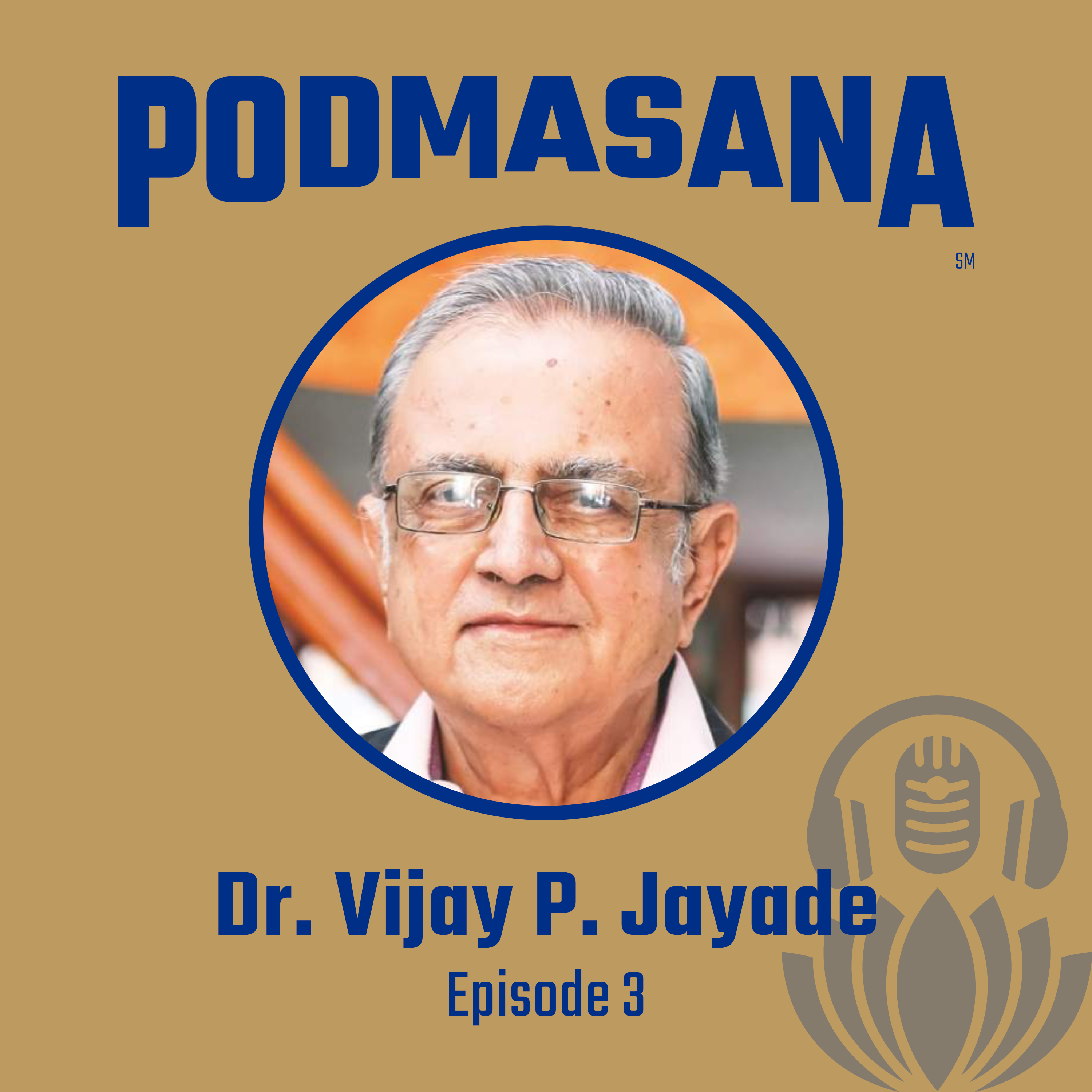
To take one of humanity's most profound spiritual texts and make it speak directly to the anxieties, depressions and desperate competitions of modern life? And what kind of person dedicates decades to this work, not as a religious scholar or philosopher, but as a working dentist who simply believes ancient wisdom shouldn't remain locked away from ordinary people? Today's guest, Dr. Vijay Jayadeh, embodies a beautiful paradox.
A man of science who found his deepest calling in spiritual teaching.
An orthodontist who spent his career straightening teeth while simultaneously working to straighten the path between the Bhagavad Gita's timeless wisdom and contemporary life's crooked challenges.
Born in 1941 in a village approximately 120 km from Hughli, Karnataka, Dr. Jayade grew up watching his father, himself a medical practitioner and dentist, devote himself not just to healing bodies, but to daily study of the Bhagavad Gita.
This wasn't casual reading.
His father had a special affection for Sanskrit, and this reference for the ancient language and sacred text planted seeds that would take decades to fully bloom.
Dr. Jayade followed his father into dentistry, completing his Bachelor of dental surgery in 1965 and his master's in orthodontics in 1967 from Government Dental College in Bombay. But establishing an orthodontic practice in 1968, Kubali was no simple matter. Awareness of dental treatment, especially orthodontics, was remarkably low. It took years of patience, persistence and continuous learning.
He traveled to the United States, United Kingdom, Japan and Singapore, constantly updating his knowledge and clinical skills. Yet throughout those challenging years of building his practice, the Gita remained in the background of his consciousness, a thread connecting him to his father's devotion. When his practice finally stabilized, he returned to what had been calling him the systematic study of the sacred text that had shaped his childhood home. His passion for teaching found expression when SDM Dental College opened in Darwad 1986 and he joined 1988.
For 17 years he taught future dentists, later serving as visiting faculty at Cibar Dental College in Gunthur. For another five years, he served the Indian orthodontic society in various capacities and and engaged in social service through the Rotary Club of Hubuli, helping to establish the area's first blood bank that collected only from voluntary donors. But it was his decades long engagement with the Bhagavad Gita that would become his most enduring contribution.
As he studied text after text, mostly in his mother tongue, Marathi, he made a troubling observation.
Even people of his own generation had inadequate knowledge of the Gita's contents.
Younger generations had virtually no idea what it taught.
Meanwhile, he watched those very generations struggle with what he calls serious problems.
The severe and often unhealthy competition of professional life driving people to desperation, reckless lifestyles, uncontrolled greed and immoral relationships, resulting in anxiety, depression, suicidal tendencies and insomnia rising at alarming rates.
The Gita, he realized, showed a path out of this labyrinth. But there was a problem.
Most available books were beyond the grasp of contemporary readers who lacked basic spiritual knowledge.
The words and concepts were incomprehensible.
The traditional approach, explaining the Gita verse by verse from the first chapter to the 18th, felt disjointed and difficult for novices to follow. So Dr. Jayade did something radical.
He reorganized the entire Gita by topic rather than chronological order, gathering verses from different chapters and placing them together with practical explanations.
He created chapters titled not just Karma Yoga and Bhakti Yoga, but Happiness and Sorrow, Mental Equanimity, and what qualities make one an ideal human being.
He has framed his adaptation as that of a common man for other commoners.
His reasoning is beautifully humble.
Just as children more readily accept guidance from siblings and friends and from authority figures, so too my ordinary people find spiritual wisdom more accessible when it comes from someone like themselves, rather than from lofty scholars.
Last year he published his interpretation in Marathi. Now, at over 80 years old, he's translating it into English, determined to reach even more people who are struggling.
The Bharati war in which Krishna counseled Arjuna, Dr. Jayade explains, is fundamentally a metaphor for our daily lives.
When we face multitudes of problems and feel helpless, just as Arjuna did, the Gita shows us our path of duty.
Here is a man who spent his professional life helping people smile with confidence while spending his inner life helping people face life's battles with wisdom.
A scientist who never saw contradiction between orthodontics and orthodox spirituality.
A teacher who understands that the greatest barrier to ancient wisdom isn't its age, but our failure to make it accessible.
On this episode of Padmasana, join us for a conversation about making the timeless relevant, the sacred accessible, and discovering how a 2000 year old dialogue on a battlefield might be exactly what we need to navigate the battlefields of modern existence.
Part 1 Early Life and Spiritual Foundation Dr. Jayadeh, welcome to Padmasana.
[00:07:18] Speaker A: Thank you, Mr. Brendan.
Well, I bring greetings to all the listeners from India, the land of Bhagavad Gita and I thank you Mr. Brendan and your wife Meenakshi, who happens to be my student, for asking me to join this podcast. And the topic that you have chosen is very close to my heart and that is Bhagavad Gita.
Before I answer your questions, as traditionally we do in India, before starting any spiritual discussion, I would like to read an invocation from one of the Upanishads. It goes as Asatoma Sadgamayu, meaning Om, the eternal principle. Please lead me from the falsehood to the truth, the unreality to the reality and the perishable to the eternal.
Tamasoma Jyotirgamaya Please lead me from the darkness of ignorance to the light of knowledge.
Mrtyoma Amritangamaya from the mortality of material attachments to the immortality of self realization. Om shantihi, shantihi shantihi Om, let there be peace, Peace and peace.
[00:08:36] Speaker B: To start off, as I understand, your father was both a medical practitioner and a devoted student of the Bhagavad Gita. Can you paint a picture for us of what that looked like in your childhood home and what did this, his daily practice with the Gita, teach you beyond the text itself?
[00:08:58] Speaker A: Well, talking about my childhood, ours was a middle class family consisting of my father, mother, me and my two younger siblings, a brother and a sister.
We were not rich, but we were quite comfortable.
Ours was a simple lifestyle.
Leave us had a telephone. We did not have even electric lights in our house till I reached the age of 10 or 11 years of age.
Until then we were reading and studying in the light of kerosene lamps. Our hometown, Hubballi, had a population of nearly 35,000, but it was quite a primitive town by today's standard. Only two or three families owned a motorcar. Others would commute by walking or using a bicycle or in a horse driven car.
I walked to my school Till I was 15 years old and then my father bought a bicycle for me. He himself commuted on a bicycle for many years now talking about him his lifestyle he had a disciplined lifestyle. He would practice yoga and Pranayama every day.
He had a penchant for writing.
He was trained in integrated medical science, which is a combination of Ayurveda, the Indian system and the Western medicine. He wrote nearly 10 books on medical treatment as well as dental treatment.
He wrote in all four languages, Marathi, Kannada, Hindi and English. He had no fixed timing for reading the Gita, but he always pondered over its meaning and referred to the book when necessary.
More importantly, he believed in following its meaning message, namely practicing the integrity of character, compassion and service to the society. I was greatly influenced by his thoughts and his lifestyle.
He had a special affinity for Sanskrit language, and I inherited the love. I was fortunate to have an excellent teacher in high school from whom I studied the Sanskrit language. It is God's grace that. That even today I have retained much of what I have learned to the extent that I that I am able to understand most of the Sanskrit writing.
[00:11:17] Speaker B: You had mentioned, Dr. Jayade, that your father had a special affection for Sanskrit. How did growing up around that reverence for the ancient language shape your own relationship with spiritual texts?
[00:11:32] Speaker A: And.
[00:11:32] Speaker B: And what's different about encountering the Gita in Sanskrit versus translation?
[00:11:40] Speaker A: That's a very relevant question. Whether it is mandatory to know Sanskrit language in order to study the Gita?
Well, it's not absolutely necessary. But if one knows the language, it makes the study that much more easier and meaningful.
Moreover, reading the literature in its original language always has a special merit.
One may read this translation of Shakespeare in one's own language, but to read the original Shakespeare literature is much more thrilling and satisfying. That applies to the study of Gita also.
So, to answer your question, yes, you can study Gita without knowing Sanskrit language, but if you know the language, then that is all the more helpful.
[00:12:27] Speaker B: You followed your father into dentistry and healthcare, completing your orthodontics training in the 60s.
During those intense years of education, and then establishing your practice in Humali, when orthodontic awareness was very low, what role did spirituality play in sustaining you through those challenges, Dr. Jayaday?
[00:12:51] Speaker A: Well, as you said, I completed my studies in the year seven, came back to my town, Hubballi, and started my practice in the year 1968.
Even though I was the only dental practitioner with a master's degree in our area, I still had to wait for quite some time before my practice picked up. The patients coming to our clinic would invariably say that they would prefer to be treated by my father and not by me. Naturally, it did hurt, but I overcame the feeling of disappointment from the teaching of the Gita to maintain equanimity under unfavorable circumstances. And those few months I devoted to reading the textbooks and revising my knowledge so that I could do the patients proper service and treatment.
[00:13:42] Speaker B: You also traveled internationally to the United States, the United Kingdom and Japan and Singapore to update your clinical skills.
As a young professional, being exposed to different cultures and approaches to dentistry, did that broaden your spiritual perspective as well? How did you see the relationship between healing the body and tending to the spirit.
[00:14:08] Speaker A: To be honest, that time I did not think so. I was more focused on the pursuit of orthodontic knowledge.
Cultural, religious, or spiritual exchange in my interaction with various people hardly took place during those visits. I did not think of healing the body and tending the spirit aspect then, but now that you mention it, I think it's a very valid approach.
It should be made a part of medical and allied sciences curriculum.
[00:14:39] Speaker B: Why do you think that?
[00:14:40] Speaker A: Well, there is a strong relationship between the body and the spirit.
And if the body has to heal, then the spirit also has to heal. And therefore there is a relationship between the two. So healing the body and tending to the spirit is a very, very valid proposition.
[00:15:00] Speaker B: So you write that you could not have much time to study the Gita during your education and early practice years, but return to it once you had stabilized professionally.
What called you back and what changed in you or in your life circumstances that made the timing just right?
[00:15:21] Speaker A: Well, to answer your question, at that stage I was doing quite well in my practice and had settled in family and social life.
However, occasionally I started feeling that something was missing which I could not pinpoint.
My practice was going well. I had a loving wife and two adorable children.
I enjoyed reading good books, listening to music, and watching cinema or theater.
So all in all, I was having a good life.
But I still felt that there was a vacuum somewhere in my life. I also slowly realized that I had several flaws in me, like ego, anger, greed, envy, and jealousy.
Further, I realized that I was oversensitive, would feel hurt at the slightest provocation, and kept on brooding for long.
That was when I realized that I needed spiritual guidance.
Thus, I went back to the study of the Gita.
After repeated readings and understanding the Gita contents, thus an earnest attempt to imbibe them, I started feeling a wholesome change in me.
I became less touchy. I would control my emotions, especially ego, anger, grief, jealousy, and greed. There was a feeling of peace and contentment.
Passing on this enlightenment to others like me was one of the reasons why I was motivated to write my book on my interpretation of the Gita.
[00:16:58] Speaker B: I really appreciate you sharing that, Dr. Jayday. I know I can relate to a lot of what you just said in terms of finding various levels of material success in life and still feeling like there's something else missing.
Have you seen that same experience play out in the lives of anyone else? You know, whether it's friends or colleagues?
[00:17:20] Speaker A: Yeah. Yeah. I have seen people who are quite comfortable, quite rich, doing well, but still not very happy.
And seeking happiness in several things, but then running in circles and ultimately realizing that is quite futile.
[00:17:40] Speaker B: Hello listener Brendan here.
If you're enjoying the show and would like to Support it, visit podmasana.comsupport to learn about all the great ways that you can contribute.
You can become a Podmasana plus member at three different tiers with a variety of perks and also make monthly and one time donations to help support the show.
Any support is greatly appreciated.
Again, that page is podmasana.com support thank you for listening and thank you for your support.
Part 2 Writing for the Common Person Dr. Jayada, you made the striking observation that even people of your generation don't have adequate knowledge of the Gita, and younger generations hardly have any idea about what the Gita preaches. As someone who taught dentistry for over 20 years, how did your experience as an educator inform your approach to teaching.
[00:18:48] Speaker A: The to answer that question, as a teacher, I felt that the students learn better when the topic is presented as related to their personal experience rather than a talk in abstract terms. Therefore, I selected some topics for my book like happiness versus Sorrow and mental equanimity. To make the book relevant to the present day readers, we have to be on the same page as the reader. Then naturally we have to talk in terms which are related to them, to their life, to their day to day problems and practices. And that's what I realized as a teacher.
[00:19:33] Speaker B: Your book has a provocative subtitle as Understood by a Common man for Other Commoners In a tradition where scriptural commentary is often written by either renowned scholars or swamis, what gave you the confidence or perhaps the necessity to offer your interpretation? As a quote unquote commenter, I read.
[00:19:58] Speaker A: The commentaries on the Gita written by great swamis and scholars. I felt that they are addressed to such readers as having some basic knowledge of spirituality and are familiar with the terms used in spiritual writings. Today's young readers lack these two aspects and therefore I felt a need to present the Gita in such a form as they would understand.
Even though I know fully well that I stand nowhere in comparison to the great scholars, I still took the courage to present the Gita as understood by a common man.
So far as the study of scriptures is concerned, I still consider myself a very, very basic level student and I am just at about the same level as any common man and therefore what I feel and what I say and what I speak may be more appreciated by the common man rather than the words coming from very highly educated and studied swamis and scholars. That was the Reason I thought of writing this book of my interpretation of the Gita.
[00:21:07] Speaker B: You took a radical approach, Dr. Jayade. Instead of explaining the Gita verse by verse from chapter one to 18, you reorganized it entirely by topic, gathering related verses from different chapters.
Walk us through that decision, if you don't mind. And what did you see that traditional commentaries were missing?
[00:21:31] Speaker A: I'll tell you my experience.
When I started studying Gita seriously, I felt that there is no continuous discussion of various topics.
The discussion is scattered over many chapters. For instance, the discussion on Karma Yoga starts in the second chapter of Gita, continues in the third, fourth and fifth chapters and concludes in the 18th chapter.
But along with Karma Yoga, other topics are also covered in these chapters.
Now for a new reader, this becomes quite confusing and it becomes difficult for him to grasp the content.
This has happened because the Gita is a dialogue between Shri Krishna and Arjuna. Arjuna asks Shri Krishna questions and Shri Krishna replies. But often one feels that the link breaks.
Occasionally a repetition also is felt.
This difficulty was expressed by another eminent scholar, Mr. Anna Sahib Khair. Also, according to his research, the Gita was written by three different authors in three different periods of time.
In other words, two different authors added at different periods to what the first author had written depending on the necessities of the period in which they lived. And this addition, most of the places has merged well. But in some places there is a disjoint and that's why a new reader finds it difficult to decipher what the message is.
Therefore, for making it easier for the uninitiated reader to understand the Gita, I compiled the verses from different chapters related to particular topics along with their meaning and explained the theme running in these verses also. It is not something unprecedented that I did.
Such an attempt was made earlier. Also a very eminent philosopher and author, Professor R.D. ranade, also known as Gurudev Ranade, a very highly respected saint and philosopher, he did it in one of his books. He rearranged the Gita under 12 chapters, theme wise.
So this is something which is not exactly unique. At least one more person has done it earlier and that is to facilitate the understanding of the message of Gita.
[00:24:07] Speaker B: It seems like you drew a lot of inspiration from from that thematic adaptation or interpretation of the Gita. Could you maybe speak to a little bit about what inspired you about that and led to you doing your own work?
[00:24:22] Speaker A: I actually came across this book little later after I had already started compiling various Shlokas verses from different chapters and putting them together.
And when I was doing that Then I happened to come across this book. So I was quite pleased to see that it was not something very, very wrong that I was doing. There was a precedent and a very highly reputed scholar had done it earlier.
So that gave me courage that what I was doing was not wrong. And I proceeded further and completed my book.
[00:25:04] Speaker B: Some of your chapter titles are traditional such as Karma Yoga, Bhakti Yoga. But others seem to be strikingly contemporary. For example, happiness and Sorrow, Mental Equanimity, and what makes one an ideal human being.
How did you decide which topics a modern reader most needed to understand?
Dr. Jay Ade.
[00:25:32] Speaker A: So let me briefly explain what Karma Yoga is. You should do your actions, your karma in the best possible manner.
Do not avoid your duty, do it, but at the same time don't hanker after its fruit.
Whether you get the fruit or you don't get the fruit.
Again, that verse that I quoted earlier.
Whether you win or you lose, whether you gain or you lose, be maintain your equanimity under both these situations.
So that is Karma Yoga. Do your karma, but do not expect its fruit and do it to the best of your your ability.
Do not avoid doing your duty.
Do not shun away, do not run away from your duty. You must do your duty, but at the same time do it in a dispassionate manner. When you do that, then you have peace all, all the time. Whether you gain or you lose, whether you are victorious or you are a loser, you still are peaceful.
So that is Karma Yoga. And Karma Yoga is, that is in a nutshell, but it could be discussed over long time. It's a. It's quite an interesting but at the same time quite complicated topic. But briefly, this is what Karma Yoga is.
Bhakti Yoga is devotion.
Again devotion.
Devotion to whatever you feel like worshipping. It might be a book, it might be an idol, it might be the synagogue, it might be a mosque, it might be a temple, whatever. Or it might be worshiping the unseen, unseen spirit or the unseen personality of God, what is known as Nirguna, without any characteristics, without any form.
So in that form also you could meditate upon and worship it.
But this worship again should be without any expectation.
Gita has mentioned four types of people who are Bhaktas, who are worshippers.
They are Arth, Jydnyasu, Artharti and Jnani. Artha is one who has some hurt in him. It might be a physical hurt, it might be mental hurt. And he needs some support from God. So he is the art Bhakta.
Other one is Jinnasu, one who wants to know what God is is the second type of devotee.
Third one is Artharti, the selfish one.
He worships God because he expects something from him. He is Artharti.
Now these three are on one side. But God says the best one is Jnani, one who is. Who is interested only in knowing, having the knowledge, knowing the Dhyana of God, just for the sake of his love for God and not expecting anything from God.
So Sri Krishna says he is the best of the devotees.
So that is, in short, what Bhakti Yoga is.
Let's think about the present day generation.
It's common knowledge that the present day generation is much better off economically.
It leads a comparatively more comfortable life than the earlier generations.
But can we say that this generation is happier than the previous generations? The answer is a big no.
This generation has its own share of serious problems. The severe and often unhealthy competition that they face in their professional life is driving them to desperation.
Also their lifestyle, which is quite reckless and mixed with uncontrolled greed, unhealthy food and drinks, immoral relationships and gambling. All these are resulting in physical health issues and also serious psychological disorders.
Cases of anxiety, depression, suicidal tendency and insomnia are arising at an alarming rate.
The Gita shows the path to come out of this labyrinth and also guides those who do not wish to fall into it.
Therefore, I thought of writing the two chapters, one on happiness and sorrow and the other one on how to attain mental balance.
Because a picture of an ideal person would be a role model for others to emulate, I included the chapter on the characteristics of ideal persons as enumerated in the Gita.
[00:30:47] Speaker B: It seems we're kind of dancing around to a certain degree as you have this ancient spiritual text that has a lot to offer with navigating modern challenges. What would you say the Gita has to say about navigating greed or anxiety?
[00:31:06] Speaker A: Gita addresses all these defects in human nature.
Be it greed, be it jealousy, be it anger, any of these things. How to control them.
The Gita offers answers to all these.
His advice is to be away from all these dualities like joy and sorrow. Be granimous when you are happy or when you are sad.
Don't get elevated to the zenith of frenzy when you are happy, because if you do that, then when there is a disappointment, you will fall in the depth of despair. So maintain equanimity.
Also other things like lust and anger.
They both are two sides of the same coin, so keep them under control. The more you keep them under control the less you are disturbed when you face the challenges in the life this way. Gita has the advice for any types of problems that we may face because of our nature.
[00:32:21] Speaker B: You compare people's relationship to spiritual knowledge to how children respond better to peers and than to authority figures, and that's a fascinating insight. I found that to be very interesting. Can you expand on why you think accessibility and relatability matter so much in spiritual teaching?
[00:32:42] Speaker A: I feel that most of us are quite ignorant of spiritual matters.
Unless the spiritual information is provided in a form that is easy to understand for a commoner and is presented such that it relates to his her day to day matters, people will lose interest very quickly.
Therefore it should be made simple, easily understood and related to the day to day problems. As you pointed out, most of us are at the level of children so far as spiritual matters are concerned.
Therefore these should be made available in an understandable form.
I felt that a commoner like me, knowing our capacity, can relate much more easily to other common people.
They will feel more comfortable when one amongst them is talking at their level. With that intention, I ventured into writing this book.
[00:33:38] Speaker B: Hello listener Brendan here.
Do you or someone you know have an article or book to share, a work to highlight or story to tell that would be a good fit for Padmasana?
If so, feel free to reach out via
[email protected] that's ideasodmasana.com and we'll be sure to get back to you.
Thank you.
Part 3 Ancient Wisdom for Modern Crises Dr. Jade, you write with real urgency about modern problems.
Severe competition driving people to desperation, anxiety and depression rising at alarming rates, reckless lifestyles that you alluded to, perhaps suicidal tendencies.
As both a healthcare professional and a spiritual student, how do you understand the connection between these contemporary mental health crises and spiritual disconnection?
[00:34:50] Speaker A: If we look at the modern lifestyle, everyone wants to be successful, everyone wants to overtake others, everyone wants to have a luxurious life.
And for doing that they don't mind adopting means which are not necessarily always fair and ultimately then it hurts your own conscious, your own conscience. And that then causes all these problems, the anxiety, depression and other mental disorders.
So if we try to learn from Gita, Gita asks you to have mental balance and not to be overjoyed or to be excessively unhappy when things go wrong.
Sukhalukhe same happiness and sorrow or grief, take them with equanimity.
So also love is gain and Allah is loss. When you gain or you lose again, take them in the same spirit.
Do not be excessively happy when you gain something or feel excessively sad when the things do not happen.
So if you are able to maintain this equanimity, then most of the problems will be reduced considerably.
The excess greed.
And that greed is because one wants to live a very successful life.
One wants to enjoy his relationship with the opposite sex. And doing it excessively, it drains your.
Drains you physically as well as mentally.
So avoid these things.
Gita says that these three things, lust, anger and greed, they are the paths leading to hell.
In other words, they are not good for you, so try to curb them.
So this way. There are many things in Gita which tell you how to live your life in a peaceful manner.
When you are in sorrow, do not feel dejected.
When you are happy, do not feel excessively elated.
Such references are there at multiple places and they keep on hammering on you that you have to maintain a mental balance.
And if you do that, then many of these problems will be reduced and you will have a peaceful life.
[00:37:54] Speaker B: You say the Gita shows the path to come out of this labyrinth. For someone listening right now who is struggling with anxiety, depression, or feeling overwhelmed by competition in their professional life or challenges in their personal life, what is the Gita's essential message for them? Dr. Jayade, where would you tell them to start?
[00:38:20] Speaker A: One has to start with himself.
There is one Shloka in Gita which I find very inspiring.
Udharet atmanaatmanam na tmanam avasadet.
Udharet means you have to uplift yourself.
Don't wait for others to come and uplift you.
Do not degrade yourself.
Atma eva atmana bandhuhu atma evaripuhu atmanah.
You yourself can be your best friend or you yourself can be your worst enemy.
So you have to choose which one you want to be, whether you want to be your own friend or your own enemy.
So it has to start right from you, right from your inner self.
Ask that self and whatever the self says, then try to follow it.
Self ultimately, they say, is a part of God. God's God lives in everyone's heart as the self.
So if you listen to yourself, then you will have answers to many of your questions.
And then of course, if you read the spiritual scripts like Gita and try to understand and follow them, then it will certainly help you.
[00:39:55] Speaker B: You had described the Bharati war as a metaphor for our daily lives, with Arjuna's helpless us mirroring our own. When facing multitudes of problems, can you Take us deeper into that metaphor Dr. Jayadeh. What does it mean to find our path of duty or dharma in contemporary life?
[00:40:19] Speaker A: Arjuna had a very serious situation to meet.
He was facing his own Kitankin and he had to fight not only with his own brothers Kavaravas but also with his grandfather Bhishma whom he loved with all his heart.
He had to fight with his Guru Dronacharya whom he loved and worshipped.
So whether to fight with those people and whether it was right on his part to kill them, that was his dilemma.
In our life we rarely come across such serious situations.
But then we have often these dilemmas.
Should I do it this way or that way?
If I do it this way will that be right or the other way? It will be right.
And then I see someone who is not doing the right thing but then he is prospering.
He is going very fast in his life and acquiring wealth and having a grand mansion and I don't have them.
So then I start feeling bad about me and then my dilemma is whether I should follow his path or I should continue my path.
Now such are the dilemmas which we face in our life.
So that is where Gita comes to your help.
Gita has discussed three types of persons.
The Satwik person, the Rajas person and the Tamas person.
Satvika is the noble person and he is the one who initially may not be as prosperous as another Rajas person but in the long run he will have the mental peace.
Rajas person is the one who is very active and always running and doing this and that and what not. And he gains lot of wealth and enjoys. But then later on he starts feeling disappointed. He doesn't know where to end and because he doesn't have the inner peace he ultimately feels disappointed and dejected.
And the third one is the Tamas personality which is the outright mad personality which everybody should try to avoid.
So this is how Gita helps you to face your dilemmas. What sort of person you want to become? You want to become a Satvik person, a Rajas person or a Tamas person.
The best thing is avoid the Tamas vices, reduce the Rajas nature that you have and try to become a Satvik person. If you do that then for the time being you may not be as successful or prosperous as your neighbor. But then in the long run you will have the mental peace and you will be much more happy.
[00:43:31] Speaker B: Dr. J, you're now in your 80s translating your Marathi book into English to reach even more people.
What is it about this particular moment in history that makes you feel this work is urgent.
What do you see happening in the world today that the Gita specifically addresses?
[00:43:51] Speaker A: If we compare our 21st century with the 20th or 19th centuries, then we have advanced a lot, economically, scientifically, technically.
But there is no peace.
There are wars everywhere. There are fights going on, killings going on, threats of atomic warfare and what not.
Now, if this has to change, and if a common man like you and me, we have to live happily, then the things have to change.
So that is where Gita comes into play.
Gita's advice, if it is followed by everyone, then we will have lot more peace, lot more happiness.
That is why the study of Gita is necessary. The message of Gita has to go to as many people as possible.
And that is my intention in translating my book into English so that you can read a much larger section of people.
[00:45:06] Speaker B: Yes. It seems like if there's going to be peace throughout the world, it first needs to come from within.
Would you agree?
[00:45:16] Speaker A: Yes, absolutely.
[00:45:17] Speaker B: Looking back at your journey, Dr. Jayade, from watching your father read the Gita each day, to becoming an orthodontist and teacher, to spending decades studying and now sharing this wisdom, what has the Gita given you personally and how has it shaped not just your understanding, but your actual experience of living?
[00:45:44] Speaker A: As I mentioned earlier, I have been able to face the flaws in my nature, in my character, with greater courage and to control them as much as possible.
That makes me feel at peace. With me.
The teaching of Gita has made me not to compare myself with others, not to complain about what I don't have, not to feel angry at the slightest of the excuses, to be more forgiving, to be more patient, to be kind, to be generous, to be. To be noble as much as I can.
And that is what Gita has taught me.
Gita. Without Gita, I don't think I would have been able to change my nature. And maybe I would have ended up in the category that I mentioned earlier.
People with lot of anxiety, depression and insomnia. Gita has saved me from all those problems. I am eternally thankful to the teachings of Lord Sri Krishna.
[00:47:07] Speaker B: I wish you all the best with the adaptation and I look forward to that English adaptation eventually being published and wish you all the success.
Dr. Jede, thank you very much for being on Padmasana.
[00:47:22] Speaker A: My pleasure to thank you for giving me this platform and reaching a bigger number of audience. I earnestly hope and pray that this will kindle at least a little bit of interest in them so that they will pursue the study of spiritual knowledge, either from Gita or whatever other source they want to follow. The spiritual aspect is important, and unless one develops that, one will not have a proper peace of mind and one will not be able to lead a satisfied and happy life. I thank you for giving me this opportunity.
[00:48:04] Speaker B: If you enjoyed this episode, please share it with people you think would also enjoy it.
You can also leave a review or rating on your preferred podcast listening platform and be sure to follow the show to subscribe to future episodes.
You can also email
[email protected] or reach out to us on the socials we're on Bluesky, Mastodon, Instagram threads, and YouTube.
Catch you next time on Padmasana.