[00:00:00] Brendon Orr: Foreign.
[00:00:14] Brendon Orr: This is Podmasana, and I am Brendan Orr.
What if the Secret to Navigating Modern Chaos, Political Division, Personal Loss, and Professional Burnout was written nearly 2000 years ago by a Roman emperor sitting in a military tent on the Danube frontier.
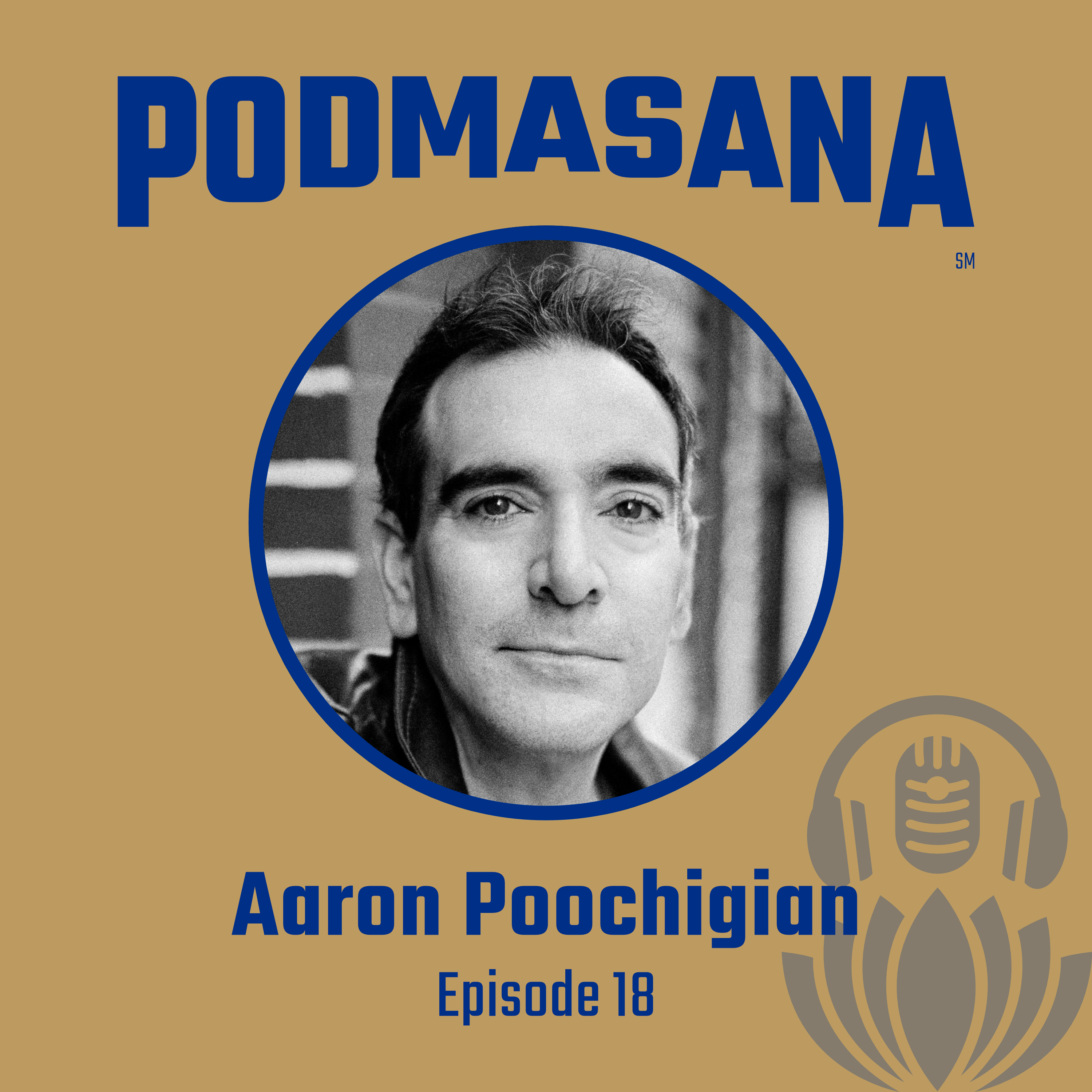
Today we're exploring that possibility with Aaron Pichigian, a poet, classic scholar, and translator who has breathed new life into one of history's most influential works, Marcus Aurelius Meditations.
Aaron holds a PhD in classics from the University of Minnesota and an MFA in poetry from Columbia University, a rare combination that positions him uniquely to bridge the ancient and modern worlds.
His original poetry collection, American divine, won the 2018 Richard Wilbur Award, and his most recent book, Four Walks in Central park, is an immersive poetic tour.
His work has appeared in Best American Poetry, the Paris Review, and Poetry Magazine.
But Aaron is perhaps best known for his translations.
As a recipient of a NEA grant in translation, he's published with Penguin Classics and W.W. norton, including the popular Sappho stun With Love and Baudelaire's the Flowers of Evil.
His translation of Euripides Tragedy Bacchi received national acclaim at the Getty Via Bam and the Guthrie Theater.
Yet his latest translation, Marcus Aurelius Meditations, maybe his most timely.
Marcus Aurelius wasn't just a Stoic philosopher who happened to be emperor.
He was a literary stylist whose private notebook reveals multiple the stern instructor commanding himself to do better, the earnest aspirant struggling with doubt, and occasionally the skeptical objector questioning everything.
Aaron's translation honors all these voices, bringing Marcus candor, energy, and surprising vulnerability to modern readers.
Written primarily between 170 and 180 AD during the brutal Marcomannic wars, while Germanic tribes threatened Rome's borders and plague ravaged the empire, Meditations was never meant for publication.
These were Marcus private reminders to himself how to stay virtuous when surrounded by corruption, how to serve others when exhausted, how to face mortality with equanimity, how to maintain inner mastery when the world collapses around you.
Sound familiar?
Aaron translated Meditations with three honor its wisdom, speak to today's readers, and bring back the original's creativity and personality.
Too often, he argues, translations are faithful to the text but don't bring the author's personality to the present day.
The result is something different, a literary translation that captures what Aaron calls the incantatory power of poetry, while making ancient Stoic philosophy feel immediately relevant.
But Aaron's interest goes deeper than linguistic accuracy.
He's written extensively on literature as therapy, mindfulness, and healing.
His articles have appeared in publications like New youw and Authority magazine, and his chapter on fairy tales and psychotherapy is forthcoming in 2026.
His piece on therapeutic regression through literature appeared in the American Psychoanalyst.
He sees literature as a positive force that reduces stress and promotes empathy, precisely what Marcus was practicing when he wrote to himself about acceptance, duty, cosmic perspective, and death.
On this episode of Podmasana, we explore what lost in Translation really means when it comes to ancient texts, how Marcus Aurelius views on kindness, lost freedom, justice, and dignity apply today, why the philosopher emperor wrote in multiple voices to himself what Stoic practice looked like during war and plague, and how an emperor facing mortality 1,800 years ago can teach us something about living fully right now.
Whether you're familiar with Stoicism or hearing about Marcus Aurelius for the first time, this conversation offers ancient wisdom for modern living, brought to life by a translator who believes that philosophy, poetry, and mindfulness are inseparable practices for becoming more fully human.
Hey listener, Brendan here. If you have been enjoying the show, would you mind pressing pause and leaving a rating or review on your podcast listening platform?
That's okay, I'll hang around.
Go ahead and hit pause.
Still there.
Come on, hit pause and leave a review. Alright. Just kidding.
Leaving a review is a quick and meaningful way that you can help the show reach others.
You can also email any feedback to the
[email protected] thanks for listening and leaving a rating or a review. Now on to Podmasana Part one, Bringing Ancient Voices to Life.
Aaron, thank you for joining Podmasana.
[00:06:58] Aaron Poochigian: Thank you very much for having me. Brendan, I've listened to a number of other Podmasana podcasts and I'm impressed that this one is is more substantive than many of the others.
[00:07:10] Brendon Orr: Yes, yes. Well, we'll aim to produce another one of those together. How does that sound?
[00:07:15] Aaron Poochigian: Sounds good.
[00:07:16] Brendon Orr: So, Aaron, you hold both a PhD in classics and an MFA, and poetry, which seems like it's a unique or rare combination.
How does being a poet change the way you approach translating ancient texts? Like Meditations?
What do you see that a pure classicist might miss? And what does classical training give you that a pure poet might overlook?
[00:07:46] Aaron Poochigian: Yes, up until the Meditations, I had only ever translated poetry. This is my first attempt to do a prose translation, and when I approached it, I approached it as a poet. As a poet, I'm interested in something called charge or excitement in the language, in the poem. You want to sustain that excitement in every sentence, every word, as much as you can. And so when I sat down and realized, oh, I'm really going to do this. I'm going to translate the Meditations, I looked toward what would sustain charge in the translation, and I determined that what it was in the Meditations is voice, which I think we may talk about a little bit later. The distinct voices in Meditation, other translations had flattened those voices into a single tone, but they are basically three distinct characters, these voices in the Meditations. And I realized those are what would sustain charge in the work. And yes, I hope. I mean, it's not for me to decide whether or not I was successful, but I hope I have.
And then also, then as a classicist looking at it and trying to make this literary translation of the Meditations, I became very. I guess as. As a scholar, I'm more sensitive to the nuances of words which fed into this character interpretation. If someone did not have a background in classics, if someone didn't have great facility with reading the ancient Greek in which Marcus Aurelius wrote, then you'd get a kind of crib, a one for one translation from the dictionary without the capt, the nuances of the various words. And, yeah, I'll give you some examples later of instances in which my classical training help me with those character voices. That is, sometimes Marcus uses lower registered diction. He uses slang for semen and feces, for example, and other translations, because they have this misconception of what the classical is, that it's cold and formal and distant. They do not translate those words with English slang, but I felt it's important, and it also helps in terms of establishing the intimate space that is the Meditations. Marcus talking to himself. Though he's the. The emperor of Rome and the most powerful person in the world, he has no reason to be formal when talking to himself.
And that was helpful. Those slang terms, more helpful. Engaging the register of the voice.
[00:10:26] Brendon Orr: Yeah, that's interesting stuff, Aaron. Thank you. And you mentioned translations, and you've written that translations are often faithful to the text, but don't bring the author's personality to the present day.
What gets lost when we prioritize literal accuracy over capturing voice and spirit? Can you give us a specific example from Meditations where choosing vivid modern language revealed something about Marcus that previous translations may be obscured?
[00:10:59] Aaron Poochigian: Yes, I can give an example, and I think it's representative of other things I did in the work.
At one point, Marcus is trying to get himself to focus on the present moment and to scorn death. And he also wants to establish that outside of the present Moment, that is our lives. We never inhabit the past and we never inhabit the future. They go on infinitely in either direction. So he's trying to force himself to focus on the present moment. Right. And so he says, what? Yesterday was a glob of ejaculate. That's birth right. Tomorrow will be a mummy or cremains. In my translation, the ancient Greek word for ashes or human remains after cremation is tefra. All other translators went for ashes, which is. Which I saw as too general. And emotionally, like we say, ashes to ashes, dust to dust. Right. It's basically a cliche. And so I used a word I picked up from watching CSI crime shows, cremains. And those are specifically human. Right. And he makes the point, yes, we're either going to be a desiccated corpse, only our remains preserved, or we're just going to be bones and ash, bones and cremains.
And so that's. I would like to think that's a very modern word. Right. Which gets at what Marcus was saying more precisely and I hope with more emotional resonance.
[00:12:31] Brendon Orr: Thanks. And you've said you're especially concerned with bringing the incantatory power of poetry to a wider audience.
What is incantatory power? And why does it matter when translating philosophical texts? And how does rhythm sound and repetition in Marcus's Greek contribute to the work's meditative quality?
[00:12:57] Aaron Poochigian: Aaron, when I first sat down to do the work, I was. I looked into. I was emerging from a dark time in my life, and I was looking at forms of meditation that would be useful to me.
I have kind of a hyperactive mind. And so say transcendental meditation, where you try to focus, I mean, get your mind to focus on nothing. That wasn't for me. That wasn't really a possibility for me. Right. And so I turned to the Meditations. I hadn't read it since graduate school, and when I first read it, I was all in on being a passionate poet. And I, through my miscarry, it was a misconception, a youthful ignorance about what Marcus was up to. I dismissed it. But now that I'm older and I've been. Been through hell and back, right, I have a much greater appreciation for the Meditations. It might be a book more for older people than younger people, but we will see. And so when I was reading the Greek aloud to myself, trying to reenact, if you will, Marcus's Meditations, I saw the, the, the rhythms of the clauses as enhancing the meditative effect of the work in the same way as, say, repeating mantras for example. Right. Gives you a sound to focus on. And in terms of repetition, the technical term for it in poetry and prose is anaphora, where you repeat a word at the beginning of sentences or phrases over and over again. Right. And so Marcus used the Meditations as an aid memoir. He wrote these entries to look back at them and remind himself of what he was thinking. There are lots of lists, and so the lists use that anaphora, and anaphora is a major structural device used in poetry. In free verse poetry, for example, there's Alan Ginsberg's famous poem America. And every sentence starts with an address to America. Right.
America I do this, or America I'm not going to do this. Right. And the anaphora, it goes back in sometimes to certainly Sanskrit scripture and in some instances to the Bible.
And so I saw that anaphora, that poetic effect, as being yet another sound effect that encouraged a meditative state. When you're repeating things, you don't have to be worrying about coming up with new phrases. Right. Or a new structural principle. Principles. And you can, yes, kind of relax and let yourself go out into the rhythm of the words as they hit you.
[00:15:42] Brendon Orr: Yeah. Very interesting stuff, Aaron. Thank you.
And your translation highlights that Marcus writes in multiple voices, and you mentioned that earlier, the commanding instructor, the earnest, infallible aspirant, and the skeptical objector.
This is a literary choice that most readers of Meditations may not recognize.
How did you identify these voices? And why is understanding this polyphony essential to understanding Marcus as both philosopher and person?
[00:16:18] Aaron Poochigian: The Meditations is far from being a philosophical treatise that progresses in a linear way. Right. Normally, say you're reading Wittgenstein, right? You start with fundamental principles, and he works through various arguments toward one conclusion. Right. A Meditations doesn't work that way. We don't know for certain if we. The text we have is the order of the entries in the original manuscript, but I am confident they are in that if an editor had rearranged Meditations, he would have grouped related material together. But it truly, the. The information in the entries truly does come basically at random.
One of the reasons the Meditations is exceptional is as. As you mentioned, those three voices, you can tell them apart.
The instructor is like a drill sergeant. And the important thing is that he addresses himself. Marcus is addressing himself through this instructor figure. Right. And that he uses a you to address himself. Second person singular. Right. But that you is a miracle. And it's the reason why Meditations is so popular today. A reader can't help but Take that. You originally addressed to Marcus himself as referring to himself or herself, the reader's self, Right. And so that you welcomes the reader in and takes that reader on a journey of self discovery. Most of the entries, yes, in the voice of the bossy instructor figure, but that might become relentless. So fortunately, there are a number of entries in which Marcus the Aspirant speaks. The word for aspirant in a Stoic context in ancient Greek, I love this is pro copton. Pro means forward, and copton means to cut. And so the metaphor is that the aspirant is like in a jungle with a machete, cutting, cutting his way forward. Marcus reveals the most about himself as the aspirate. He talks, as you mentioned, about his vulnerabilities, that he's susceptible to anger and indignation, and he's trying to cure himself of those things. Because Meditations is not a linear philosophical treatise, Right.
There is a fair amount of inconsistency in the Meditations, but that is to be expected.
Right. He is working towards the goal of becoming a perfected Stoic. I don't know if he ever got there. Right. There are hints in his death scene that he may have. Right. But we. Yeah, he doesn't work linearly. And that voice then gives us the vulnerability, but also inconsistency, Right. He says he should love. I can give the reasons for this. He should love all of his fellow humans, Right. And embrace them and be tolerant of them. The instructor says that. But then the aspirant reveals that he's kind of cranky. He can be nasty about other types of people. He can reduce them to stereotypes. And I see that. I like that in that it humanizes Marcus in the Meditations.
Right. And then finally, there's the very charming Objector voice. His purpose is to be the instructor's patsy. He whines and contests and despairs. Right. He always says the wrong thing. And that's another humanizing element in the meditations, in that I see that voice as my own when the instructor is telling me to get up and do my duty as a human being in the morning. That happens in about five entries, right? The whiny objector says, but it's so warm here in bed, I don't want to get up. Right? And then the instructor can go off explaining why the objector is so wrong. And so with this. Yeah, polyphony, these series of voices. And there are other voices from quoted authors and hypothetical characters, right. With this polyphony, then we get what I call a psychodrama. It's a school of psychology that was founded in the 1920s in Europe. I can't remember exactly where there is a school of psychodrama. And in psychodrama, patients act out their roles and the roles of other people in their conflicts. And they also, this is the important thing, act out aspects of their psychic state. Right. And so I came to see. And this builds on the. The voices, right? These are the voices of characters, and they are interacting in a drama so that the Meditations is dynamic, right, in that way, with these characters playing off of each other. Whereas, as I said, previous translations, as I see it, tend to dissolve these very distinct voices with different registers and different tones, tend to dissolve them into one faux classical voice.
[00:21:31] Brendon Orr: Yeah, very interesting stuff, Aaron. And so you've translated love poetry by Sappho, the dark beauty of Baudelaire's the Flowers of Evil, the Greek tragedy, and now Stoic philosophy. What through line connects these seemingly disparate works? Is there something about translation itself, the act of channeling another consciousness across time that perhaps draws you?
[00:22:00] Aaron Poochigian: I. I could say I'm addicted to translation. I could. I could say that I'm trying, and I'm trying to recover from that addiction. I'm a poet in my own right, and I want to focus from now on. I think Meditations was my last translation. I want to focus exclusively on my own work. And that goes back to when I first started translating. I always. Since I was 18, I knew I was going to be a poet and focus on that. And I went to grad school just to learn Ancient Greek and Latin better. Well, I got all that and a heck of a lot more, and eventually got a PhD. But when I first approached translation, I saw them as craft exercises in which the words and their meanings are more or less given. You can certainly debate about them, but the issue then becomes the form into which you're going to put this poetry or even this prose, for example. And so they allowed me to focus on ways of bringing the poetic power of the original over into English. And what I learned from my translations of poetry also applies to Meditations, in that I was. I'm always interested in sustaining literary charge. Right. And excitement. My fear is that, I mean, I read this is. This is what I assume, that the reader is always waiting for the slightest excuse to close the book and never look at it again. Right? And you have to not give the reader that chance. Right? You got to sustain the magic. You got to work some magic in order to make what I call a literary translation. I Certainly my father was a philosophy, philosophy professor. And I.
I'm up on Stoic philosophy. I've written on it in the past. Right. But in Meditations, Marcus is often recapitulating earlier Stoic theory, using earlier Stoic terminology. And I certainly got that balance. But I would say even over half of the interest of the work to me. Right. Was the literary aspects, the metaphors and imagery that Marcus uses, other rhetorical voices like anaphora. Right. And all that went to the end of the goal of all my translations. That is to make literature again. I don't get to decide whether I was successful or not. Right. But literature sustains that excitement, Right. Whereas previous translations that are cold and dispassionate. Right. They misrepresent, as I see it, the original. Right. And they give the reader way too many opportunities to close the book and not read any further in that translation.
[00:24:42] Brendon Orr: As we've been talking about your translation, Aaron, in the back of my mind I've been wondering whether or not you have taken the book to any poetry slams or whatever you might refer to them or call them. Have you?
[00:24:56] Aaron Poochigian: I have not yet. I love reading sections of it and I think it would do well, especially the sections with the repetition, with the anaphora. It would sound like poetry. And to be honest, I was completely surprised. But a previous interviewer said that I had translated the poetry. Sorry, that I translated the Meditations as poetry.
And I don't see that. But there are elements. I don't think of the medit my Meditations translation as poetry at all. But I can see how that questioner came to that conclusion, that given the amount of poetic devices that Marcus himself uses, and as I said, the incantatory power of those repeated introductions to sentences.
[00:25:43] Brendon Orr: Hello, listener. Brendan here.
If you're enjoying the show and would like to Support it, visit podmasana.comsupport to learn about all the great ways that you can contribute.
You can become a Podmasana plus member at three different tiers with a variety of perks, and also make monthly and one time donations to help support the show.
Any support is greatly appreciated.
Again, that page is podmasana.com support.
Thank you for listening and thank you for your support.
Part 2 the Philosopher Emperor in War and Meditation Marcus composed most of Meditations during the Marcomannic wars from about 170 to 180 AD sitting in military tents along the Danube frontier while Germanic tribes throw threatened Rome and plague ravaged the empire.
How does knowing this context change how we read passages about acceptance, duty and Mortality.
What does it mean that philosophy's most famous meditation on inner peace was written during chaos and war?
[00:27:13] Aaron Poochigian: Stoic, as I see it. Yes. The knowing that historical context only makes what Marcus is arguing for in the Stoicism. Right. That is not allowing any distraction from one's internal state, which is constantly assessing what's coming into one. And you have to accept all of that. Marcus is very much anti distraction. He calls everything that doesn't have to do with virtue and just actions and distraction. His term for them is to call them matters of indifference, matters we don't care about one way or another. And certainly he had had a lot of work to do when he was in Rome serving as emperor. But as the emperor on the frontier, there are all the more distractions going on outside of him. Right. More and more daily work that he cannot ignore. Right. But mostly this context makes me think about death in the Meditations, which is a major concept. Before I talk about death, I'll just mention a few situations in which the war creeps in to the Meditations, right. He begins one entry by saying, imagine hacked off human body parts lying in front of you, for example. Right. And at another point he says that life is like serving in a foreign war, as he himself was doing as he'd advance outside of the boundaries of the Roman Empire. And all of that then focuses, at least in the Meditations from Marcus, on scorning death. It was all around him and it became cliche. One can, we learned In World War II, one can become inured to death, right. To horrible violence. Right. And keep doing.
Yes. What one is supposed to do. Death works in meditations in a couple of different ways. Marcus will use it to put pressure on himself for the purpose of urgency, to say, here you are in your life. There's a very finite amount of time left. Right. And it's basically just a dot. Right. Given the infinite past and infinite future. Future. Right. And so he uses that urgently for himself to say, now's the time to start being a perfected Stoic. Now's the time to do just actions before you die. Do it while you still can, he says in a couple of different entries. And then also, Marcus trains himself at the same time. Death is used for urgency. Marcus also trains himself to scorn death.
[00:29:57] Brendon Orr: Death.
[00:29:57] Aaron Poochigian: And this is one of the ways in which Marcus is way very much ahead of me in terms of enlightenment. I'm terrified of death. But he brings it up again and again and he says, it's nothing to be afraid of, right? He says, think about all the changes and transitions that have been in your life. You were born, you were an infant, you learned to walk, you became an adolescent, you became an adult, then you go on to became an old man, and then you die. And he says death is just like any of those previous transformations in your life and is nothing to be afraid of. And that fits in with his theory of the objects of indifference. He says even one's own body is an object of indifference. He says, yeah, if people are there hacking your flesh, burning your flesh, reducing it to infection and pus and, yeah, burnt flesh. Right. Your mind should still remain serene even as that is happening, because your mind knows that body is an object of indifference. It is natural for it. Right. To break down. It's going to do it one way or another, with violence or not.
[00:31:13] Brendon Orr: Yeah. And as you were describing all that, there's a connection to Eastern philosophies or approaches to seeing the body as not the self. Right. But this is obviously an example based in war. But it's all interesting to see the synergy here across traditions. Yeah.
So Marcus never intended these writings for publication. Right. They're essentially his personal journal, reminders to himself about how to stay virtuous, serve others and face death with calm.
How does reading someone's private spiritual practice feel different from reading a treatise written for an audience?
What vulnerabilities does Marcus reveal that he might have edited out if he'd known the world would be reading?
[00:32:02] Aaron Poochigian: We have another autobiographical work from an emperor, the first emperor of Rome, Augustus. It's called in Latin the Res Gestae divi augusti, the accomplished deeds of the deified emperor Augustus. And that is. It's autobiographical and Augustus wrote it. But it is a piece of propaganda for the empire. It's completely whitewashed. Augustus never did anything wrong. Right. It's all blamed on other people. And that's an example of imperial autobiography that's meant for an audience. Right. The scholarly consensus, and I agree with it, is that the Meditations was absolutely not written for an audience. Marcus reveals weaknesses in himself. He reveals he has a susceptibility to anger and indignation. Right. And he also in one entry said he calls himself. Well, no other way to put it. He calls himself dumb, like slow to process new information and put it into his life. Right. He calls himself slow witted, if you will. And if Meditations had been intended for publication as a work attributed to the emperor Marcus Aurelius. Right. All of that material would have been cut out. Right. Any weaknesses and vulnerabilities would have been cut out.
Translating a work like that, which is a person writing to and from for himself. Yes. Was very new to me.
One of the ways I handled it. Yes. Was portraying it, as I said earlier, as drama.
Often as I was going through Marcus's exercises, and they were my own translation exercises, I felt like I was Marcus's therapist, like I was his shrink, because he's revealing all of these intimate details about himself and his failings and his aspirations, all in this work. Yeah. I felt. I mean, I myself have a therapist who uses methods somewhat similar to Marcus's. I felt like I was Marcus's shrink. That was the kind of intimacy we had. Right. It wasn't that of family. Sometimes it was like that of friends. But the overriding metaphor I think of for translating the meditations was translator as therapist, Listening. Listening to what Marcus had to say and coming to conclusions about it. Yes.
[00:34:36] Brendon Orr: Yeah. And so thinking of how revered Marcus is as a historical leader in the sense that he was not broadcasting his internal world or his thoughts, you contrast that with. It seems like the modern leadership style where leaders can't help but broadcast whatever it is that they're trying to say. Do you have any thoughts on this apparent contrast, Aaron?
[00:35:03] Aaron Poochigian: Yes. I mean, that feeds in Marcus, I am confident, pushed himself to live by his Stoic philosophy. Right. He is all in on it. He is a religious zealot.
But even in his. So even. Well, there are two portrayals of Marcus that we find in film and scholarship and other writing about Marcus Aurelius. He ends up, I'll give the example of the film Gladiator that came out in 2001. He's a character there in the beginning, and he is the beatific, the saintly philosopher king, infallible and perfectly virtuous. Right. The other portrayal that also dates back to antiquity and shows up, showed up in a biography of Marcus I recently read, is that he is a prig, Right. That he's a callous killjoy. His Stoic philosophy made him unfeeling towards others, and he was not fun to be around.
Right. And Marcus in one entry even says, even a virtuous person on his deathbed will have people gathered around him, waiting, eager for him to die, so that they can get some kind of inheritance, some windfall out of the person's death. And so he seems to be aware that he comes off as callous to others.
I tried in my translation, to give a human being that came in the middle. Right. Nobody's perfectly virtuous, and Marcus certainly shows in the Meditations that he is not callous and unfeeling. Right. He pushes himself again and again. Yes. Not just to love his fellow humans, it's in fact built into his philosophy, a requirement not just to tolerate, but to care sincerely for his fellow human beings. And so I tried to give that human Marcus, in the middle between perfect virtue and grumpy, callous curmudgeon.
[00:37:05] Brendon Orr: Thanks, Aaron.
And so Meditations isn't a systematic philosophical treatise as we've referred to earlier. It's 488 entries of varying length, often repeating the same themes and exhortations.
You note that this repetition reflects Stoic practice, habituation like physical training.
How should modern readers approach this structure? Should we read it straight through? Or more like a book of daily meditations we return to?
[00:37:40] Aaron Poochigian: You could use either method. Assume like students, for example, when this textbook is assigned in class, right. They'll read it from beginning to end. Right. But in terms of. And this is what most readers are interested in when they buy a copy of Meditations, they're interested in self improvement. Self help is the top seller in all bookstore sections. Right.
And for that, then I would suggest just choosing random passages. I know some of my friends who are devoutly Christian will look at the Bible that way. They'll just choose some random passage each day and focus on it. And so Meditations being broken down into those mostly for the most part, short, 488 entries, right. That makes the Meditations very digestible for the reader. Right. And in terms of a daily meditation practice, right. Focusing on one or two sections chosen at random would certainly work very well for a personal practice, meditation practice. And because these entries are for the most part arbitrarily arranged, I think that, that that method is as good as any other.
I do want to make a point. I guess since we're here, most readers do turn to the Meditations for self help, for internal work in themselves. And one of the things I tried to emphasize in my translation, I'd like to think one of the things that makes it different is that I emphasized that, that inner work for Marcus, most readers go there and stop there. That inner work, the purpose, all of it is for just action, right? And so that's preparatory to doing good deeds in the world that help one's fellow humans. And so I wanted to point out that, yes, the self help work which most readers go for. Right. Is at least in the Meditations, it's preparatory to virtuous action, that you have an obligation to do that as well.
[00:39:47] Brendon Orr: Yeah. And so Aaron Marcus reportedly died in 180 A.D. by refusing food and drink, thus maybe embodying his Stoic acceptance of mortality.
Yet throughout Meditations, he commands himself to leave life contentedly and accept death as natural.
How do we reconcile this philosophical acceptance with the very human struggle against fear and attachment that runs through the text?
[00:40:22] Aaron Poochigian: In the first final entry of Meditations, which very fittingly has to do with death, Marcus advises himself to leave life contentedly because what brought him into existence and what runs the universe is itself content.
And there he is talking about the fundamental Stoic concept of nature, Nature with a capital N. Right. Nature can do no wrong. It is a perfect system. What it does, it creates fruit. He uses the metaphor of fruit bears fruit, both for the individual parts that make up this gestalt whole. And what's the important thing? Why nature is content is that this fruit also serves the purposes of nature itself. And so in that final entry, he's saying he should die contentedly, as contentedly as nature. And if that final section is, in fact, you know, Marcus's last statement on death, he seems to have got there in that he accepted that his death was coming. He didn't fight against it. In fact, one historical source says, as you mentioned, that he stopped taking liquids and food and hastened his own demise. And so I would argue, yes, there's evidence that he achieved that enlightenment, that contentedness, which made him embrace his death. And there are other reasons behind that. Marcus, and this is very Stoic, Marcus says that we have to accept everything that happens to us in our lives. And beyond that, beyond acceptance, we have to be grateful for it, grateful even for our death, because nature has given it, given it to us.
Marcus did, if he denied himself food and liquids, in a sense, commit suicide. And it's kind of a difficult topic to talk about. But Stoics advised suicide in certain situations, right? Marcus talks about overcoming obstacles, and they're just opportunities to innovate, right? And so you come up, you use some other virtue that allows you to turn that obstacle into a benefit. But he also says if you're completely blockaded, everything around you is an obstacle, and you can't make any headway in terms of virtuous action. He does say, then you should kill yourself, right? Well, he says when you kill yourself, you shouldn't be indignant, and you should still be grateful. And he says if you kill yourself that way, you can. You've at least one thing in life. Suicide's also important in Stoic philosophy. Marcus thinks of the universe as deterministic, right. That nature started the universe long ago and everything else is falling in terms of causes and effects, like dominoes down through time, Right. And so in a deterministic universe, the question is, is there any room for free will, right, in that universe where everything is caused by. And the Stoics say, yes, right, we all have to die, right? But in certain situations, we can decide how and when we die, right? That is up to us. That is free in us. And so death and suicide in that last section all come together in that Marcus seems to have achieved that enlightenment and been grateful for everything and accepted by fully his own death.
[00:43:56] Brendon Orr: Yeah, fascinating stuff, Aaron. Thank you. And Marcus emphasizes repeatedly that humans are rational animals designed to serve each other within a universal ethical commonwealth. This term called koinonia. This is radically different from individualistic self improvement. How does this stoic vision of universal human duty connect to what we might today call mindfulness, compassion, practice, or even political engagement?
[00:44:29] Aaron Poochigian: Marcus sees the various existences in the universe. I'll be more specific in a second. As organized hierarchically, right at the bottom are material things that don't have a soul, like rocks. But then we move on to plants. And he says that plants have a soul, right? They're higher than, say, rocks that don't have a soul. Above the plants in the hierarchy, we get animals, such as horses, for example, who have a soul and in addition feel drawn to herd together to be around similar members of the same species, right? And then finally we move on. Well, this other, higher post human in the hierarchy, gods and other things, but humans are above the animals and they, in addition to having a soul, they have a portion of divine intelligence called the logos, right? And so we are logicazoia. We are rational animals. We're higher than the animals in that we have this logos inside of us in this hierarchy. Marcus says lower things are created to serve the higher things, right? And so we can talk about oats, for example, that serve horses, and then humans can eat that as oatmeal, right? But the difference is that whereas lower species and existences are meant to serve higher ones, we humans are unique in that we are designed to serve each other, right? Not to serve necessarily. We can do that. What's higher in the hierarchy? But we have an obligation to serve each other.
And there are two concepts related to that. You mentioned koinonia, which I translate as the human commonwealth. Marcus, as a Stoic, believes there is a republic literal, and it's literal republic, to which every human being belongs. That's the koinonia a state to which we all belong. And then we each have a membership in our specific state, the one we actually, actually belong to. And he talks about us, and other Stoics do as well, such as Seneca and Epictetus, talk about us as having dual citizenship in the Koinonia, and for me, in the United States of America. And are the just deeds we do serve both our state and. And that Koinonia. And they come together. Good. And so that brings us back around to, say, mindfulness and compassion practice. Marcus sees us as having an obligation to be mindful and even in terms of meditating, right? And again, the purpose of that, though, is serving just action, helping other people whom we ought to help here as our fellow rational animals. And compassion practice. I like that phrase. That fits really well with what Marcus does for himself, right? And that he regularly fails. He reveals he's indignant and pissed off and doesn't respect certain groups of people. But again and again, he brings himself around, right, and tells himself at a minimum, to tolerate your fellow humans, but at a maximum, to help them get what they want, even if, you know, it's meaningless, like somebody wants a fancy sports car. That's an object of indifference, right? But nonetheless, we humans are designed to serve each other. And so the practice in compassion practice is particularly important.
It's not just empathizing with one's fellow humans, which we're required to do. It's helping our fellow humans, which we are also required to do. And I would see that as separate from mindfulness and compassion practice. But political engagement fits in to certainly the Koinonia, the commonwealth to which we all belong, and then in terms of service to our home state. And Marcus sees that as the best thing we can do, right? That is engaging with the political practice. And Marcus, as an emperor, sometimes does talk about himself as an emperor. He tends to keep his status as the most powerful person on the DL, right? On the down low.
But it does emerge now and again. And he says you. He's talking to himself. This is the instructor, right? Were intended, were built to preside over fellow humans as a ram presides over a herd of sheep, the male leader of the flock. And so all humans are designed to help fellow humans. Some of them do it in political actions, and emperors get to do it right? At the highest level. Their just political actions can help hundreds of thousands of people all over the world.
[00:49:35] Brendon Orr: Hello, listener. Brendan here.
Do you or someone you know have an article or book to share, a work to highlight or story to tell that would be a good fit for Padmasana.
If so, feel free to reach out via
[email protected] that's ideasodmasana.com and we'll be sure to get back to you.
Thank you.
Part three Stoicism Therapy and Timeless Practice Aaron, you've written extensively on literature and mindfulness for publications like New youw and Authority magazine. And you have some upcoming work on fairy tales and psychotherapy.
You argue that literature reduces stress and promotes empathy.
How did Marcus Aurelius use writing meditations as a therapeutic practice? And what can his approach teach us about journaling, self talk, or what many now call cognitive reframing?
[00:50:52] Aaron Poochigian: Cognitive reframing hits at the very heart of the meditations. Most therapists in America today use what is called cognitive behavioral therapy, abbreviated as cbt, and that involves making internal adjustments to our assumptions, right? But stoicism takes this to a radical degree, right? It says, this is what I love about stoicism. Our happiness depends entirely on ourselves, right? Whether or not we get a job, for example, or whether or not someone is mean to us or says bad things about us. That is all entirely irrelevant in terms of our happiness. A number of ancient Greek philosophies also have their happiness as their goal, and they are called eudaimonistic philosophies, from the ancient Greek word eudaimonia, which means happiness, literally means, well, demigod, that the little God in us, we are heeding it and attending it to it perfectly. Right? And so in terms of the things that actually affected me and changed my life, I would like to think for the better, right. This radical acceptance of our happiness, depending on ourselves, on our judgments, has really helped me. I mean, I'd been in therapy for two years, worked with cognitive behavioral therapy, and made some headway. But I think I made much more radical and swift progress in my own case. Right. By accepting this principle. Right. My happiness is upped to me.
Yes. In one market. Yeah. In one entry, Marcus says, today I have cast out all of my distress. Right? I've gotten. I've gotten rid of all of my distress. It wasn't out there in the world, but it was down there in my assumptions. Also, in terms of just general meditation practice, I would argue Stoics frequently would set up a session each day to reflect and advance themselves in their meditation process.
The philosopher Seneca, for example, had an evening practice, a retrospective on the day, thinking about and reassessing everything that happened to him during the day. I am confident, based on six entries in the meditations, that Marcus had a morning practice again and again. He says, as soon as you wake up, say this to yourself, right? And it happened six times. And he doesn't talk about a nighttime reflection. And so I think he had a morning practice. And in one entry he actually walks us through his meditation practice. He says, you can do it anywhere, even if there are people around you shouting and screaming, you can retreat inwardly. And the word he uses can mean literally in ancient Greek, vacation. It's the word anachoresis that shows up in an old word in English, anchorite, a word for a hermit, right, who withdraws from the world. But we can withdraw into ourselves, he says, anytime or anywhere we want, Right? And so, yes, I mean, that is, I guess, would be his advice. Advice for those who come to the meditations for meditation advice. He certainly gives that as well.
[00:54:22] Brendon Orr: Thanks, Aaron.
And Marcus offers concrete daily practices, the morning preparation for difficult people. Focusing only on what's in your control, contemplating mortality, rational self examination.
Which of these stoic exercises do you find most applicable or most challenging for modern practitioners? Have any of Marcus's practices become part of your own routine?
[00:54:51] Aaron Poochigian: One of them has. I'll lay out two of them and then the other one I have been trying to practice one of them. The second one I'll mention, I've been trying to practice myself and I've found it helpful. One of them is what I call the stripping method, right? You look at some object out in the world, right, that people prize, that people think is important, say, I don't know, a bar of gold, for example, that we want to have, right? And he says, you look at it and you strip it down into what makes it up, right? And then also how long it will last. And you're supposed to come to the conclusion that it won't last long. Nothing lasts long. Marcus talks about time as if it's fast forward. And so you take, for example, a beautiful statue you might want to have in your apartment, and you see that it's made of mere marble that he calls elsewhere a callus on the earth, right? He talks about the imperial purple gown of the emperor as made up of mere wool sheep shearings. He reduces it to that. And then this expensive purple dye. Purple was the most prized color for clothing in the Roman world because it was the most expensive. It had to be imported from what's now Libya, right? You had to get it from actually Murex mussel shells in the sea. You extract the dye. So it had to be. It's hard to process, hard to extract and then it had to be imported, so it's the most precious among Romans. And he says, no, my imperial robe is just sheep shearings and rock snail blood. Right. Reduced to that. He says, the same with food, for example, right. He's not eating beef, he's eating cow corpse, as he puts it. And that trains him then this exercise, training trains him then to scorn objects of indifference, things that are out there in the world that aren't important, like just action. The second exercise I have found useful, and I'm trying to put in practice in my daily life, is the Test of Instant Divulgence. In two sections, he says, your mind should be so composed that if someone asked you, what what are you thinking right now? Right. What you would be focused on is completing a just action. You wouldn't be distracted by anything. You wouldn't have thoughts in your mind that this person is annoying and I don't want to talk to this person anything like that. Right. And so it keeps you honest.
And that has been really good for me when I will, for example, go into a nasty mood, hopefully for a short time. Right. I think about this test of instant divulgence and I think, what if other people could see your mind right now? Wouldn't that be humiliating? Right. Wouldn't that look ugly to them? And I've gotten, yes, some fruit out of that practice. It has allowed me, yes. To escape from that nasty mood.
[00:58:05] Brendon Orr: Great, great. Thanks, Aaron. And you've mentioned that Marcus's views on the virtues of kindness, freedom and justice, acknowledgment, dignity, couldn't be more timely.
We're living through our own period of division, uncertainty, plague, aftermath, if you want to refer to the COVID pandemic that way, and a sense of exhaustion that seems prevalent in society.
What does Marcus offer that modern self help or wellness culture doesn't? What makes Stoic philosophy different from, or perhaps complement to meditation therapy or other contemplative practices?
[00:58:46] Aaron Poochigian: Yes. Here again I would emphasize that Stoicism is a eudaimonistic philosophy. Right. That it points toward happiness and that's the goal of therapy as well. I would say Marcus is not. The meditations is not different in type from these practices, but it's different in emphasis. Right. It takes meditations, takes cognitive behavioral therapy and takes it to a radical or extreme degree. And I respect that because he's taking an argument to its logical conclusion. Right. And so I would say, for example, the meditations is not so different from cb from cbt. Right. But it's in at Least for me, it was more effective than cbt. And that I got to see this psychological theory I was not sure I accepted. Right. Taken to its philosophical and its logical conclusion. Right. And then also, yeah, the major way in that Meditations is different from other self help books. Right. Through which one could work. The difference is passion. Marcus is fervidly devoted to Stoicism. And so I would say there's no line between philosophy and religion in the Meditations. They overlap here perfectly. Marcus time and again sounds like a fire and brimstone preacher, both when he's propounding something positive and when he's laying into sorts of people that he doesn't like. Right. And so I. It was the passion of his entries that helped me more than CBT had, I would say. Right. And so yes, certainly the passion on the one hand makes it different from.
And how personal it is to Marcus makes it different from other self help books. And then also the philosophical rigor of the work and that he'll take something that struck me as wishy washy in. In cbt and he makes it a philosophical principle that makes perfect sense to me. Right. We are all obliged to work on ourselves internally. And the reason we do that internal work is not just because we're working towards our own happiness, but because we are obliged to help our fellow humans. And it's interesting, that's the message that has mostly been ignored in our highly individualistic society and also our highly lonely society. Right. I've read a lot about a loneliness epidemic in the press. And so, yes, those are the two ways I would say Meditations distinguishes itself as a self help book.
[01:01:30] Brendon Orr: Thanks, Aaron. Marcus describes the Hegemonicon, this idea of ruling power, the rational faculty that governs our judgments and actions, as an impregnable mental fortress that we referred to earlier when properly trained in an age of information overload, social media, constant distraction.
How do we cultivate this inner fortress?
Is what Marcus called ruling power, similar to what we might call awareness, mindfulness, or even presence.
[01:02:05] Aaron Poochigian: It is related to those. The Hegemonicon is the portion of divine rationality of the Logos that each human has inside of him and her and we are to talk. He uses different metaphors. One is that of cultivation, almost like it's farmland. Right. And you're cultivating this Hegemonicon so that it bears fruit in your life. Other metaphors he used you mentioned, one of those is an impregnable mental fortress. And that's one of the ways in which the World War seeps Over into the Meditations before book three. In the Meditations, Marcus says that what that book was written at Carnuntum, which is the Roman capital.
Oh, yes, the capital of a Roman province that is on the Austrian border. Right. And that's where he was waging war. And so he was inside of a fortress and talking about his mind as an impregnable fortress.
And I would say, retreating into that mind, he talks about. The inward vacation. Right. Is even more relevant today than it was in Marcus's day because there are so many more distractions in our lives right now. Right. I think, for example, of my cell phone. I'm like a slave to it every time it dings, I have to go and look at, yeah, whatever, some random email I've been sent as an advertisement. Right. And so one of the reasons I would argue Meditations is so popular with readers today is that it gives you an out from all of the distractions. Marcus even says, and he no doubt had his notebook there in front of him. He calls books by other authors distractions. He wants to be free of any dependence on anything. The metaphor he uses when he says, yes, stop, don't have any other. Anybody else's books around you. The metaphor he uses is that of alcoholism.
The word for it in ancient Greek is dipsa, which can mean thirst, strong thirst, but also can mean alcoholism. And he says, cut off your dependence on these external things, even books. Right. And I would say that applies also then to all the information we can look up on Google right. At any given moment, right. To say, no, none of that is allowed here. We're going to focus entirely on improving ourselves so that we can be better people.
[01:04:48] Brendon Orr: And last question, Aaron.
Marcus Aurelius is often held up as the ideal of a philosopher king, someone with immense power who, who nevertheless remained humble, self critical and dedicated to virtue.
He faced plague, war, betrayal, personal loss, and the overwhelming burden of running an empire, yet continued his daily practice of writing to himself about goodness, acceptance and service.
If Marcus were alive today and translating his own work for this moment, what do you think he'd want modern readers, especially those in positions of power or influence, to understand? Most urgently,
[01:05:36] Aaron Poochigian: he talks about himself as emperor and his obligations in a few sections. And that's getting back to here, that portrayal of Marcus as the beatific philosopher king. And in several sections, as far as I can tell, he has actually achieved that role. He deserves that title. He says again and again in the Meditations, right. That a leader needs to have respect for the freedoms of his subjects. Right. Preserving those freedoms is one of the reasons. Yeah.
Is what a leader should do. And this is remarkable. And there were a number of horrible emperors that Marcus mentions, the worst of them being Nero, right?
Who reigned a good 150 years before Marcus Aurelius. Marcus uses him as an example of a person who is addicted to the passions, addicted to sensory. Sensory pleasure. And so Marcus, yes, in his role as philosopher king, says some very surprising things. He admires as his heroes Romans who lived before Rome was an empire, before it was, when it was a republic, right? And so he admires, for example, the Brutus, who famously was one of the assassins of Julius Caesar, right? And so he, being an emperor and having absolute power and being the most powerful person in the universe, right?
Told himself. And he invents a new verb. He says, don't become cesarified.
Don't become addicted to luxuries, for example, right. But rather stay focused on what's important. Marcus abhors all forms of bling, right? Of. Yeah. Of useless flashy stuff. He hates it in his prose style, he hates it in his attire, and he hates it out there in the world. And so, yes, I would say Marcus Aurelius did achieve that. His ideal, right? He became a hero as a Roman. And all the evidence suggests, first that he didn't want to be an emperor, right? He was reluctant and even upset when he was drafted basically into the ranks of dynastic succession, right? There was Emperor Hadrian, and Hadrian made Antoninus Pius, the next emperor, adopt Marcus as his son and heir, right? Marcus didn't want to be an emperor, he wanted to be a philosopher. And he talks about this in a number of entries. But Stoicism in general holds that this is true. One is obliged to be scrupulously dutiful in one's career, right? You should find the art you want to practice and spend your whole time doing it. And so though he wanted to be a philosopher, he set aside, I think, some time in the morning to work on that. And from that comes the meditations, right? But in every other respect, he was the perfect emperor. He was scrupulously dutiful. He presided over law courts in Rome, for example. And when war started, he went. He didn't send some other general out there to campaign for him, but he accepted waging war as his duty as an emperor. And so I'm hesitant, as I mentioned earlier, to see any human being as perfect and flawless, right? Humans just don't come that way, right? But Marcus, more than any other emperor about whom I have read or whom I have studied, right came closest to achieving that ideal. And so I admire him greatly. I don't know if I were emperor or right, if I, yes, would have been as virtuous as he proved to be.
[01:09:32] Brendon Orr: Well, thank you, Aaron, for helping us understand the man, the mind and the spirit of who was Marcus Aurelius and putting this book out there. And thank you very much for being on Padmasana.
[01:09:48] Aaron Poochigian: My pleasure. It was a pleasure talking to you, Brendan.
[01:09:51] Brendon Orr: If you enjoyed this episode, please share it with people you think would also enjoy it.
You can also leave a review or rating on your preferred podcast listening platform and be sure to follow the show to subscribe to future episodes.
You can also email
[email protected] or reach out to us on the socials.
We're on Bluesky, Mastodon, Instagram and YouTube.
Catch you next time on Padmasana.