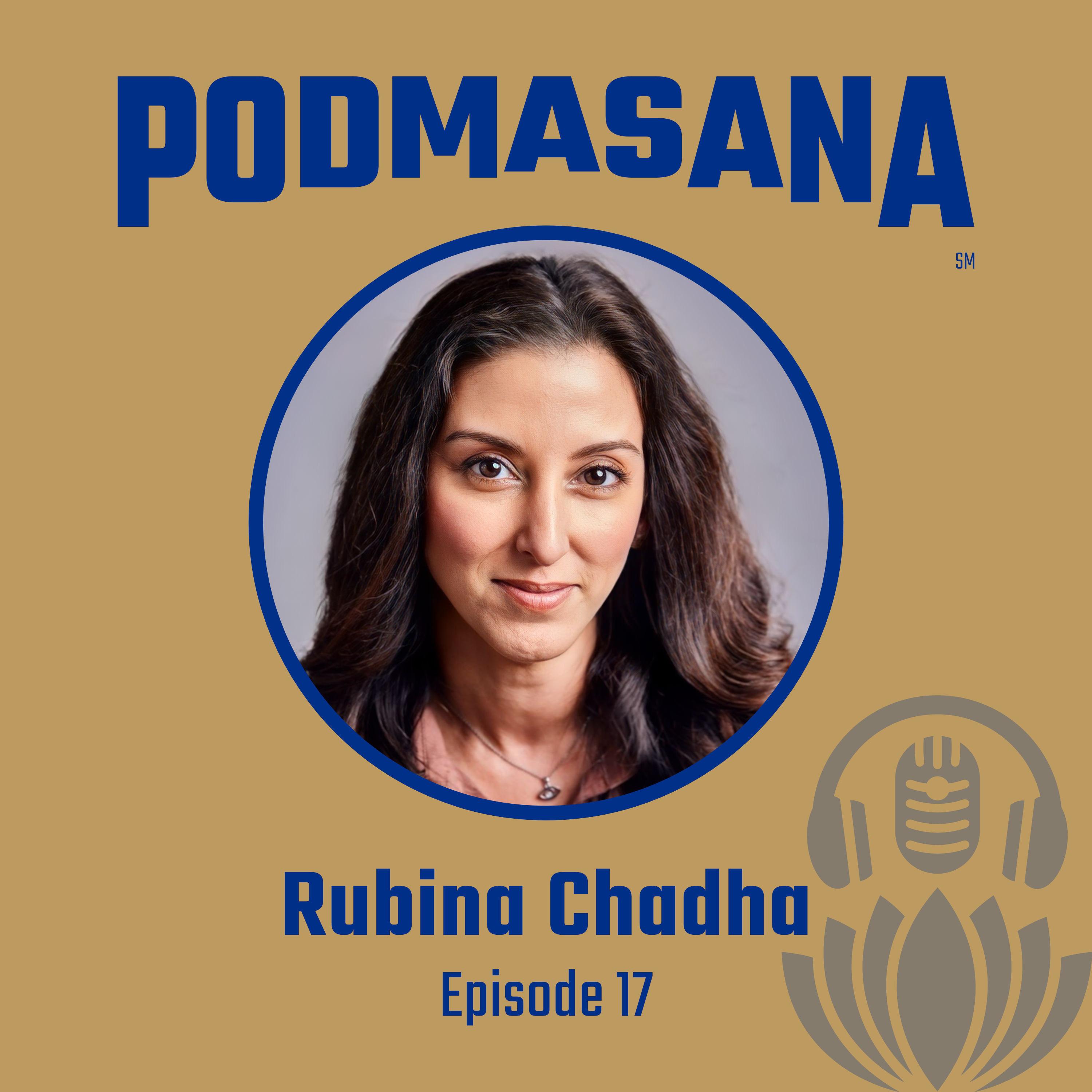
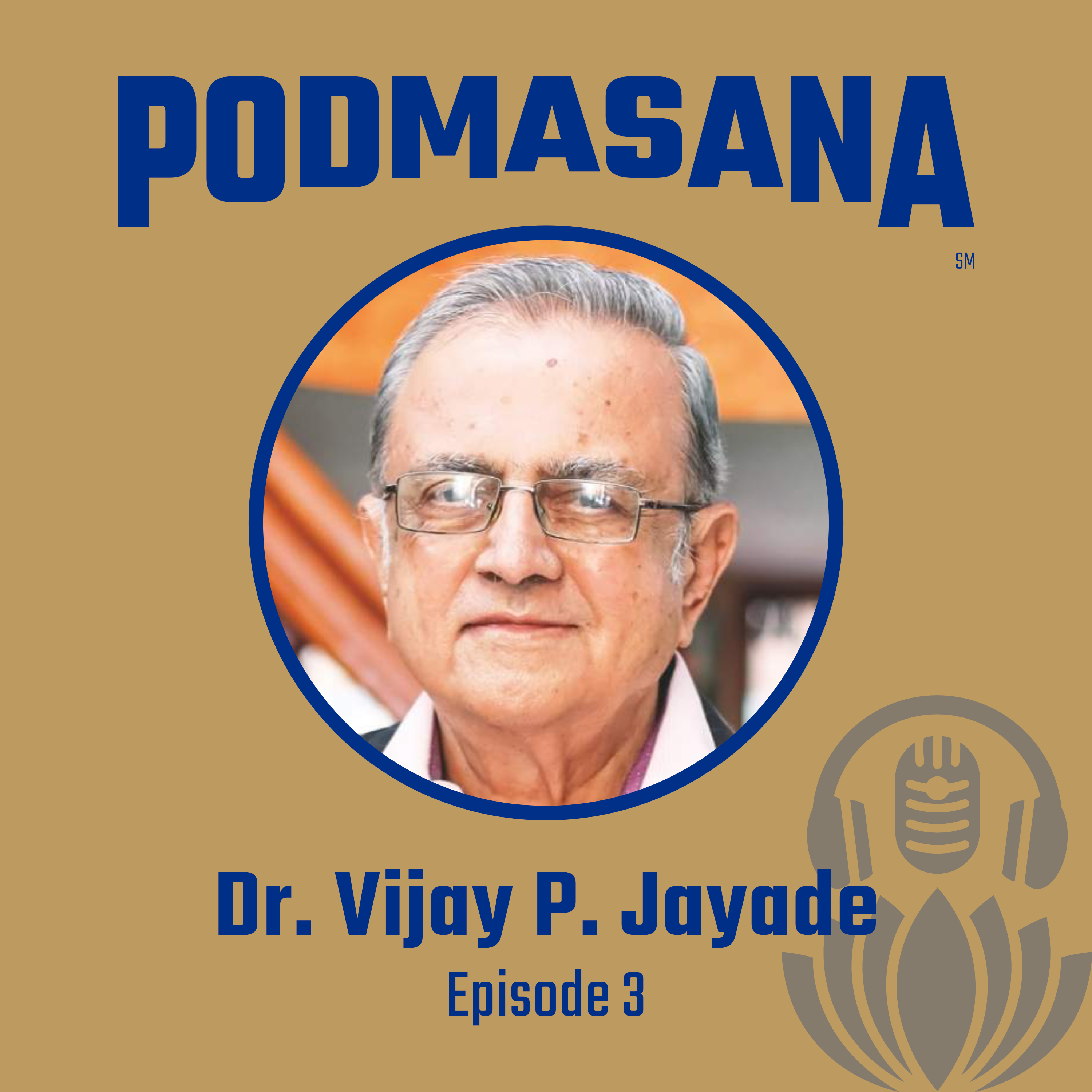
[00:00:14] Brendon Orr: This is Podmasana and I am Brendon Orr.
What if burnout isn't about doing too much, but about disconnecting from the signals your nervous system has been sending all along?
What if clarity doesn't come from thinking your way out of stress, but from learning to listen to what your body already knows?
Today we're exploring these questions with Rubina Chadha, founder of Inner Design, a body based mindfulness and creativity method rooted in lived spiritual practice, nervous system awareness and artistic training.
She's an internationally recognized mindfulness educator, trauma informed professional, creativity mentor and motivational speaker who helps leaders, creatives and organizations move from burnout into clarity, emotional regulation and aligned leadership.
Rubina was born and raised in Southern California to Indian immigrant parents, growing up in a household where meditation, mantra and silence were simply part of everyday life.
Spirituality wasn't introduced to her as belief or philosophy.
It was embodied, shaping how her family breathed, responded to stress, and related to uncertainty.
At 8 years old, during a group meditation, she experienced a moment of deep stillness that altered her relationship to time and identity.
She didn't have language for the experience, but it became an internal reference point she would return to throughout her life.
As a teenager, she discovered photography through her father's 35 millimeter camera and it became her first conscious meditation practice.
Photography trained her to pause, to witness, to respond rather than react.
Unlike many art forms, you cannot capture what you are not actually seeing.
This relationship between attention, perception and timing became fundamental to her understanding of creativity as an internal state rather than an external talent.
She went on to study fine art at the Art Center College of Design and later worked in high pressure creative and corporate environments, systems that rewarded output, speed and perfection while quietly disconnecting people from their bodies and internal signals.
Over time, she experienced burnout not as collapse, but as incoherence.
On paper, everything looked successful.
Internally, her nervous system was overextended and depleted.
That period became a turning point.
Inner Design emerged from that rebuilding.
It's not a philosophy she created intellectually.
It's a method shaped through lived experience, teaching, parenting, and years of working with students, educators, leaders and creatives.
At its core, Interdesign teaches people how to observe their internal state, regulate it through breath and somatic awareness, and then use structured creative processes to restore clarity and agency.
What makes Rubina's work revolutionary is is a simple but often overlooked premise.
Most people try to think their way out of stress, but stress is not primarily a cognitive issue.
It's a nervous system state.
Inner Design helps people become literate in their own internal signals, shortened breath reflects urgency Held breath signals suppression Irregular breath accompanies overwhelm.
When people learn to read these patterns, they gain immediate feedback without judgment.
In addition to educational and executive spaces, Interdesign has moved beyond private sessions and corporate boardrooms and is now recognized on national platforms and stages.
Rubina has been featured in the global DOCU series Women in Power, recognized as a CREA Award winning Executive Contributor at Brains Magazine and honored by the International association of Top Professionals and CIO Women Leaders.
She's also an award winning AI artist recognized by American Photography Awards for Innovation in Creative Expression on this episode of Padmasana, we explore how breath becomes the fastest way to influence the nervous system, why creativity is a cognitive and perceptual function, not just artistic output, how motherhood stripped away everything performative from her practice, and what it means to redesign your life without abandoning responsibility or ambition.
We discuss creative vitality, the capacity to respond to life with flexibility rather than rigidity, and how people can restore access to what's already present when the nervous system is supported and attention is anchored.
Hey listener, if you've been enjoying the show, would you mind taking a few moments and leaving a review or giving a rating on your podcast listening platform?
It really helps the show connect with others.
Please also share this episode with anyone you think would be interested.
You can also donate to the show to help contribute to its future production or become a Podmasana plus member for some extra perks like ad free listening to early episodes, ongoing access to the Padmasana Archive, a private chat community, and live video Q&As with featured guests.
Thanks for taking the time to support the show. However you choose to do so, it means a lot.
Part one From Silence to Sensation Rubina, thanks for being on Podmasana.
[00:06:59] Rubina Chadha: Thank you for having me here.
[00:07:01] Brendon Orr: Yeah, great to have you on.
So Robina, you grew up in a household where meditation, mantra and silence were part of everyday life, not as belief or philosophy, but as embodiment.
How did growing up with spirituality as lived practice rather than a concept shape your understanding of what mindfulness actually is?
[00:07:28] Rubina Chadha: You know, it's interesting. I didn't grow up learning mindfulness as a tool, I grew up inside of it. There was no separation between the life and the practice of it. And it wasn't like meditation was only scheduled at a fate that way. It was kind of the tone of the environment. So having silence and having that time to yourself was normal, was kind of almost expected and awareness around that was was very normal.
So sometimes people ask me like how did I learn this work. And I kind of say, you know, I didn't learn it in a traditional sense. I actually recognized it later that I had learned it.
It's not like, you know, most people who are introduced to mindfulness after they're already overwhelmed. So it became something that, in that sense, it would become something that you can associate with fixing. And for me, it was never about fixing. It was about returning. That big difference between learning mindfulness and being kind of conditioned by it early.
[00:08:32] Brendon Orr: Yeah, I appreciate that, Rubina. And I'm wondering, looking back at those younger years, do you. Do you see it, like, from a place of gratitude?
Or is it. Is there even some curiosity there where. How would life have been different if I didn't grow up in this environment? Could you maybe speak to that a little bit?
[00:08:49] Rubina Chadha: I think. I think I have that curiosity, definitely, because it wasn't separate. It was just kind of like in these ordinary moments, you know, and most people say I need to go meditate. And for me, I think because, because of that early conditioning, it became such a baseline in my nervous system. It's hard to see what it would be, you know, without it.
And I guess it's something for me as I. As I grew into the world and left maybe some of that behind. I noticed when it moved away from it is what happened for me, instead of coming at it kind of from the outside in, you know.
And I think that with mindfulness, I really believe that you can understand mindfulness intellectually and still not feel it in your system. So that embodiment, really, I talk about it a lot, is when your system recognizes it without needing to really think about it. And I feel fortunate that that was something that was just so much of a deep part of my upbringing.
[00:09:50] Brendon Orr: Yeah. And at 8 years old, you had a moment of deep stillness during a group meditation that altered your relationship to time and identity.
You didn't have a language for it then, but it became an internal reference point. Could you describe what that experience was like and how you've come to understand it now?
[00:10:11] Rubina Chadha: Yeah, I think when I look back, it's around that age where the memory is strong enough. I was around 8. 8 years old, and I had this moment in meditation where everything just really became still and also very clear.
And yes, I didn't have, you know, language for it, but I remember my. The sense of time kind of slowing down and my. And everything becoming really large. I guess when you're little, you kind of feel overwhelmed by this. It kind of takes over, you know, and this my Sense of self became less rigid. I'll say it that way. There was no pressure. There was just this awareness is what I could call it now.
And that moment really stayed with me for, you know, still to now as a reference point. It's always been something I kind of feel. I float back into that, I guess is the best way to describe it. And you know, I think if a person has never experienced stillness, then, you know, everything that you're doing later on is an attempt to imagine it or construct it. But when you felt it even once in your system knows that difference.
It's, you know, it just returns. It returns easily. I won't say it with effort, easily or hard, but I'll just say it's an access point that you can always return to.
For in my experience it's been a very different relationship to the practice because I think that instead of chasing something that I've never felt or it trying to re, you know, relive or return even to that thing that I felt, it's just something that doesn't feel so far away from me. It's always there. It's like, oh, here I go right back into that familiar place.
[00:12:02] Brendon Orr: Yeah, I appreciate that framework. And it seems like even at 8 years old, you were experiencing or becoming aware of this internal stillness that's maybe always there rather than, you know, we live in a culture or society or a time where sometimes stillness is something that can be like, sold as this external product, do X, Y, Z or Buy xyz. And then that stillness comes. Could you maybe speak to a little bit of how that familiarity with this internal stillness kind of informed that relationship as you grew up?
[00:12:36] Rubina Chadha: Yeah, I'll say looking at it now, I think in our fast paced world that we live in, stillness can even sound scary.
And I think for some people we're worried to leave behind something that's so familiar, which is action and activity.
And for me it's not that. Right. Because I've had that pleasure of that, that juicy. I don't know what to call it really, like just so, so natural.
It really is just such a natural part of yourself. It's really not something that is separate from you. And, and like, you know, if you're asking like it's something that's contained and something that we're trying to look at. So it's kind of hard concept sometimes to talk about stillness because it's really the probably most natural and comfortable place that you can be within and yet we lose connection from it again. Yet it's not really something that's separate from you. It's just you coming back to yourself, you coming back to what's natural. And I think that we maybe it's even something that was much. Or it's maybe the 8 year old me was seeing something that the infant me lived in or the infant you and the infant, many of you, all the, you know, every listener, everyone in the audience, everyone in the world has reference to that space of stillness, right. Which also feels like it's not empty, it's infinite, it's full of something, yet it's not overpowering. It's simple and it's natural. And so I think that, you know, coming to that recognition and having that and holding onto that and it doesn't have to be like everyone may not have access to that in their childhood, but for me, I've been really passionate about bringing some of that to youth because the younger you feel it, the longer you, I think, can, you know, have that reference point, you can have access points. And the reality is in youth, most of the time, naturally, or hopefully there's not a lot of external stressors. And so it's probably an easier access point. They don't have to go through as much mind noise like we do, right. As much chaos that we're surrounded with. And so having that, you know, at any point in your life, I'll say it that way, is that anyone at any point can have access. It's not like you're too late and it's too far. You know, just that is a container. I think you called it a container and it is that. But it's also kind of beyond that, you know, it's beyond that space. It's so elusive to talk about. I feel like I'm just spinning you guys in circles, right? It's really more than words.
It's really just that feeling of being comfortable, at peace, at ease and natural with yourself. And then when you can come out of that stillness and carry it through your day, that's really, you know, the mindful living comes from that.
[00:15:31] Brendon Orr: Yeah. Profoundly simple or simply profound. One of those perhaps?
[00:15:36] Rubina Chadha: Absolutely. I love that. Yes, absolutely.
[00:15:39] Brendon Orr: Yeah. So photography became your first conscious meditation practice through your father's 35 millimeter camera. You say it trained you to pause, to witness, to respond rather than react.
And how did that relationship between attention, perception and timing become foundational to understanding creativity as an internal state?
[00:16:08] Rubina Chadha: Yes. Photography was like the first time that I consciously experienced presence as a practice outside of. Right. Sitting down and meditating on this, this presence In a. Out there in the world, in activity.
And it just. What was in front of me, really, it gave me this opportunity to pause and see what it was. What's in front of you. Right.
And I think that photography really taught me that you can't capture something if you're not present with it. And I talk about creativity in the sense that it's a process, you know, it's not an outcome. It's not about the outcome. And if you think of all different creative expressions, let's take painting and contrast it with photography. A painter can walk away from their painting and come back and they can tend to it over days, whereas photography, it's really right there in the instant, in the moment, you know, the snap of your fingers, the snap of the. Of the shutter. And yes, of course, you can keep creating art as you go to process it, and you can modify certain things. You have some access to tools and things like that. But I'm talking about capturing that moment where it's really a happening. You know, it's something that's in front of you where the light is changing ever so slightly. And just being. It's a person, if it's changing, being aware of that right moment that you feel that connection happens.
So it really put me in the position to move out of that space of reaction into observation. And what I realized is that, you know, creativity doesn't start with making something. It starts with seeing.
That's where I began to train the skill of attention in the visual sense. And, you know, you have this ability to see whatever out there is directly connected to your nervous system state and how they interact.
So, you know, I see, for example, if I'm rushed, I see less. If I'm regulated, I see more. Probably everyone can relate to that. And you can stand in the same exact place as someone else and see something completely different, because it might be a different moment that's showing up. And I don't think of creativity in a way of talent.
Right. That's really.
And right now it's becoming profound, I think, as we move into this more and more technical, technologically advanced states. But creativity is perception, and it's dependent on that state of perception and presence.
And that's where each person gets to express themselves in a form of a story, in a form of a message, in the form of whatever it is that you're saying when you're creating. And so it's really moving through that perception and not into production mode. And that's really what is key.
So a lot of Times. You know, I do a lot of mindful, creative workshops and in those I will even state, you know, here it is, your medium. If it's pencil and paper or watercolor, and whatever it is, you may toss it out in the garbage bin at the end of this process if you want. I'm not going to look at it, I'm not going to judge it. You're not going to judge it. You're just going to go through these moments with me, this movements of your hand, your breath, your awareness, and. And then just be with whatever's coming through. And then, you know, we're not trying to create a masterpiece. And sometimes people, often people will tell me at the end, I think I just created a masterpiece. Because that energy that's moving through is creativity. Right? And so getting that, having access to it and really just being still with it is what allows it to have movement through our system.
Can be really just. It can be transforming, it can be really healing.
But it, on top of all of that, it can be beautiful. And when I say beautiful, I don't mean beautiful in the way that beauty is a concept. Beauty is really more than, you know, in the eye of the beholder, more than something to admire. It's beauty happens in nature. Beauty is when we are, you know, privy to what is, what is actually just completely that what is, and with a sense of appreciation and like back to what you said, that sense of gratitude, of this is something that might be outside of me, but yet it's also part of me and I'm part of that which is outside, you know, just having that full circle, that full connection, that experience is what I think I would say is beauty is beautiful.
[00:20:53] Brendon Orr: Yeah, love that. Thanks, Robina. And you studied fine art at the Art Center College of Design and later worked in a high pressure creative and corporate environment or many of those environments that had this culture of rewarding output, speed, perfection.
When did you first recognize, Robina, that these systems were disconnecting people, maybe even including yourself, from their bodies or some of these internal signals that we've been touching on?
[00:21:23] Rubina Chadha: Yes. So I was trained in a, in commercial art and worked in the entertainment industry, which was really and still is probably very cutthroat. And I think I really noticed that internal disconnection, you know, as you moved into high performance and especially in those corporate spaces. Creativity isn't about the process, like I'm saying, it's about the output and the outcome. And it's not your output. You are are outputting your talents and skills by Someone else's, I think, vision, right? Or someone else's expectation.
And that was hugely disassociating for me. I felt, oh, I'm doing this thing. It's important and producing at a high level. And everyone around me is disconnected from themselves. And so this was normal, right? We pick up from our environment. So I'm also disconnected from myself. Speed was rewarded and, you know, output and perfection of what it was. And I just felt this internal awareness that was. I was really not part of the system. And I'll say that disconnection doesn't look like failure. It actually, you know, it's. It looks like success by the system of what it is. But it. That dysregulation that was happening was, you know, so intense.
I couldn't put my finger on it at that time. I was like, I'm highly successful. I'm making all this money. It's really great. I have this great life. I can't enjoy my life. I have no time to myself. And really, what am I doing? That was a big question, was like, what am I doing? I'm in this constant movement, constant motion, constant pressure, constant doing and overriding my internal signals to meet these expectations. And then, you know, that's so normalized because it's giving them the results that they need in the short term.
And as I started to see it in myself, I felt, something is wrong here. But then I also started to see it in others, that all of us participating in the same pattern of going towards, you know, burnout. Besides burnout, going towards this creative desert, I guess I'll call it. You're just desolate. You don't actually have creativity moving through you because it has become a production and it has not given the rewards of what creativity actually is in the process of it. So we were just not. We were pro. Not processing at all. We were just producing. Just the outcome was important.
And unfortunately, I think that is what we're seeing is the change in all fields from whatever was built in the Industrial revolution right to the times of industrial. What we see right now is shifting from that. People, and especially young people in the work field are like, I won't do this at the expense of myself. My mental health is important. Back then, nobody was talking about mental health or knew what that was even, or could really ask for those things, right? They were not.
They were not in our field of consciousness yet. And so that became something that was really confusing to me because I. I knew it inside of me. My body told me, my nervous system told Me. This isn't really you. This isn't what you came in here for. You were excited to be part of this cog, maybe a cog, you know, in this. A wheel in this cog. And you thought you were going to create beautiful things, but now you're just creating, like a machine, and you're not really part of that beauty. That expression, the creative vibrancy, I call it creative vitality, was just, you know, diminished completely.
[00:25:07] Brendon Orr: Yeah.
And you described your burnout not as collapse, but as this term, incoherence. On paper, everything looked successful. Right. But internally, your nervous system was overextended and depleted. What does incoherence feel like? And how is it different from the dramatic burnout stories we usually hear? Rubina?
[00:25:31] Rubina Chadha: Yeah, my burnout did not look like everything was falling apart. I wasn't having a nervous breakdown. I was like, you know, walking around, walking around. On the outside, everything was working great. And internally, nothing felt aligned in the sense of my thoughts, my body, my actions, they were not working together. And I was having this internal conflict of exhaustion was coming through that, because it was like, oh, you know, this feels really good. I'm getting recognition for this work. I. I won a Clio Award for something. All of this stuff seems like what, you know, everyone's running for. But the exhaustion was just this depletion, the complete fragmentation internally.
Looking like I can still function, but completely disconnected. And I think this. This type of burnout was quite dangerous, or it can be really dangerous for people out there who don't see the signals, because you're still producing, you're still showing up, but there's no clarity underneath, and you're making decisions without alignment. And over time, this is going to create more stress.
And I think that was what this internal conflict. For me, it was like, outside, everything was perfect. Everyone's. You have everything. And I felt like, why is this so stressful?
Not because of the busy days. It's so unaligned. And so, you know, I left. I kind of ran away. I was like, I gotta get out of this. And I just. I didn't know where I was even going at that point. I just thought, I just need to. I need to leave this and see what comes next. And what came next was just, you know, simple things like walking in the park and feeling my breath and looking around and being in nature was like, I can breathe again. And I started feeling creatively inspired. I want to pick up the camera again and look at things. And it started to just come back to refuel.
So that Part of that refueling was, you know, going back to my practice.
I kind of grew up on the mat, right? The yoga mat. It wasn't a traditional mat, but I never left it, right? So I just went back to the mat and started doing the things that made me feel vibrant and brought that creative vitality back to my life so that I could make decisions next. What would be the next step? What would be the next thing that I could do that I should do? Right? That was kind of like that entry point. I think people feel that they. They go out on hikes, they take themselves on retreats, and all of this stuff. But the difference for me was I wasn't going back to that same place of dysregulation because inside of me, I knew that I was dysregulated because of something outside not being correctly aligned. And so I refuse to go back to that, refuse to go back into dysregulation. Whereas we don't realize, we don't have those signs that something we're doing daily is causing dysregulation or what can we do? Maybe people can't leave, right? So I. I wonder now, and that's what much of my work is about, is going back to the places where I think people are being dysregulated and bringing it to them at their conference room table, at their boardroom, at their desktop, and not having to leave it and go to the mat or go to the retreat.
[00:28:38] Brendon Orr: Hello, listener. Brendan here.
Do you or someone you know have an article or book to share, a work to highlight or story to tell that would be a good fit for Podmasana?
If so, feel free to reach out via
[email protected] that's ideasodmasana.com and we'll be sure to get back to you. Thank you.
Part 2 Breath, Body and Creative Regulation Robina Inner design is built on a premise you say is simple but often overlooked.
Most people try to think their way out of stress, but stress is not primarily a cognitive issue.
It's a nervous system state.
Why do we default to trying to think our way through when our bodies are screaming at us?
[00:29:42] Rubina Chadha: I believe it's because thinking feels like control. So I often say that this is not mindful.
What I'm talking about is not just, you know, listen to this, you know, message from me and feel inspired and just think about it. It's. It's actually going and bringing that into your own lifestyle in a way that is embodied.
It's not lifestyle changes. It's kind of Looking at again, right? If you're sitting there in the boardroom, this is my life. This is where I, you know, my livelihood. I need to have this.
I want to have this, and I don't want to leave it. A lot of times, people don't want to leave their successes, which is valid, right? You work your way up.
And we've been conditioned to believe that if we just think about something enough, we can solve it. And that's kind of what's out there.
And the problem is, stress is not a cognitive issue. It's a nervous system state. And so until we realize that. So understanding that, hearing that, and then knowing, okay, I understand this as a concept, but now what can I actually do to implement something to move myself to understand my nervous system and to move myself from different, you know, different points of regulation. The body processes safety before our mind even processes it logically.
So if your system doesn't feel safe, your thinking is already compromised, and you're like, oh, I'm gonna think my way through positively. But your body's in conflict. So this is like part of that inner conflict, which I noticed, right? We can't override that when there's that internal war. We really have to bring a sense of calm and understanding to it. Yes. I'm dysregulated. Like, stop and say, okay, I understand. I'm really stressed. And this is bringing me something that's not my natural comfortable state. And, you know, take a pause from it. And a pause doesn't have to be like, I'm. I'm running away to the mountains. Hello. You know, you may want to go in a cave at that point, but just like, you know, sit back in the chair and be like, oh, now my back is actually supported in the chair. I was sitting on the edge of the seat and not realizing that. So some things that are simple like that, and little cues that we can bring, right? This is what I call like yoga off the mat. Like bringing your yoga from the mat that you might have practiced in the morning. And then you're just like, why did I leave the mat? And everything went with it. So how does that practice come with me? How am I postured? Because that is giving signals to my. On my internal organs, my nervous system, my brain is picking up on those senses, my posture, because I'm in stress. So how can I actually, you know, hack my own system? In a way, right? We talk about the biohacking, and people think it's a big, extraordinary thing. No, it's happening all the time. In a very, very simplistic way. So I won't call it peak performance. I'll just say this is actually you being in your own peak performance is you being the ultimate you of saying, oh, I'm safe right now. I feel threatened because my boss is yelling at me.
But it's not like, you know, I can't make it through this, and I need to access higher thinking, and I can't do that while I'm in this state where I'm feeling that shock or whatever it might be, right, the dysregulation. And so if I sit back and I tell myself, oh, let's take a few deep breaths, let me just soften my body, my belly, my chest, where I'm feeling the tightness and breathe into it, and then just giving myself that pause to be able to say, okay. When I feel okay, I'll know the answer. But because we're rushing our thinking, and we're thinking that our thinking is solving our problems, we're on the wrong level. And so when you get to that regulated system, the clarity comes and you can think right appropriately. It's not the other way around.
[00:33:30] Brendon Orr: And you teach people to become literate in their own internal signals. Shortened breath tends to reflect a state of urgency. Held breath signals suppression, irregular breath accompanies, like a sense of overwhelm or being overwhelmed.
Can you walk us through how someone begins to observe their natural breath without trying to fix it immediately?
[00:33:56] Rubina Chadha: I love to give the examples of watching a child because it's hard to watch ourselves often, right? So we've all seen children, whether we have them or not, or we raised them or taught them or whatever it is. We've seen children, we may have been in the grocery store and we see some child throw their theirselves on the floor. A tantrum, Right? So something memorable like that. Actually, this is a child regulating themselves. We are conditioned that this is so unacceptable. And the parent doesn't have control. No, of course the parent doesn't have control because this is the child's nervous system walking them through their own whatever it is. Dysregulation because of disappointment, usually small disappointments. We have these all day long and we've learned to stuff them down. And so what does a throwing a tantrum child. What does the tantrum throwing child, I should say, look like? The first thing you might see is like, they stomp their foot and you. They raise their fist and they're like. And you just see that first breath of frustration come out of them. And so often that is a really obvious one to notice is that we need to kind of forcefully exhale, you know, spewing out those frustration vibes through our breath. So can we all just like, you know, with our mouths closed, like huff and puff it out, right? And so knowing that, oh, what happens there, there's a sense of clarity, right? You notice that in that breath. So things like if you've practiced Bhastrika even you notice that also alleviates, right? That's the same kind of breath. And so we can practice those things now if we look at every kind of emotion backwards, looking back at it and kind of dissecting it, we can notice those things. When I am in the garden or walking, going on a beautiful nature walk and I see a nice flower, I want to lean over and smell a rose. What kind of breath is happening, right?
So observing those kind of things, it's light hearted, it's, it's soft, it, it feels like there's a lot of air brings joy, right? It's very delicate. And so when you want to have access to something, like I want to have access to the joy, maybe that might not be here. It's that light inhale, it's not heavy exhales, it's more of the inhale, right? More focus on the inhale that's elongated and the exhale feels really light. It's not a sigh where a sigh is something again, you're coping with something that is more difficult and the body needs to let out the sigh.
So just kind of those three extreme emotions, if you kind of dissect them and look at them from the point of observing the breath, right?
And for me, the biggest thing that I teach is the breath awareness. It's not to fix that breath, it's to observe it. So maybe if we just spent time in the day observing the emotions as we go through the modulations of our moods through the day, for whatever reason, external, internal, cosmic, all those reasons, observing it, oh, right now I'm feeling this, oh, what does my breath look like? And then, you know, having that awareness around it instead of trying to control their breathing, right? So controlling the breathing actually creates more tension. So I like to guide people to notice that where is the breath? Where's the rhythm? Is it smooth? Where do I feel it? And that awareness that we bring to it is what is stabilizing.
Breath awareness is stabilizing just because of the fact that you're bringing awareness to it. And building that awareness also brings tolerance. When we talk about the window of tolerance and trauma Informed care.
And I think that, you know, there's that huge difference between noticing and interfering. A lot of people are avoiding their internal state not because they don't want to feel better, but because they don't have the capacity to sit with. With what's there. So being, you know, less judgmental about that, just even one breath observed without changing it can begin to shift awareness.
[00:38:04] Brendon Orr: And once someone learns to read their breath patterns, Robina, inner design introduces subtle intentional shifts to restore the coherence. You say this isn't about forcing calm. It's about creating enough internal safety for clarity to return.
What's the difference? And why does that distinction matter?
[00:38:29] Rubina Chadha: Yes, you know, we have all these things where calm is out there, but I feel like it can be forced.
And you know, the system that we're talking about, our nervous system, our whole being, the system of our whole being, when it feels safe, it will naturally organize itself.
And actually forcing the calm is another form of control. You can look calm on the outside, like I tell you about my story, right. And completely still be dysregulated internally. And that's suppression. So regulation is different.
It's restoring communication within your system. And when that happens, clarity, peace, calm, all of these great side effects, we'll call them, come back without forcing. And it all again begins with understanding the nervous system safety, not forcing the calm that is actually suppressing it. You're allowing your natural state to resolve your state, Clarity.
[00:39:30] Brendon Orr: So maybe the worst thing we can say to our loved ones, whether they're partners, family, friends, even a. Even a stranger, is calm down. Maybe we like, what else? Well, what else should we be saying? Like just breathe.
[00:39:45] Rubina Chadha: You know, honestly, you're right. Right. There's that whole thing that nobody in the history of calm down has ever calmed down by being told to calm down or demanded from them. So actually what. That's such a great question. You say, what can we say? Instead it's. We think it's about saying and solving the problem outside there. I would say it's about maybe co regulation. You're in front of somebody. If you can start to watch your breath. If you have access to. Oh my gosh, I'm not getting pulled into the spiral of another person. This is where that awareness becomes so. It's so practical. Right? Oh, my gosh, I can see this person in front of me.
I would love to tell them to calm down. But am I calm? Am I common? How can I keep calm while they're. Whatever. They're having whatever state of mind that they're in.
How can I keep myself calm and then just how can I keep holding on to that calm? That's what we really are doing. When we call it like quote unquote, holding space or in trauma informed care, that's really what it is. That trauma informed presence is once you put on the lens of looking at things through trauma, every little dysregulated state. I'm not trying to be over dramatic calling it all trauma, but it all falls under the trauma informed care system of saying that, okay, there's something happening here. I don't have to engage with it. I don't have to call it out and ask the person to calm down. I have to hold myself right now.
And it's hard because sometimes it's in a slipping away state. You start to feel sucked in and you're slipping away and just like hold on, deep breath in, having that and then watch what happens. Maybe I would love for, you know, others hearing this to try, just try and practice it, try and catch it one time. Maybe, you know, go in next to a person that's dysregulated, Go in with full awareness. Just like when you're going to the cage of a lion. Everything is alert in you. You be fully alert and know I have the power to hold myself still with a space, with this silence, with this breath, and keep myself regulated. And it's a lot of steps, I'm really simplifying it here, but there's a lot of steps to prepare for something like that. And then coming into that, you know, interaction, I almost will put a hundred percent guarantee the other person will actually quote, unquote, calm down.
Because you have given that presence as an access point to them. Their nervous system will regulate it. Right? We know about our mirror neurons which will kind of come into sync with those around us. And so with that, as much as you can can hold on to that, you know, keeping the calmness, you will bring that peace around you. And I think that, you know, we started to practice that even few people here in this audience, we could create peace and calm in the world out there. It is each person's responsibility to maintain from being dysregulated. Rather than asking the other person, stop being dysregulated, show it what it is and live it and be that.
[00:42:47] Brendon Orr: And you treat creativity not as an artistic output, but as a cognitive and perceptual function that allows people to see options, generate new responses, and move beyond habitual survival patterns. How does regulated breath that we're touching on unlock Creativity in this way.
[00:43:09] Rubina Chadha: Yeah. So I again, right, Creativity is not, it's not a talent issue. It's not. Art is for certain people and not for others.
It's, that's, it's a state of being. It does give you access to see options. We talk about design thinking, right? Is understanding, oh, what is this thing designed for out there and what is it solving as a problem?
And so I like to say that, you know, it's. We're not talking about being limited to artistic output, but what is creative problem solving? Solving. What is that?
Creative vitality. What does it look like when it moves through you and having this new way of, you know, understanding how different ways of thinking, different ways of learning the experience, different ways of being. And this regulation is bringing adapt, adaptability back into you. So I think of it as a tool or a technique to learn how to design anything in the world from the inside out.
And when I say that, you know, this methodology is looking at the things out there in the world of like, okay, right now we're talking about technology in the world of AI and I believe that AI is going to demand of us as humans to become more conscious. And why not let the robots do the robot stuff, do the things that we have been trained, right? Like we said earlier in this talk about the industrial revolution and now we're moving into this more maybe conscious revolution or era, right? And so to me it starts with breath awareness as well as creative expression and why.
So we'll ask the questions of like, what is it that you would like to design in the world? Anything in the universe, right, as an activity and how does that fit in to expand your knowledge into design thinking?
And then why would you want to do this? How? Why? And how again is this contributing to a greater society?
What's the contributing factor? And why is it that. Right? So I would say the inner design is about a new way of thinking in the sense of not mindset again, but mindful awareness, living. So this self knowledge of your systems of breath awareness, nervous system regulation is going to, you know, overcome what our previous world has been, our prior eras have been. And now our purpose is about being connected to your consciousness and bringing this as a reality to your pathway, breaking the concepts that are around that are holding people and you know, this ability to stay inward and also move beyond this outer, whatever they are, conflicts or levels or instances that you come across being able to stay inward like I talked about, right? Going into the cage of the lion and staying inward as you're engaging outwardly at the same time.
So this is kind of this whole new. A new method of looking at life and choosing to make live by these methods.
[00:46:42] Brendon Orr: And so we touched on creative vitality as this framework within inner design and as the capacity to respond to life with flexibility rather than the sense of rigidity. When creative vitality is low, Robina, people default to control, perfectionism, or avoidance. But how does someone know when their creative vitality is depleted? And what's the first step to restoring it?
[00:47:11] Rubina Chadha: The first step is noticing that it's stress. Okay, so stress is the creator of being disconnected from creative vitality. And what stress does is a few things.
It creates, first of all, this tunnel vision that I'll call it, right, tunnel vision. But it's basically full of that judgment of the thing of what the mind does, which is great. The mind is constantly in judgment because it's assessing what you know is good and bad, right or wrong, what's safe. But when you're living from that place, you start to see. See things from this very limited perspective. And regulation is going to expand that perception, right? Breath is creating space in your system. Every part of our body is oxygenated, all of our cells. And so I'm talking about nervous system. It's not just the vagus nerve. It's everything going that is a big part of it. That's an access point or an entry point. But, you know, when you have the nervous system that's regulated, your perception expands. You literally see more, more, you know, have you noticed when you're stressed and you're looking around, where's my glasses? Where's my keys? And all that stuff? It's literally in front of your face and you can't see it, right? Or it's on your. Your glasses are on your head, or somebody's like holding their phone, walking around, where's my phone? So that is that tunnel vision. That's, you know, for example, you. You realize you're. Oh, my God. It wasn't right there the whole time. You're like, wow, no, the little elves or the little fairies just brought my keys and put it on that shelf. It was really right there. And so that stability that we're looking for outside in our life, it's actually internal and create space there internally.
And that space is what creates options. And that those options create creativity and expands you, like the whole perception becomes expanded from that. You literally can see more.
I'll say it this way, that creative vitality is really your ability to see, stay flexible under pressure. And when it's low people become rigid, they rely on that control, perfectionism and avoidance and the instinct becomes to push harder. But actually that's what is reducing the capacity even more.
So the first step is not doing more, it's stabilizing that system so flexibility can return. And we're talking about the internal flexibility and bringing more high vibrating creative vitality.
[00:49:36] Brendon Orr: Hey listener, if you've been enjoying the show, would you mind taking a few moments and leaving a review or giving a rating on your podcast listening platform?
It really helps the show connect with others.
Please also share this episode with anyone you think would be interested.
You can also donate to the show to help contribute to its future production or become a Padmasana plus member for some extra perks like ad free listening to early episodes, ongoing access to the Padmasana Archive, a private chat community, and live video Q&As with featured guests.
Thanks for taking the time to support the show. However you choose to do so, it means a lot.
Motherhood, Leadership, and Presence Rubina, you say that motherhood made it impossible to bypass embodiment because children respond to nervous systems, not concepts.
They mirror regulation and dysregulation immediately or soon after they are exposed to it.
How did becoming a mother refine the inner design method and strip away anything performative?
[00:50:58] Rubina Chadha: So I recently became an empty nester, so it's never done, but motherhood has changed everything for me. Even so, looking back on the full 18 years, really, I think that motherhood really removed any kind of outcome driven.
It's hard to say that, right? It's you feel like parenting is about getting through the outcome of a good child, but it really removed that performance outcome driven expectation for myself because it forced me into real time embodiment.
You know, I couldn't perform regulation for my child.
You can't pretend to be regulated to a child. They really are responding to your state immediately. I'm a very intuitive child on top of it and up until now, even if I'm in his presence and I have a really busy mind or I have a lot of thoughts or I really want to say something or do something and he's in a quiet state, he'll just be like mom, you're too much and I haven't even opened my mouth. So I I it really forced me personally in my experience, having that sort of, you know, dynamic with my son, it's been beautiful. I think he's been my my teacher, my yoga teacher. Maybe in some ways I had to live what I was teaching, not understand it, not explain it, but actually live it. And it really did force me into that state of not my words or my intention, just completely who am I, how am I showing up and what's present right here, right now.
[00:52:28] Brendon Orr: Yeah, maybe everyone needs a good kid guru to kind of like be their mirror from time to time.
[00:52:33] Rubina Chadha: Yeah, absolutely. I love that you said that. Actually my kid is my guru in so many ways. Yes.
[00:52:40] Brendon Orr: Yeah, yeah. And so you've been featured in the Women in Power docu series and recognized as a CREA award winning executive contributor at Brains magazine and honored by multiple organizations. Robina, you're also an award winning AI artist, which I now understand is a thing.
And how do you balance being a public facing leader with maintaining your own practice and avoiding the same burnout you help others navigate?
[00:53:14] Rubina Chadha: Leadership for me starts internally. It's the quality of my decisions I know are going to depend on my state.
And so being regulated allows my decisions to come from clarity and reflect that. And so instead of focusing only on what to do, I'm focusing on where I'm operating from.
Regulating first and then acting. And so it's been really such a place to be. You know, sometimes I'm on these stages and I'm just about to get on the stage, or I know inside of me now, my nervous system is telling me, you won this award, you're going to get up there and give the speech. And yet there's still that excitement, there's still the fear, there's all that nervousness. All of those energies are in everybody. Right? So it's not like I can escape it, but I'm just present with it. I know, okay. My nervous system is telling me I'm getting on the stage, I'm winning this award, and yet I need to give my attention to my nervous system before I get on there. And so lots of times I'll get up there and just say, oh, I just need to take a deep breath. I'm saying it out loud on the microphone because I'm reminding myself, regulate and stand in this. And it can be scary. I'll say it that, you know, honestly, it's. It can be scary because it's coming into the unknown. And so I can only imagine now when as different leaders step into positions, sometimes we look at them and we're like, oh my gosh, how did they get there?
Or they deserve it and I don't deserve it. But it's really getting your system in a place where you can accept that. Right. We talk about that a little bit in manifestation, but I won't say it as manifestation from outside. It's actually internal regulation to be able to step onto bigger and bigger stages. And so for me, I'm living it right now even as I'm talking about it, because it's actively happening. And as I step into each new version and each new stage, for me it is about up, leveling my awareness and coming into that place that can carry me through that next stage.
[00:55:11] Brendon Orr: Love that, Love that. And Robina, you've written for Brains magazine on topics that we've touched on previously. But AI won't replace leaders, but it will reveal who's truly present. And this really stood out to me. Robina, what did you mean by this? And how does presence based leadership differ from the performance driven leadership that a lot of organizations reward?
[00:55:38] Rubina Chadha: Yes, I think that the most important thing here is because of the outside organizations rewarding that, you know, the pressure that's there. It's not about removing the pressure or the responsibility. It's changing how we meet it. I still have the same demands, but I'm not meeting those demands from urgency or depletion. I'm meeting them from that regulated system.
And that again is increasing the capacity. But it doesn't reduce ambition. It actually makes it sustainable.
[00:56:11] Brendon Orr: Yeah, and that's a good segue. So you've got an upcoming book that explores how people can redesign their lives without abandoning responsibility or ambition.
For someone who feels trapped in a life that looks successful but feels disconnected internally, just like, you know, you once did, where do they begin? Robina,
[00:56:34] Rubina Chadha: I, I really help people understand that their internal state is directly connected to how they are performing, creating and leading. And when they learn to come from this, you know, regulated internal state, their clarity, their creativity, their decision making, all of these become accessible again. And your life is made from all of those steps, Right. It's every little decision you make is what builds your life. So having a place where you can go internal and know you're making the right decision for yourself, you feel completely aligned from it. Not from the mental state, not from the thought, not from again mindset. But coming into your being and saying this feels right. Internally, it's really, it's very important and it's really easily accessible. It's just that we don't want live in the society that makes this normalized yet. I'll say it that way, right? I feel like this will become the normalization as we move into higher consciousness and greater awareness. And it's, it is happening because if we look back a hundred years and hundreds of Years we haven't been in this place where we're as aware as we are now. So I really look forward to that journey as we all grow as a community, as a society.
[00:57:56] Brendon Orr: Yeah, love that and agree very much.
[00:57:57] Rubina Chadha: Agree.
[00:57:58] Brendon Orr: So you say your role is not to give answers, but to help people learn how to listen again.
After over a decade of this work, what have you learned about what gets in the way of people's ability to listen to themselves and what makes them finally willing to start that process? Robina,
[00:58:20] Rubina Chadha: your being, your body is always telling you answers. And you'll know, you'll say this, I knew that. Why didn't I listen? Right? You hear people say that all the time or you feel that, oh, my gosh, I knew this was not right, or I knew this was going to happen. So that knowing is inside of you somewhere deep. It's not hidden and buried either. It's just covered with. With, like, cobwebs. Maybe because it hasn't been used just like, you know, in the sense of a muscle that we train that might not have been used at first. It feels difficult and it might even feel painful. And I'm not talking about, like, on that physical level, but some. It's so foreign because we haven't been taught. Listen to yourself. Right?
Listen to yourself. And that's been something that, you know, I did in parenting my child is listen. You know, I may not agree with this externally. I may share with you this and that, but inside of you somewhere knows this answer.
And if you just get quiet enough, you get still enough, you access this pause, you move past your mind, which is there to give you information. It's chattering because it's telling you all the stuff. You can tell it. Okay, I heard all the information. Now I need to go deeper within and feel it in my being. And I think that, you know, this is something that is trainable.
Everyone has it, has access to this.
[00:59:44] Brendon Orr: Well, Robina, thank you very much for who you are and what you do, and thank you very much for being on Padmasana.
[00:59:54] Rubina Chadha: Yes, thank you, Brendan. This conversation has been really wonderful and meaningful.
[01:00:00] Brendon Orr: If you enjoyed this episode, please share it with people you think would also enjoy it.
You can also leave a review or rating on your preferred podcast listening platform and be sure to follow the show to subscribe to future episodes.
You can also email
[email protected] or reach out to us on the socials.
We're on Bluesky, Mastodon, Instagram and YouTube. Catch you next time on Padmasana.