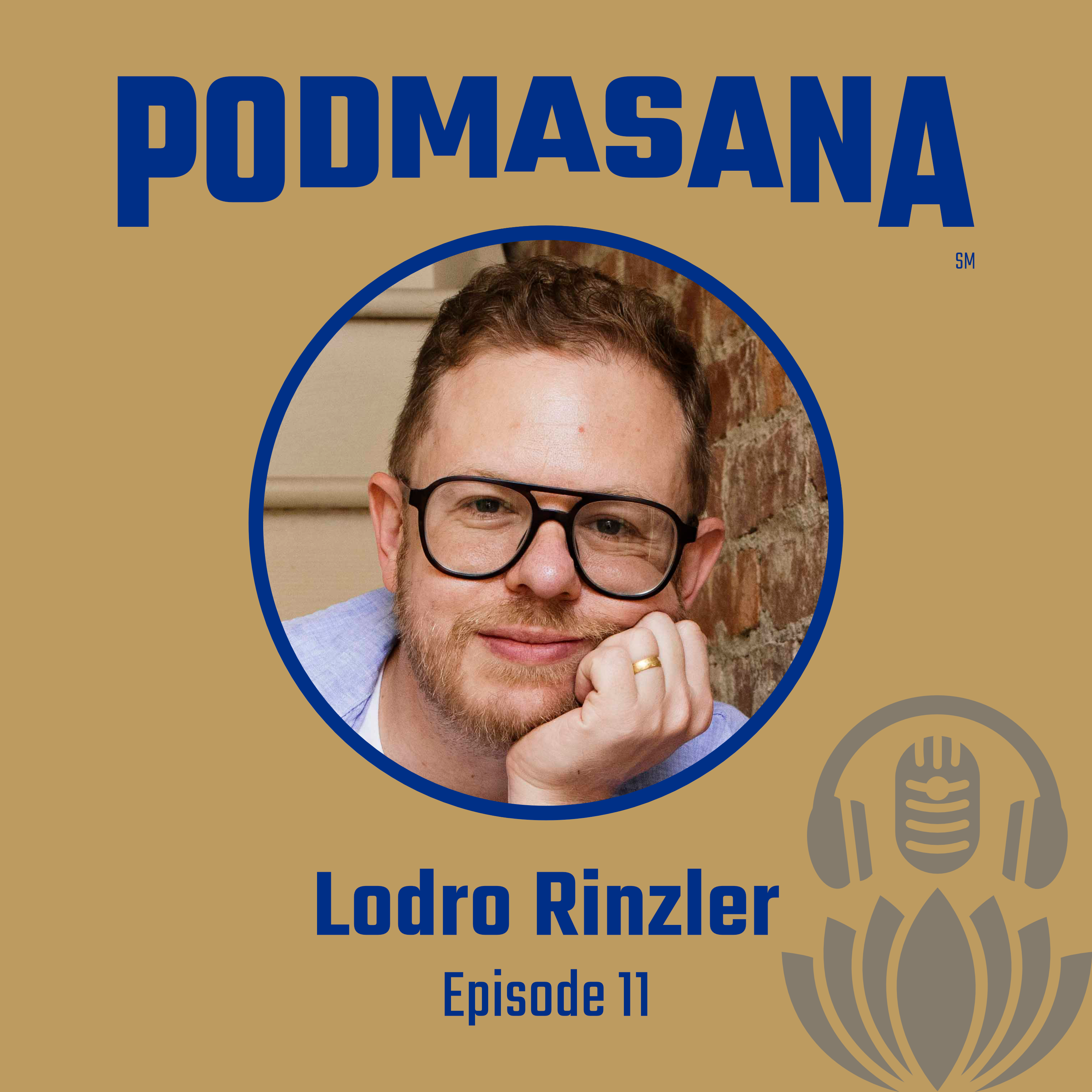
[00:00:14] Speaker A: This is Padmasana and I am Brendan Knorr.
What if the voice in your head telling you you're not good enough, not ready, not worthy?
What if that voice has been lying to you your entire life?
Today we're exploring a radical idea with meditation teacher and best selling author Lojo Rinzler that underneath all the self doubt, judgment and noise of modern life, you are already whole.
You are basically good.
Lojo has been teaching meditation for 25 years in the Tibetan Buddhist tradition.
He's the author of eight books including the international bestseller the Buddha Walks into a Bar and his works Walk Like a Buddha and the Buddha Walks into the Office have both received Independent Publisher book Awards.
Named one of 50 innovators shaping the Future of Wellness by Sonema, his work has been featured in the New York Times, the Wall Street Journal, the Atlantic, Good Morning America, CBS and NBC.
He's spoken across the world at conferences, universities and businesses as diverse as Google, Harvard University and the White House.
He also hosts the weekly X Men Horoscopes podcast where guests have their mutant destiny decoded.
His latest book, you Are Good, you Are Enough, arrives at a moment when we desperately need its message.
In a world increasingly defined by division, burnout, and what Lodro calls a pervasive sense of not enoughness, he offers something both ancient and urgent.
The Buddhist teaching of basic goodness.
This isn't toxic positivity or self help platitudes.
This is a fundamental reimagining of who we are at our core.
Lodro argues that we've been operating under a false premise that we're fundamentally flawed, broken or lacking.
And from that premise we build entire lives trying to fix ourselves, prove ourselves, or numb ourselves to the feeling that we'll never measure up.
But what if we're not basically a mess?
What if the inner critic running your life is simply wrong?
Through decades of Buddhist practice and teaching, Lodro has developed a practical, down to earth approach to silencing that critic and reconnecting with innate worthiness.
His work speaks directly to a generation grappling with disconnection.
People who are spiritual but not religious, who are disillusioned by the state of the world, and who spend their days managing what Lodro calls Incredible Hulk syndrome.
You Are Good, you Are Enough is designed as a toolkit for navigating the messiness of modern Life, complete with five guided meditations and 15 on the spot exercises.
It's been endorsed by figures like Sharon Salzberg, Kristin Ritter and Seth Godden who recognized that Lodro has a gift for making Big spiritual ideas feel accessible, totally doable, and even fun.
Whether you're new to meditation or a longtime practitioner, whether you're thriving or barely hanging on, this conversation offers something we all need to hear.
You aren't broken.
You never were.
And the work isn't about fixing yourself.
It's about remembering what's already true.
On this episode of Padmasana, we explore how recognizing our own basic goodness and isn't just personal healing, it's the key to extending compassion outward to friends, family, strangers, and society itself.
We discuss how someone who started meditating at six grew into a teacher, making ancient wisdom accessible to modern seekers, how to work with the inner critic, how to build resilience in the face of chaos and stress, and how to reclaim childlike wonder as a powerful tool for living.
Hello listener Brendan here.
If you're enjoying the show and would like to Support it, visit podmasana.comsupport to learn about all the great ways that you can contribute.
You can become a Podmasana plus member at three different tiers with a variety of perks, and also make monthly and one time donations to help support the show.
Any support is greatly appreciated.
Again, that page is podmasana.com support thank you for listening and thank you for your support.
Part 1 the foundation of Basic Goodness Lodro, thank you very much for being on Padmasana.
[00:06:22] Speaker B: Thanks for having me. I'm so happy to be here today.
[00:06:25] Speaker A: So Lodro, you started meditating at six years old in a Buddhist household in New York City, and by your teens you were sitting silent in month long monastic retreats.
How did that early immersion in practice shape your understanding of basic goodness? And what do you see differently in now than you maybe did as a young practitioner?
[00:06:51] Speaker B: Yeah, it's an interesting question.
People always ask like, what was it like growing up in a household where you meditated? And it's not like I have another lifetime that just can obviously compare it to like, oh, that other household where we didn't. But I think that more than the meditation aspect, more than being introduced to that so early, the fact that I was raised in this culture of basic goodness was pretty profound because as a kid, when something goes wrong, and they do all the time with kids, it wasn't, oh, you're a bad kid, it was you're basically good kid. And yeah, you made a mistake and this is what happens and we can move on from that and learn from that. It's a different perspective that I think actually really just shifted how I then ended up relating not just to my kid now, but just to everyone that if someone does something out of the blue, I'm like, oh, okay, they're so basically good, but they're kind of clearly just a little confused in this case. And let me look at them from that perspective as opposed to the perspective of they're a bad person or whatever it might be.
So I think that got ingrained in a very early age for me, and I feel very lucky that that was the case because I realize many of us are not raised with that idea of, well, you actually already are enough, you have enough as you are. We're raised with the idea of you need to do more, you need to produce more, you need to achieve more, and then you get to be happy is just a worlds away, these two perspectives.
So I think that early immersion in practice and in that understanding of basic goodness really just probably gave me more confidence as a human, just made me more empathetic, more understanding of others. I think that's sort of the main effects.
[00:08:24] Speaker A: Thanks for sharing that, Lodro. And so your new book opens with a radical premise for the reader, that you are not broken.
So in a culture built on self improvement and fixing ourselves, why is this message so hard for people to believe?
[00:08:43] Speaker B: I mean, I think you just named it, frankly, which is we have been told from a young age that we are broken, that we need fixing, that we need to level up and become something other than who we are, and then we get to be happy or successful or whatever it is that we're striving for.
And this book is asking the question, what if that voice in your head that says you're not enough is simply wrong?
What if that voice that was formed from sort of a societal whisper in your ear saying you need to do more, you need to achieve more, actually is BS because most of us are trying to fix something that was never broken in meditation.
I mean, you know this, you've talked about this on your show. It's not just about becoming calm. It's about discovering that you're already okay. You already have everything within you that you need. So, for example, the self help industry, the fitness industry, the makeup industry, they make billions convincing you that you're a problem that needs fixing. That's not true. You're not basically a mess, you're basically good. And that is not just a Buddhist idea. That's just an idea that we can encounter when we meditate, when we get out of our own way for a moment in meditation, we say, oh, in this moment, I'm okay.
That's basic Goodness. It can be that simple. That's us touching in with our own awakened nature. It doesn't have to be a complex thing, but it does take someone sort of pointing it out and saying, that's what's happening here for you to start to realize it, discover it, and develop a relationship to it. But that societal whisper in our ear of, I'm not enough, you're not doing enough, etcetera, that is so powerful. It could come from our family, you know, telling us at a young age, you can't do this for a living because you'll never make money. It could be someone in your church saying, people like us don't do things like that. It could be any number of things, but it gets ingrained in us.
I'm reminded of this time I read about this in the book you are good, you are enough, which is a friend of mine, Neil. He had not heard the concept of basic goodness. He grew up in a small town and he's queer. And he was told from a young age that that meant that something was basically wrong with him for liking the people that he did and falling in love with the people that he did. And even though he eventually got over that and came out and living a wonderful life in New York City, it was only that moment when he first heard the teachings on basic goodness that he started to tear up because he was like, oh, my God. No one's actually ever told me this.
No one told me that there was nothing wrong with me. No one told me that I'm 100% okay as I am. And just hearing it from that shift of perspective, it makes the world a difference to so many of us. That's just one of a thousand examples I can think of of how this very basic teaching can be quite life changing. Just changing the view of how we relate to everyone around us.
[00:11:21] Speaker A: Yeah, it's. It's very touching, and it's interesting to think about how the simple is often the most profound. And maybe it's hard for many to accept that the. The simple is sometimes the most profound.
[00:11:34] Speaker B: I was. I was listening to your episode with, gosh, Joe McClernan.
[00:11:39] Speaker A: McClernan.
[00:11:40] Speaker B: Joe McClernan. And he was talking about how he was going into volunteering at cancer wards and. And working with people and just sort of showing up and talking to them about the most basic stuff. You know, he said, I'm just essentially telling the patients the things that they already know that they should be doing, and it's really helpful. I was like, man, that is the key description of me as a meditation teacher, I'm just sitting here going, you probably already know this, that you're not basically messed up. But hearing someone say it can actually be really helpful. Sometimes we just need someone to say it to us.
[00:12:09] Speaker A: Yeah.
[00:12:10] Speaker B: Yeah.
[00:12:11] Speaker A: And so this new book is called you are good, you are enough.
[00:12:16] Speaker B: But.
[00:12:16] Speaker A: But many people reading this will potentially immediately think, well, I'm not.
How do you work with that inner critic that shows up the moment we try to believe in our own goodness?
[00:12:30] Speaker B: Lodro.
Yeah.
It is such a hard knot to unravel because each of us have our own buttons in terms of how that voice has developed over time. That inner critic that you called it that when someone says, oh, actually, you're basically good. Many people will be like, nope, that's not true. Or the other one, I get a lot, which we can talk about at any point is, nope, my ex is actually really not good.
Or whoever, nope, that politician is actually really not good. There's always some version of everyone could be basically good. Maybe I am definitely not that person over there. But, yeah, a lot of people struggle with the idea that they are fundamentally whole, complete, because they have spent so much time chasing out for external things that when I get that job, then I'll feel fulfilled. And then they get the job, and they say, well, I should be married by now. Once I get married, I'll feel fulfilled. They get married. Then it's like, well, now I need a house. And many of us spend decades of our life chasing after the next thing that we think will make us feel whole.
And I think if someone's listening to this, they're already starting to suspect that's not working for me.
Not that getting married and having a house isn't lovely, it's perfectly lovely. But that that will somehow bring us everlasting happiness. We're like, oh, maybe that's not the way I get there. Maybe the way I get there is through connecting to something deeper within myself, that I can find contentment within this moment. I think we're living in a really potent moment, a really aggressive moment, frankly. And I keep having this quote rattle around in the back of my head. It's from Thich Nhat Hanh, and he said, life is filled with suffering, but is also filled with many wonders, like the blue sky, the sunshine, the eyes of a baby. He says, to suffer is not enough.
We must also be in touch with the wonders of life.
And I think those are the lines that open his book, Being Peace, which is a classic at this point. But that's it. It's not just, oh, everything is suffering in Buddhism. Right. Because, you know, I think we get a bad rap for that.
It's also filled with many wonders. Meditation is the thing that helps us let go of that story, that inner critic that you referred to, and be more present for the beauty that's happening, the wonders that are happening right under our nose, the blue sky, the sunshine, the baby's eyes, Those things that are happening right now because I'm showing up fully, I'm finding that sense of contentment and fulfillment that I've been chasing in external things all along. But it just comes from letting go of that critic long enough to be here, to be 100% present.
[00:14:59] Speaker A: Yeah. That's great stuff, Lodro. Thank you. And so, Lodro, you co founded MNDFL Meditation Studios in New York City and have taught thousands of people, what patterns of self doubt do you see showing up again and again regardless of people's backgrounds or circumstances?
[00:15:21] Speaker B: Yeah.
Thank you for that. I.
Even before Mindful, even before this new book, it was actually when I started traveling for my first book, the Buddha Walks into a Bar in 2012. So a long time ago now that I started seeing this pattern emerge that you're referring to that. And it hasn't changed even in, you know, the last 14 years. You'd think these things would, but they do not. I was in Boston and I was leading a workshop and someone submitted an anonymous question saying, my boyfriend never says that he loves me. What should I do? I don't know if I'm worthy of love. And I read that and I was like, that is heartbreaking.
Right? Like, I'm seeking this outside. I don't. I've internalized the story as a result that I am not worthy of love.
And we talked about it, you know, a lot of people talking about, like communication with your partner and things like that. Fine. I went to New Haven. Just a few days later, someone sitting in the back row raises his hand and goes, I work over at Yale in the research department of X, Y and Z.
And I. I think if they knew just how under qualified I was, they wouldn't have hired me. And that I'm actually not worthy of the work that I'm doing. Like, I, I shouldn't be there. I feel like a fraud is what he said. I said, how long have you been. Five years. Okay. You know, like, there's only so many years that you can hold onto that story, I think. But there's. I'm not worthy. I'm a fraud. My relationship, I'm not worthy. I'm a fraud in my job. If my friends knew, you know, how I spent my free time gossiping, they wouldn't want to be friends with me. Whatever our version of that may be. There's something of, like, there' wrong with me.
And if everyone knew about it, then I wouldn't be allowed here. Like, there's Amanda Palmer, one of the founding members of the Dresden Dolls. She, in her book the Art of Asking, tells this story where she was busking on the streets in Boston and lived on, like this massive walk up, small, tiny apartment on the top floor. And that she would go to sleep every night afraid that the fraud police would come for her.
They would kick down her door and say, who are you to be playing music for people right now? You aren't even classically trained.
You didn't go to any of these schools in this city. You didn't do this professionally. You have no right to be collecting money to play music for people.
And that they would drag her out of her bed and arrest her and be like, you know, don't worry, we told everyone that, you know, you're under arrest. And I love that image because it's like, that's not uncommon. That is, to answer your question more directly, that's a trend. People are like, I feel like I am not enough. And that gets internalized into the sense of what we might often refer to as imposter syndrome, or in the Buddhist tradition, we might call it the trap of doubt. Doubting that we are whole, doubting that we have enough, that we are enough as we are, and saying, I must be broken as a result.
[00:18:04] Speaker A: That's really powerful stuff, Lodro. And, you know, as you were talking, I was, in my mind, I was just picturing like every human on the planet right now essentially feeling like this silhouette form of themselves. And they're. They're either consciously or unconsciously trying to tend to this inner goodness while being bombarded maybe with negativity, like on the outside.
And so, like, how does one really try to tend to that good inner nature that is always there? Maybe the first step is becoming aware of it, accepting it, and then. And then tending, tending to that. Could you maybe speak to that a little bit?
[00:18:39] Speaker B: Yeah. And I know that you've checked out the book yourself, and it's this funny thing, eight books in, where I'm like, y', all, we just gotta meditate. We really can. We just all agree that we can meditate while you're reading this book. That'd Be great. And I think there's a lot of things, like there's still a lot of re education. I think that has to happen in the public eye around what meditation is and isn't. But it can be as simple in mindfulness meditation to be present with the breath. And then when you get distracted, you come back to focusing on the breath. It's not. It's not a complex concept. It's often referred to as simple but not easy. It's like a very simple thing to do, but it's not easy because our minds are so wild. But it is exactly that practice that can help us drop these stories. What we're constantly doing is we're saying, oh, there's that story of anxiety, of jealousy, aggression, whatever. I can acknowledge it. I can come back to the breath. I'm cutting through it, I'm coming back. Happens again. We cut through, we come back. Every time we do that, we're creating new neural pathways in the brain. We're actually literally rewiring the brain to not chase after these stories of the inner critic. We're actually rewiring to say, I can just be here.
And that's really powerful. So even doing, for example, 10 minutes a day of meditation, just that simple practice. I mentioned mindfulness meditation, sometimes called shamatha, which means calm abiding or peaceful abiding meditation.
That can be really huge.
Just taking 10 minutes a day to say, oh, I can take a break from that rampant voice in my head and just keep training, that I can come back and not buy into every story that I tell myself about myself.
[00:20:19] Speaker A: In a recent substack, Lodro, you had a post that that was titled what do I Believe in?
And you explored your own relationship with doubt and belief. How has your personal practice with self doubt evolved over the years? And what surprised you about writing this new book?
[00:20:40] Speaker B: Yeah, that's a good question. And thank you for reading the substack. So my wife and I run something called the Laundry, which is based on the old quote, you know, after the Ecstasy, the laundry. And this is very much the spot where we talk about, like, just what we're actively processing in a given time. This isn't like the lessons from On High. This is really what's going on. And in that piece, what do I believe in? I really just talked about, like, a meditation student of mine who was asked, like, what? So what do you. What do you believe in as Buddhist? And he's like, I don't know if I believe in anything. I believe that when I practice it's very helpful. I was like, that's a great answer. You know, and I of course had my own belief systems growing up. I'm sure anyone listening to this were did as well. And I think that there's a lot of belief systems here in America that are not serving us. Like, oh, if I go on social media, I'll get these dopamine hits and they'll, they'll really help me. Or it's like ignoring the research that says that social media, like reliably, like, leads us to anxiety and comparison, despair. We believe in capitalism and celebrity culture. We buy into that. Like, if you take big swings and you're talented enough, you'll break through the noise and achieve wealth and fame and like, that will make you happy. And as I was saying before, like, many of us fall short of that and are miserable and then many of us might hit that and then we're still miserable. So that doesn't work. So we're starting to look at some of the things that we believe in that are not serving us.
So this kid's like, I meditate, I sit a lot. You know, that's what I believe in. It's like, that's lovely because it's believing in our own experience.
It's believing in something that we can actually really embody, that we, we have faith and trust in our own experience is the words that we probably use in Buddhism.
So, you know, I obviously writing this book, believe that everyone possesses basic goodness. That's a big part of what I believe in. And I do think that we're at a really hard moment in time. Just about my own self doubt evolving over the years. And what surprised me about this book. This book, what surprises me about the book is that how timely it is. I think I started writing this book three years ago, before my daughter was even born. And it's only coming out now. And it's great. That's coming out now because this is a time where there is a lot of division, there is a lot of, as I said before, aggression.
And to look at how we can connect to others through the point of view of I'm basically good, you're basically good, we can work from there, despite confusion and neurosis arising in between.
That's helpful.
It sounds complex, it sounds crazy. But the idea of how do we actually heal our society at this point is actually starting to recognize and understand each other. And that's a big part of what this book is about. So the part that's surprising me is that it feels very Timely. But in terms of my own personal relationship with self doubt, which you asked about, the thing that's surprising me there is not the writing of the book, it's the promotion of the book. Because here I am with you and I'm a fan of the show. I love what you do. And I'm sitting here going, man, am I making any sense at all? You know, it's like all of this sense of like, self doubt, like at this Moment, I'm here 100% with you, but I'll probably walk away going, man, that was all gobbledygook. I can't believe I did that or I said that weird thing or whatever it is, Self doubt is creeping in in promoting this book because I found this, my eighth book. Every single time there's a book, this comes up to a greater or lesser degree of what if people think it's all the stuff we said before. What if people think I'm a fraud? What if people say, I hate this book and this person's a jerk? What if, you know, all of those things? What if I put my foot in my mouth, et cetera, et cetera? It is something that comes up for me, and I actually had the good fortune not that long ago to talk to this guy. Joe Kelly. Joe Kelly is a longtime comic book writer. He currently writes Spider Man. Big title. And he's got a thousand, like, literally several hundred comics. I want to say 500 comics that he's written in his career. I told him that. I said, how does that feel? And he goes, honestly, every time a new one comes out, every month, I go through this process of self doubt that's so intense.
Every time one of his comic books comes out, he goes, what if people rail against me on the Internet? What if people say I've completely ruined this character?
And some of that could happen. And I'm sure someone on the Internet has said that about him. But to not let that overpower us is really powerful. So because I wrote a book on basic goodness and this trap of doubt and how we might fall into it, of course the trap of doubt is coming up trying to get me. And I'm just sort of saying, okay, you know, like, that is. That's a very normal thing that'll happen when you put out a book. I don't have to buy into it. I don't have to cling to the stories. I can come back to the things that are matter, the conversations that matter, the sort of authentic presence that matters. Because I think that actually wins out.
[00:25:11] Speaker A: That's really great. And it was making me think of how if someone is very talented, quote unquote successful, pursuing a passion or working on a passion, short term, long term, there's still that nagging or ever present ego voice that maybe is not saying the kindest things and maybe we're essentially trying to remind the ego. Actually we're good, you know, it's all okay.
[00:25:38] Speaker B: There's. I'm reminded of this story of a friend, a mentor of mine, Sharon Salzberg. She's one of the founders of the Insight Meditation center and they're actually celebrating 50 years this week. So good for them. Congratulations. Really major achievement of having one place really established and spreading these teachings for so long. And she right when they were founding that place, she told me the story that they started by doing a long retreat, just a handful of them that were going to be running the place and they were going to do a month long retreat. She goes, for the first week I'm just going to do loving kindness for myself and then I'll move on to the next step and the next step and the next step over these weeks.
And after the first week they got called away, they said, hey, there's this community member who's really sick. We need you to go visit them.
And so she's like, oh gosh, I'm getting pulled out of this retreat many weeks too early. All I've done is this one step.
She's running around, she's throwing things into her suitcase and as she does she knocks over her mug and it goes shattering onto the floor.
And she notices that self critical voice come up.
And she also had that in that moment she had referred to it as Lucy, like Lucy from Peanuts. That's her negative character. And she said, oh, you know that voice, I call it Lucy. And she knows that voice come up. She goes, oh Lucy, it's okay.
The practice worked, right? The practice, even after one week had done something to her of like, oh, I don't have to buy into that self critical voice so much. Oh, Lucy, it's okay. It's a mug, right? So I think the more we train in meditation, the less of a hold this trap of doubt has on us.
[00:27:10] Speaker A: Hello, listener. Brendan here.
Do you or someone you know have an article or book to share, a work to highlight or story to tell that would be a good fit for Padmasana?
If so, feel free to reach out via
[email protected] that's ideasodmasana.com and we'll be sure to get Back to you. Thank you.
Part 2 Practicing in the mess.
Lodro, your bestselling book, the Buddha walks into a bar, spoke to people who are identifying as spiritual but not religious.
How does. You are good. You are enough. Continue that conversation. Especially for people navigating 2025's and 2026's particular brand of chaos and division.
[00:28:12] Speaker B: Yeah, yeah. I mean, you and I have alluded to this a few times now. This brand of chaos and division that's happening here, it's like it's bad people. It's pretty bad out there right now.
I said this was a timely book. It's just like I feel like it's just dropping a bucket of water on a forest fire. It's not like this is the be all, end all to solve the world. But I think it's my small contribution, particularly as you said, for people who are not necessarily Buddhist, where they're not anything in particular, but they're looking for some guidance to come home to who they are, to discover that they are basically good, that they have that foundation.
And then when we start to notice that we are basically good, we look around, we say, I guess that's everyone.
So there's this three part arc we'll call in this book where it starts with, you are basically good and practices and ways of looking at how we ourselves are basically whole, complete, good enough as we are and coming into a deeper understanding of that, developing a real relationship to that concept or experience, I should say. And then the second arc is everyone else is basically good and that's the people you like, which I think is easy. Oh yeah, I like my child. My child's basically good. Perfect example of basic goodness for people who are like, this isn't real.
When you look at a brand new kid, they come into this world, they aren't starting to doubt themselves, they aren't questioning their decision. They're just fully themselves. Right. Like that's a good example of basic goodness. Your partner, your friends, okay, I like those people. They're probably basically good. And then there's this massive group called people I don't know. And that is harder to identify. Oh, I guess that person behind me in line or the person holding up traffic are also basically good. And then the last one is the people we don't like, which is the hardest part. And that's where the chaos and division comes in, where I start to label someone else as bad or other.
And then I start to move in that direction of telling myself stories of why they're bad and how I don't have to treat them as basically good.
And I can dehumanize them, I can villainize them, which is. I have a couple chapters in this book just around that, you know, I have chapters on the idea of the danger of villainization. What about that? World threatening politician society is an effed up. And that last one actually takes us to the third arc, which is society is not something out there, some massive other thing. It's us. Like right now, you and I are in a podcast society. And anyone who's listening to this is participating in that. That is a society. My home is a society with two dogs and a wife and a child. And we have particular ways of doing things here. And it's probably different than my neighbors down the street. And each of these are mini societies. Society is made up of you, me, everyone we like, everyone we don't know and everyone we don't like. That is society.
So if it's a bunch of basically good individuals, we could argue, and I know this is controversial, we could argue the society itself is basically good.
And that is a really tough thing to look at right now because it doesn't feel good because there is so much division, because there is so much othering.
That person on the other side of the aisle is wrong, they're doing things wrong, they're ruining the world. And then they say the same thing about us who are on the other side of the aisle. So it's, it's really, really hard to start to talk about seeking to understand people we disagree with, seeking to recognize their goodness amidst their confusion, because not everyone wants to have that conversation. But I genuinely believe that this is one of the ways that we can actually help heal this world. That this is not necessarily about like when we villainize others, we're villainizing ourselves. We're sort of shutting down our own open heart. It only. We are only hurting ourselves.
So this idea of like enlightened society, it doesn't start in Washington, it starts in our nervous system. It starts with me working with my own mind, recognizing my own basic goodness, and then starting to look at other people. Because if we don't reclaim basic goodness, society's just going to keep fracturing.
And as you said, basic goodness isn't Buddhist. It's not a Buddhist concept. It's spiritual, it's practical. It's an experience you can have on the meditation cushion when you drop some of these stories and you say in this moment, I'm okay.
And then once we realize that, we start to look at other people because if we keep seeing each other as monsters, we're going to create a monstrous world and no one wants that. If we want a peaceful world, we have to look upon each other more peacefully.
[00:32:25] Speaker A: Yeah, agreed, Agreed. And I appreciated you touching on some of the content in the book, Lodro. In addition to that, you include five guided meditations and 15 on the spot exercises in the new book.
Can you share one simple practice people can use right now when they're caught in a spiral of self doubt or maybe just a sense of overwhelm?
[00:32:51] Speaker B: Yeah, good question. Thank you for that one. And I could come up with a thousand. In fact, that's probably why this book exists because it's like there's a thousand ways to do this, but for one that just came to mind, I'm going to do one and a half. I'm going to cheat.
I would say taking three deep breaths in through the nose, out through the mouth is a really good way to sort of calm down the nervous system.
And then it's just long enough, 30 seconds that we might have cut through some of the stories we're holding and we can start fresh.
So starting with that and then moving into this question that I actually going back to Thich Nhat Hanh, learned from him, which is what is happening right now?
To just ask what is happening right now? Right now I'm not in this work conflict or right now I'm not in spiraling about what I didn't get done yesterday or whatever. It's right now my hands are on the wheel, my foot is on the gas.
Right now there's a song on the radio. Right now, there are people driving by. That's what's happening right now. To tune into the present moment, to come back over and over again, I think in some sense we would say, oh, this present moment is very scary.
And you know, we can go on CNN.com and refresh every minute and find out more things that could scare us. And that's, I'm not denigrating reading the news. I actually, as you know, have a whole chapter on just sort of how do we do it in a safe and sane way because we don't want to get overwhelmed by it. But as I was saying, this doesn't feel like a great moment, but if we're actually fully present, we can start to see some of those wonders of the world. Oh, look ahead of me in this moment, there's a guy driving with his dog and they seem to be having a really nice time. And I can feel what we would Call Mudita sympathetic joy for them. Oh, I can rejoice in their joy. And that makes me feel uplifted. I'm no longer overwhelmed. So again, three deep breaths, in through the nose, out through the mouth, then asking what's happening right now?
Just to ground us in this present moment, to let go of the stories, even temporarily, if they're so important, these stories, they'll come back. You don't have to worry about it. But more often than not, we just need a little break from them.
[00:34:52] Speaker A: I love those examples, Lodro. And I think it's an important reminder how the reality online maybe doesn't always mesh with the reality out in the world. And sometimes we can actually just be present and observing of the goodness, whether it's nature, you know, in our neighbors, in the strangers in our communities. And so I think that's a really great practice. So thanks for sharing it.
[00:35:18] Speaker B: Yeah. Well, thank you. Thanks for saying that.
[00:35:20] Speaker A: Yeah. And maybe onto the territory of something scary. You have written about what you call Incredible Hulk syndrome. You know, we've got this idea of Hulk smash. Of course, if people aren't familiar with the character, that feeling of rage or reactivity that can take over in stressful moments, how does recognizing our basic goodness help us work with those intense emotions?
[00:35:47] Speaker B: Hmm. Yeah.
Yeah, I called it. So, as you said, this was in the Buddha Walks into a Bar, my first book. And as a longtime comic nerd, a self proclaimed one, I absolutely love this idea that there's just this mild mannered scientist, Dr. Bruce Banner, but every time he gets angry, he hulks out. He becomes this giant, green, monstrous monster that ends up kicking things over wherever he goes and creating a lot of havoc. Because that is sort of what happens when we let our anger, our aggression, whatever it might be, run rampant over us.
We say the things that we don't actually, we would never say if we weren't held in that sense of rage. We text that person back something really nasty. We say, it's just there's so many ways that we end up causing pain because we don't know how to handle our strong emotions. You see it all the time these days.
You know, I see people arguing in comment sections on anything. You could have the most benign thing that you posted. And someone will say, you know, here's my belief about that. And someone else goes, that's wrong. And then they just go back and forth because they. Neither of them are willing to take a break and say, oh, this is just perpetuating our aggression. And this is just stressing out both of our mornings. And no one else is reading this, right? We see that all the time. So I think recognizing our basic goodness to help us work with these intense emotions is just sort of cutting through the noise and realizing that that's not who we are. We are not our strong emotions. I wrote another book called Love Hurts, which was Buddhist Advice for the Heartbroken. That's the subtitle, and it is a book about all of the various forms of heartbreak. And I say, hey, you know, if you are still feeling heartbroken and you need someone to just say, hey, you will love again, reach out to me at this email address. Every week that book came out.
Wow. That book came out a decade ago, and I still, every week get some email from someone saying, yes, that's me, and I will. You know, I actually said, if you would like, you can leave your phone number. I'll call you. So once a week, I'm, like, hopping on the phone, maybe even just leaving a voicemail for someone, maybe connecting with them live and saying, hi, I'm so sorry you're going through this. And if there's good news to the truth of impermanence, it's that even these devastating, horrifying emotions that you're feeling right now, that they too, will change, that they will shift, they will fade, you will heal, and, yes, you will indeed love again. And talk to them a little bit just about, like, how do we support ourselves as we go through that process? But I think that's the main thing that we say. The way that I'm feeling right now is actually impermanent. I don't have to cling to it. In Buddhism, we call this two arrows.
The first arrow, let's say you're going through the forest, and out of nowhere, an arrow comes out and hits you in the arm.
That's the first arrow.
And what we should do is we should take that arrow out and tend to our healing. But what most of us do is we end up going, who shot me? Was it Charlie that shot me? I bet it was Charlie. He's always out to get me. This is so typical of him. And, you know, we keep going, and we going while the blood is splurging out of our arm or whatever. That's the second arrow. There's. The first arrow is, oh, there's pain that happens as part of life. The second arrow is the suffering that we layer on top of that pain in our own heads.
Meditation is a tool that can help us work with that second arrow that I don't have to spiral so much. And that means that I'm more available to take the arrow out and tend to my healing because I'm not spiraling so much.
These emotions are often triggered by a thousand stories that we tell ourselves.
Why did they leave me? Will they come back? What do I have to do? What can I say that would make them come back? For heartbreak, for example. And the moment we let go and we look at the emotion underneath it, actually it starts to become more ephemeral, more impermanent. Oh, it's an ever changing thing. If I said, hey, tell me what you were feeling last Thursday at this time, you probably couldn't because you don't know. It's shifted a thousand times since then. So I think there's something sort of like a good news truth to this, which is the way that we feel, Even if it is really painful right now, it's going to shift, it's going to change, it's going to fade. And underneath, the basic goodness is always going to remain. It's the. I'm using five analogies at once. It's the equivalent of, we have this wide open sky and clouds come across it. The clouds do not bother the sky. The sky is absolutely unbothered to have light, fluffy clouds, gray storm clouds, whatever. It's not a big deal. That's basic goodness. It's the sky underneath the clouds.
So sometimes the clouds are really intense for us. Sometimes the clouds are less so. But either way, the basic goodness remains.
[00:40:17] Speaker A: Yeah. And that's great stuff. And maybe it's an important reminder that even the Incredible Hulk has an inner Buddha nature that, you know, if he was to get in touch with, maybe there would be less smashing.
[00:40:29] Speaker B: Yeah, there's actually, I'm going to plug this book. A friend of mine did the illustrations, Jason Lowe. He collaborated with a wonderful writer for a book for Marvel called Hulk not smash, which is a book on mindfulness. That's great. This beautiful image of the Hulk meditating on the COVID Yeah.
[00:40:43] Speaker A: Yeah, that's great.
So the book talks about extending recognition of goodness outward to friends, family, strangers, even people we disagree with.
In our current climate of polarization that we've talked about, how do we see basic goodness in people whose actions or beliefs we may find harmful?
[00:41:08] Speaker B: Yeah. I would say the first step is to notice the resistance that we have to do that, because I think it's very natural to say, actually, I don't want to do that. I'm happy to recognize basic goodness in the people I like or even some of the people I don't know, but I find that person harmful. And that means they're not basically good, as opposed to a different point of view, which is that they are basically good. And they are probably divorced from that to a large degree. There is a whole. I'm not going to call it a controversy, but there's a discussion with my publisher of hey, what are we going to title this chapter that end up being world threatening Politician. Because within it, I talk very openly. I'm just going to say it to you that I've been teaching meditation for 20 years. And in any really perceptive audience, there's always one person that will be like, hey, what about Hitler? And so for much of my teaching career, it was, what about Hitler? That person's not basically good. And that was the gold standard for this question. And then in 2015, people began to ask, what about Trump? And then by 2022, what about Putin? And it seems like now we're just more readily willing to add people to the list of people who would generally be irredeemable, devoid of basic goodness. And I apologize to anyone who's already offended by those examples, but those are the ones that people would kick to me. And the short answer is yes, even them. And I had to pause before going on to the full answer, but obviously I'll go with Hitler. Hitler did atrocious things, crimes against humanity. We're not saying this is a good person or someone worth admiring. That is not what I'm saying.
The idea is that he was so distanced from his basic goodness that he was able to convince himself to do horrible things and that they weren't right and that they were right to him, but they weren't, obviously. So it's that sort of delusion that comes up when we are so divorced from our basic goodness. We're acting from a place of not enoughness.
And, you know, I'm sure I'll end up on a list somewhere for this. But, you know, with our current president, there is something there around.
I don't think this person feels good about himself. I don't get that impression. I think there's a lot of, like, puffed up, proud, arrogant energy. But I think that there's a lot of overcompensating happening, a lot of always having to push himself up in order to, like, feel like he's in control. And it, it feels very tenuous to me. And at some point, it probably will fall apart. And, you know, I, I think that's going to be fine, frankly. But the idea here Is like, it's hard for any of us to contemplate that an authoritarian ruler, a politician that we don't like, that they possess basic goodness is difficult for me, but they do. Like I can think, these people love people. They have people who love them back. They experience moments of genuine open heartedness with those individuals. So there's some moments of genuine connection and connection to their own basic goodness. And then they immediately snap into, but everyone's wrong but me. And you know, you could use any, by the way, ruling figure. You could do Saddam Hussein, you could do Mussolini, whatever. The point is the same. Even that person that we might tend to label evil is basically good and not in touch with their basic goodness. So it's both. We can hold both.
And I think I quoted the Tibetan teacher Chogan Trungpa Rinpoche in this chapter where he said, everybody loves something, even if it's just tortillas.
Like, everybody has the ability to soften, right, and connect to the world around them, even if just in very small ways. And that's considered evidence that everyone, absolutely everyone possesses basic goodness, that everyone is capable of love and compassion, that they can come back to that.
I was traveling, I think, for the Buddha walks into a bar maybe actually it's the second book, Walk Like a Buddha. And I was, I want to say, in North Carolina and I gave this talk and this question came up, like, exactly what I said, like, what about Hitler? And I did my, my spiel about like this was everyone's basically good. And there are some of us who are very confused. And I'll also say I'm basically good. I've acted out of confusion at times. You know, I know that maybe not to such an extent in the, in causing as much harm, but I've caused harm unintentionally because I wasn't connected to my basic goodness. I know that about myself.
I learned from that.
I continue to learn from that. And like, it's. The harm that gets caused is very, very small compared to like, you know, when I was 20s or whatever. But like, I think that there's still some sense of like continuing to understand. Like, oh, that then gives me, I don't want to call it even empathy, but an opening to understanding for people who are often acting out of confusion. But the story goes, I gave this talk and I was staying with this wonderful family on the road and on the way home, the woman who was driving me home says, you know, it's so I really appreciate what you said about basic goodness back there. And she Shared this story with me that her.
She had kids from previous marriage. Her husband had kids from previous marriage. And one of her husband's kids was still living with them for a while. And in her words, fell in with the wrong crowd. And they were doing a lot of drugs, and they did something unspeakable. There was a murder, and I'm not gonna get into details because I don't wanna ruin anyone's day. So there was a murder, and this kid went to jail, and she went to visit him, and she was like, this is not the person I raised.
This person is so divorced from who they used to be. And she didn't give up on him. She just kept going back over and over again. And then one time, he asked about the family dog. She goes, oh, yeah, I'll talk to you about the family dog. And she saw a little glimmer of who that person used to be, that they could come home to themselves.
And then a couple months later, he asked for art supplies. He used to love to draw, so she brought him art supplies. And he got back into that. She said, gradually, little bit by little bit, this person who had become so divorced from basic goodness came home to themselves just through a supportive environment of someone seeking to understand them. I always think of that story because it's so beautiful. Like, it'd be so easy for me to just say, that's a bad person that murdered this person.
It is a whole other thing to say through the eyes of his mother or stepmother. This is someone who really went down a dark road and they're coming home to themselves and that they can be redeemed.
I always think of that because we can philosophize about, you know, these big figures that we may never meet. But to say someone like that, that makes a lot of sense to me.
[00:47:13] Speaker A: Well, it seems like a powerful example of the power of love, light and goodness.
[00:47:21] Speaker B: Yeah. And just someone willing to hold space and be there with you as you navigate the toughest of times, which is really generous.
Yeah.
[00:47:31] Speaker A: So in part two of your book, Lodro, in the chapter dealing with spouses, you refer to the five A's that David Rico, longtime author and therapist, describes in his book how to Be an Adult in Relationships. What are these five A's, and how can we apply them to our own relationships at a familial or a societal level?
[00:47:54] Speaker B: Yeah.
This is a good test of my memory. So, David Rico, really lovely book. He wrote a book, how to Be an Adult in the Relationships. And these five A's have sort of Bled from there into common conversations. They are attention, acceptance, appreciation, affection and allowing. So attention is that thing that we were just talking about, oh, I'm going to be fully present with you. You know, when I show up and I give you my full attention, there is some room for softening. There's not as much room for resentment or anger or whatever it is. And when we're talking about a spouse, like, I think that's definitely the case. You know, my partner and I, we have a two and a half year old daughter. And it's been a very different change for us to be like, wow, we are relating to each other way too much through the lens of like, what are we doing with our kid? And not enough, just one on one. So to sit down regularly and just be like, here's our time together.
Even if it's just, you know, 10 minutes after she goes to bed and we, if we can sit down and just be a hundred percent present is actually really wonderful. So letting go of the stories that we might tell ourselves about our partner, our relationship, just creating space to experience their basic goodness more directly through undivided attention. So that's the first. Acceptance is the second one. And there's. I tell the story in the book about how when I got down on one knee to ask my now wife to marry me, I was like, oh, I'd gone through my process of here's why I think this is a good idea. I totally can accept these things, that there will always be dishes in the sink or whatever. Like I, I will take the good with the bad. And you know, I think this is a great cost. You know, what's, whatever the economic thing is that people say. But like it was just, oh, it made sense. You know, there's some sort of process I had gone through intellectually not understanding marriage at the time.
And then I got down on one knee, I was like, so trig, like right now you have to tell me yes or no. It's so unfair that we do that. That one person gets to go through a process and then be like, right now tell me yes or no or we're getting married, it's ridiculous. But anyway, she said yes, mercifully. And then we had like a great period of time, like figuring out what that meant to us. Like, what is marriage for us? What does that look like? What do we need to, you know, do to really accept one another completely? And that was it. Like, as I said, I was naive of me to say, oh, I understand all what I'm getting into. I Didn't. And I love her, and I continue to be in awe of my wife. I think she's an incredibly wise being. Yeah. Anyway. But there's a lot of great things I could go on about her, but there's also, like, all the eccentricities of another person that you spend your life with. So it's both. It's like, can we accept all of it together? And it's like, it's okay for me to feel annoyed if there's glasses stacked in the kitchen sink, but I can also just notice the feeling.
Pick them up, wash them without letting that spiral into some story that amplifies the irritation.
That's also where meditation comes in, and it's really helpful. So a is attention, acceptance. Now we're at appreciation. And for us, I. I think that's like, just the simple power of saying the appreciative thing that we might think in our own heads aloud to the other person. Like, here I am saying to you how wise she is. I should probably tell her more. It's that, like, actually just saying these things of, like, sort of a game changer. Just, like, I really appreciate you, or, like, I think your new haircut is so great and you look so great. It's just very basic things. How great you are with the kid or whatever it is that spontaneously comes to mind. Because I think a lot of times we might think these things, or they might be fleeting glances, but we don't actually sit down and say, hey, by the way, I actually really appreciate you for who you are. And then, where are we? The fourth a. The fourth A is affection.
I did not grow up in a household with a lot of physical affection, which is not a slight against my parents. It's just the way it was. And so it took me a long time to understand how powerful, like, a hug could be. And I read while in the process of researching this book that in Disney World, apparently they have a hug rule for its characters. Like, you're not supposed to, like, character you, Mickey, or whatever. They're not supposed to, like, go first when hugging a kid.
The kid can hug for as long as they want. The idea being that you never know how much that kid might need a hug. Which.
Not gonna cry on your podcast, but, yes, I love that. And so I just adopted that, too. So every night before my kid goes to bed, it's like, we do a big hug. And she can hold me for a second. She can hold me for 90 seconds. It could be anything. But, like, I'm just. I'm here for it. And it's actually so precious to just be like, this is our moment of real deep physical affection that we both love.
Same thing with my wife. You know, I genuinely think that just a hug or the way that we hold hands is just wonderful. And the last one is allowing, which just comes down to allowing your partner to be who they genuinely are, to do the things that they love to do. I only know two things. I only know Buddhism and X Men. And my wife is surprisingly tolerant of the second one and, you know, allows me to be who I am and like talk geeky things and occasionally will even watch things with me. And, you know, she has her own quirks. You know, I joke in the book like she was, I was working on a chapter. She was off at a garlic festival that day and you know, cool. You want to do a whole festival devoted to garlic, do you? But like, there's some sense of allowing these people to just be who they are without necessarily boxing them in with what we think they should be. So those are the five A's, and I think they really do help us reconnect to the basic goodness of ourself and our partner and to start to let that flow more freely in the in the relationship itself.
[00:53:13] Speaker A: If you're a devoted listener of the show, becoming a Podmasana plus member is a great way to provide ongoing support of the show and get extra perks across three tiers, such as early access to ad free episodes from the growing Padmasana archive, discounts on merchandise, and optional recognition in show notes and on Padmasana's website.
Higher tiers also get access to bonus episodes, a private chat group, live video Q&As with featured guests, a personal thank you, mention in episodes and more.
Listeners can support the show via monthly or yearly subscription starting at just $3.99 per month.
A 20% discount is applied to all yearly subscriptions.
Yearly Podmasana plus subscribers even get free merchandise.
Subscriptions automatically renew and there are no contracts.
For more information, visit podmasana.com/.
You can also make a one time or monthly donation to support the show at podmasana.com support 1% of all revenue from Padmasana+ memberships and donations are committed to carbon removal.
Thank you so much for considering a Padmasana plus membership.
Your support means a great deal and your subscription helps to cover the research, writing and audio production that go into every episode of Padmasana Part 3.
Living the teaching so Lodro, you've built a significant platform through social media. Your substack the laundry that we talked about earlier and mndfl Mindful Studios. How do you balance being a public facing teacher with maintaining your own practice and avoiding burnout?
[00:55:18] Speaker B: Yeah, I mean, this is a horrible thing to say, but I don't really buy into a lot of the social media stuff. Like I will post there and hope like it's sort of like shouting into a void and hoping that something might be helpful.
But I don't. It's not like I'm actively thinking like, oh, I really gotta cultivate this. I should probably collaborate with someone and get more. Like that's just not something I've been interested in, probably to my own detriment and to getting the word out overall about these things. But I just honestly a thousand times would prefer sitting down with you and having a real conversation than just trying to get into comments and, you know, chatting with people online.
It just doesn't always feel like the same thing to me. But I do think that the overall question of like putting oneself out there and being a public race, it's actually really hard. I remember I wrote after my first book came out, someone wrote me anonymously through my website saying, lodro, you four eyed hipster. And they used a slur against me. And I'm not going to repeat it, but I was like. And then it continued to be like, what a joke I was for writing a book with Buddha Walks into a bar in the title novel. And like, you know, I read through it with the opening. It was really hard to take the rest of it seriously, being honest. But you know, that's a great example of like the trap of doubt can come up at any time, right? Like, oh my gosh, there it is. Like there is actually someone out there that genuinely dislikes what I'm doing. And there will always be that. I know that now. I know that. And it is just the nature of the beast that you put out work and you hope the work helps people. And if there are people that take offense or they just don't like the cut of your jib or whatever that is, you know, like they, they're going to do their thing and they will try to tear you down and use whatever they can to do it. And that's unfortunate.
Those are people who are clearly suffering. Those are people who are not feeling very confident in their own basic goodness. One of the signs of the trap of doubt is that we slander others. When we feel disconnected from our basic goodness, we start lashing out and saying, well, that person's bad. That person's bad. That's just a classic sign. I know that sometimes it hurts still, sometimes it doesn't hurt as it used to. Really.
It's also, gosh, I'm doing so much comic nerd dumb with you. I had a good opportunity to talk to Marjorie Liu, who is a wonderful comic book writer, and she wrote this issue, which featured the first gay marriage in a comic book. And as a result, got a lot of flack and a lot of phrase. I mean, I think she's an icon for doing that. And she and I were talking, I said, how did you deal? She was like, I got hate threats. Like, people threatened to kill me. People said I should never write again. They were petitioning no one to hire me. I said, how did you do that? And she goes, well, I had to realize it actually didn't have anything to do with me. They didn't know me.
I said, you know, f. Like, I didn't. Yeah, of course. That makes complete sense. Like, that person, you're a hipster, four eyed, blah, blah, blah. Like, I don't. I doubt that they even know me or if they met me once, they have an idea about me, but they don't. It's not like this is someone who I actually really know.
So I. I think that you'll often find, like, anyone. I remember when that happened. I turned to my girlfriend at the time and I was like, this happened. She goes, this really dates us. That it was right when Justin Bieber was ascending to fame. And she goes, do you think Justin Bieber doesn't get these people?
And of course, you know, he absolutely does. So it's like, the more you put yourself out there, the more you do sort of say, hey, there's going to be a small contingent of people that will probably not like what you're doing. But that pales in comparison to the overall intention of putting out these books, which is if there's just one person who reads this thing and starts meditating and they start to actually then develop a relationship to this innate goodness inside them, and that changes how they relate to the other people around them. That's throwing the biggest stone in a pool of water that I possibly can. That's the best way that can help society is to have at least just one person start to recognize their basic goodness and treat other people through that lens. If it's more than one huge. But just that is enough and worth everything.
[00:59:11] Speaker A: Yeah. Thanks, Lodro. And so the new book, you are good, you are Enough, is described as offering a powerful message that recognizing Our own goodness is the key to healing the wounds of isolation and fear. So how does individual recognition of basic goodness translate into something like collective healing?
[00:59:33] Speaker B: Yeah, thank you for that one. It's such a thoughtful question, and I feel like I don't get enough questions about, like, the whole societal aspect of, like, how does this actually really help the world? Because I do. When I said this was timely, I do believe that this is why it is timely, is if I start to look at the world through the lens of I'm basically good, you're basically good, I no longer write anyone off. I don't give up on anyone.
And that is a huge perspective shift in terms of how we treat each other. That I don't say, this person's slowing me down. I'm in a rush, and I need to get to the front of this line. And they're just taking their time, say, oh, this person is a human being. I can actually understand who they are. I am more willing not to villainize, but to just say, I've been there. I've also faced uncertainty in the front of a line before. I get it. I can actually put myself in your shoes more because I'm recognizing your basic goodness and more willing to give this person a break. And again, everything in Buddhism, we talk about interconnection or interdependence, that our conversation here, we're just having a conversation on two computers. It's meaningful to me. Hopefully it's meaningful to you. But then someone might listen to it that we never know. And that is, again, throwing that stone in a pool of water. These ripples that then come out from that stone, we don't know.
So me treating that person at the frontal line with basic goodness in mind, me giving someone a break or giving someone another chance when other people might not, that actually has massive ripple effects on our society. And I don't always know where those go, but I believe that they're there. I think that the truth of interdependence, which I talk about in you are good. You are enough. At length, in a pretty, hopefully accessible way, is that sense of the more we do just a little bit of work on ourself, the more we start to recognize the basic goodness in others, the more that other people then are affected, the more that society overall starts to realize we're basically good. I talked about many societies before.
My home society, our podcast society, right now, my work society.
I run an online community of meditation practitioners called the Basic Goodness Collective. People from around the world, that's a society so all of these societies that we take part in, if I show up and I'm present for them and I'm open hearted for them, that leaves one imprint. If I show up and I'm distracted or mildly annoyed, that leaves another imprint. What imprint do we want to do in all of our mini societies? When your kid shows up and says, is trying to interrupt your workflow, what do you do? Do you treat them as an annoyance or do you treat them with your full presence and generosity? So we are always impacting society. That's the thing. We just don't realize that that interaction with your kid when you're really busy at work or that interaction with someone at the front of the line at the post office is part of a society and that these things have ripple effects on the more overall society.
[01:02:24] Speaker A: I appreciate this great metaphor of a ripple. As you were talking, I was thinking in my mind of all the times where I've skipped rocks on a lake or thrown a rock into a lake or seen a kid do the same or others do the same and the connection with, you know, we don't know where that rock's gonna land at the bottom of the lake, but we know that that rock is in the lake and we know that there has been a ripple that has rippled across the water. So yeah, as you were speaking, there was just that powerful visual that was playing out in my mind.
[01:02:53] Speaker B: Yeah, no, I always think about that because it is that straightforward. We want to have a one to one reaction. We want to be nice to the person at the front of the line and then have them turn out to be the person who delivers, you know, our pizza that day and they got it on time and they say, oh my gosh, I had such a nice day because you were so nice to me. We want it to be that simple. It's not, but it's okay because we are interconnected. We're just doing something that helps overall move the needle in a positive direction for society. As small as that might be.
Hmm.
[01:03:23] Speaker A: So actress and bestselling author Kristen Ritter says this new book in your work make these big ideas feel accessible, totally doable and fun.
How do you approach teaching ancient Buddhist wisdom to people who might be turned off by traditional religious frameworks?
[01:03:44] Speaker B: Yeah, there's an old joke that if someone is fearful about organized religion, you have nothing to fear within Buddhism because we're very disorganized. But I joke, but there is something about, you know, I study with a teacher who studied with a teacher who studied with a teacher, and I have a community that I work with, the basic goodness collective. But it's not like there is some sort of massive overarching dogma that's affecting any of this. It's like I learned something from someone who's a little bit further up this spiritual mountain than I am. And that means that I can then turn to people who are a little further down on the spiritual mountain and say, hey, here's how I got to here. And that person's trying to lead me up to where they are. And that's we're all just sort of helping each other up the mountain to become more who we are.
And that's all it is. I think that when the Buddha got up from under his tree and started teaching meditation, he could have been dogmatic. He could have said, here's what you do on Sundays, or here's what you eat and don't eat. He didn't. He gave some general guidelines for how we could live life that would bring us back to ourselves. But he said, you know, anything I teach, you should test the mettle of it. You should absolutely look at this, and if it doesn't mesh with your own experience, don't take it on wholesale.
I think that's really important that no one asks anyone within the context of, you are good, you're enough, or any of the books I've written or anything I've experienced in Buddhism to buy in with some sort of leap of faith. It's always, let's do some of this and experiment together. And if this is helping you, then keep going. I think that is a really nice way of doing some sort of growth for any of us. You don't have to take a leap of faith. You can try the thing, see if it works for you.
[01:05:16] Speaker A: Yeah, I like that. I like that. So a fun question. Lodro, you host the X Men Horoscopes
[01:05:22] Speaker B: podcast where people know I'm so nerdy. Yes, continue.
[01:05:25] Speaker A: Yes.
Where each week you and a guest discussed an X Men comic issue that aligns with a significant month and year from their life and what the issue maybe reveals about their future.
From one X fan to another, how might we apply the insight and wisdom of your new book to the X Men universe and its characters, many of which struggle with connecting to or seeing their inherent goodness.
[01:05:59] Speaker B: Yeah, it's a beautiful question. I appreciate all of these thoughtful questions. And for this, I do think that there's an overarching theme in the last 60 years of these X Men comics, which is these are people who feel like they are on the outside of society due to the way that they are, they. That they talk about someone who feels like maybe something's broken in me. The overarching narrative is, someone's born a mutant, is what's generally called, and that they get some sort of powers or they might look differently, and as a result, they're immediately treated differently, almost as dangerous, because of who they are.
So it's really hard for people in that position in our real world or there to say, oh, my differences actually don't make me strong.
They make me. You know, I'm compromised. I'm broken. To come to an understanding of, actually, you're incredibly whole, complete good as you are, is the profound lesson for every arc of any of these X Men characters that actually, I'm not broken. You know, we have 1960s, we have cyclops saying, I can't ever be in a relationship because of my optic blasts, and I can't get close to anyone because I might accidentally blow them away. And over time, he comes to a real understanding of who he is and that he's not dangerous and there's nothing wrong with him. And now he's, you know, wonderfully married. There's a thousand versions since then of those characters of, I have been told that something's wrong with me. And it turns out, through connection with found family, through my own spiritual journey, I can realize that there has never been anything wrong with me and that I'm already whole and complete as is. So I think that there is something very powerful in the mutant metaphor that speaks to everyone. You know, I said, you know, sort of outside people, outside the norms of society or the commons of society or whatever we want to call it. But, you know, there are so many different communities of marginalized groups that feel very strongly identified with this metaphor. And I understand why, because so many of us have been told that actually you don't conform to the way things are supposed to be or the way people look or whatever it is, and thus you are wrong or bad. I feel very passionate about that because that's. We so many of us have that internalized narrative. We've talked about it extensively thus far, and, yeah, that's prevalent in comics as well. And the beautiful story that's often portrayed is that character realizing that they were never broken, that they're actually whole completuses.
[01:08:19] Speaker A: Thank you. Thank you for that answer.
So, Lodro, after writing multiple books and teaching for years, what do you understand now about basic goodness that you didn't understand when you first encountered this teaching? And what do you hope readers take away from you are good, you are enough. That maybe goes beyond the pages of the book.
[01:08:44] Speaker B: Sure, yeah. I think that there is something here in my own development and understanding. I always joke that like some people in Buddhism, you say, oh, you receive these teachings either by hearing them, meditating on them, contemplating them. I can do all three. I have to write a whole book before I really understand the thing.
That's my own process of really getting to the bottom of these things. So going through this process, I guess I didn't realize just how prevalent the connection is to this concept of basic goodness. And we're going to get high flute and woo woo, folks. Sorry to enlightenment itself that they are often used interchangeably with the term, for example, Buddha nature. That we are inherently Buddha, we are inherently awake. Buddha just means awake for anyone at home who's unfamiliar.
So the idea that we are really what we're talking about in this seemingly fluffy oh, we're good. What we're saying is we're already enlightened. We already, like, that's if we want to be really hardcore about it and Buddhist tradition, we're already enlightened.
All we have to do is let go of the stories that keep us from rediscovering that and living through that lens and that it's not just sort of a puffy piece of like, everyone's good, relax. It's a sense of there's real skillful means that come about when we're fully present and fully in touch with our basic goodness. We see things more clearly, we react more clearly than we would if we were lost in our own head and lost our own stories. A lot of times people are lost.
They doubt that if they gave up their stories, if they gave up their shtick, that they would be effective in the world, that they would be productive, that they would hold down their job or their relationship or whatever. When in fact, when they start meditating, they say, oh my gosh, I'm just much more skillful in these things. I'm much more able to meet this moment as it is and see what's going on with my partner, what's going on with my colleague, whatever it is, in a way that I wasn't before. So it's something incredibly practical. I guess it's a twofold answer. It's like that I really understood that this is what we're really talking about is becoming enlightened. And also on a more worldly side, that connection to basic goodness really just makes us show up more fully and compassionately and wholeheartedly for every encounter that we take on.
And then what was the second half of the question, the last sort of takeaway message?
[01:10:59] Speaker A: Well, yeah, and just like, what would you. Is there anything that you'd like readers of the book to maybe take that maybe goes beyond the scope of what is ever written in the book?
[01:11:09] Speaker B: Yeah. I would say, based on our conversation, it's that you are not your worst thoughts about yourself. You are not that story that you have told about whatever is wrong.
You are good, you are enough. And if we remembered that about each other, the world would look very different.
Because the revolution that we're waiting for, it's not based in self improvement. It's self recognition. It's recognizing that you're already whole, complete and good as is. And the moment that we stop trying to become enough is the moment that we actually start living a really wholehearted and meaningful life.
[01:11:41] Speaker A: That's powerful stuff, Lodro. Thank you.
So, last question. Lodro, you dedicated the new book to your young daughter.
If you could imagine for a moment the adult version of her sitting in on this interview, having navigated some of life's challenges and inherited the world that was left to her.
What would you say to her in that moment?
[01:12:06] Speaker B: Lodro?
Yeah, it's so interesting. I have such a hard time imagining who this being will become. It feels so open ended right now.
There's so many possibilities and so many choices this being will have to make before they become an adult. It's so hard to conceptualize it. But is the question what they would actually think about this? I think that ultimately, first of all, I have to share this story because I'm so moved by it that the other day, you know, she and I picked out new pajamas for her and they came in the mail and we were very excited about them. And my wife put her in the new pajamas that night. And I came up to give her a hug at the end of her bedtime routine and she looked at me, she goes, you're a good daddy. She'd really considered it.
So I guess the short answer is I would hope that she would still think that I am a basically good daddy. But what that means is not that I haven't made mistakes, because I'm sure I already have and I'm sure I will, but that I have wholeheartedly tried to be as connected to my own basic goodness as and tried to relate to her through that lens as much as possible. That's my real hope, that she would sort of listen to this and say, yeah, he's doing his best to walk the walk because none of us are perfect. We all make mistakes, but sort of like the good would outweigh the bad. The intention has always been there and the follow through has been.
Overall, pretty okay.
[01:13:28] Speaker A: No, it's very touching. Logo. Thank you.
[01:13:30] Speaker B: This feels wildly realistic. I'm sure I could come up with something more romantic than that, but it feels realistic of like, I don't know anyone who doesn't feel a little effed up by their parents. So I would like to think that they would be like, well, this person really.
Maybe I say the wrong thing when she's a teenager. I don't know. Right. Like, I just don't. I can't project out. But that this person really, really gave it their all to try and understand me and that they really tried to connect to my basic goodness. Yeah.
[01:13:56] Speaker A: Yeah. Well, maybe in 20 years we can have her on and she'll tell you. She'll tell us how you did.
[01:14:02] Speaker B: I'm here for it.
[01:14:06] Speaker A: If you enjoyed this episode, please share it with people you think would also enjoy it.
You can also leave a review or rating on your preferred podcast listening platform and be sure to follow the show to subscribe to future episodes.
You can also email
[email protected] or reach out to us on the socials.
We're on Bluesky, Mastodon Instagram and YouTube.
Catch you next time on Padmasana.