[00:00:00] Brendon Orr: Foreign.
This is podmasana and I am brendon orr.
What if the miracles described in ancient yoga texts, once thought to be metaphors or supernatural impossibilities, are actually real?
What if they're manifestations of collective love, heightened consciousness, and disciplined spiritual practice available to anyone willing to do the work?
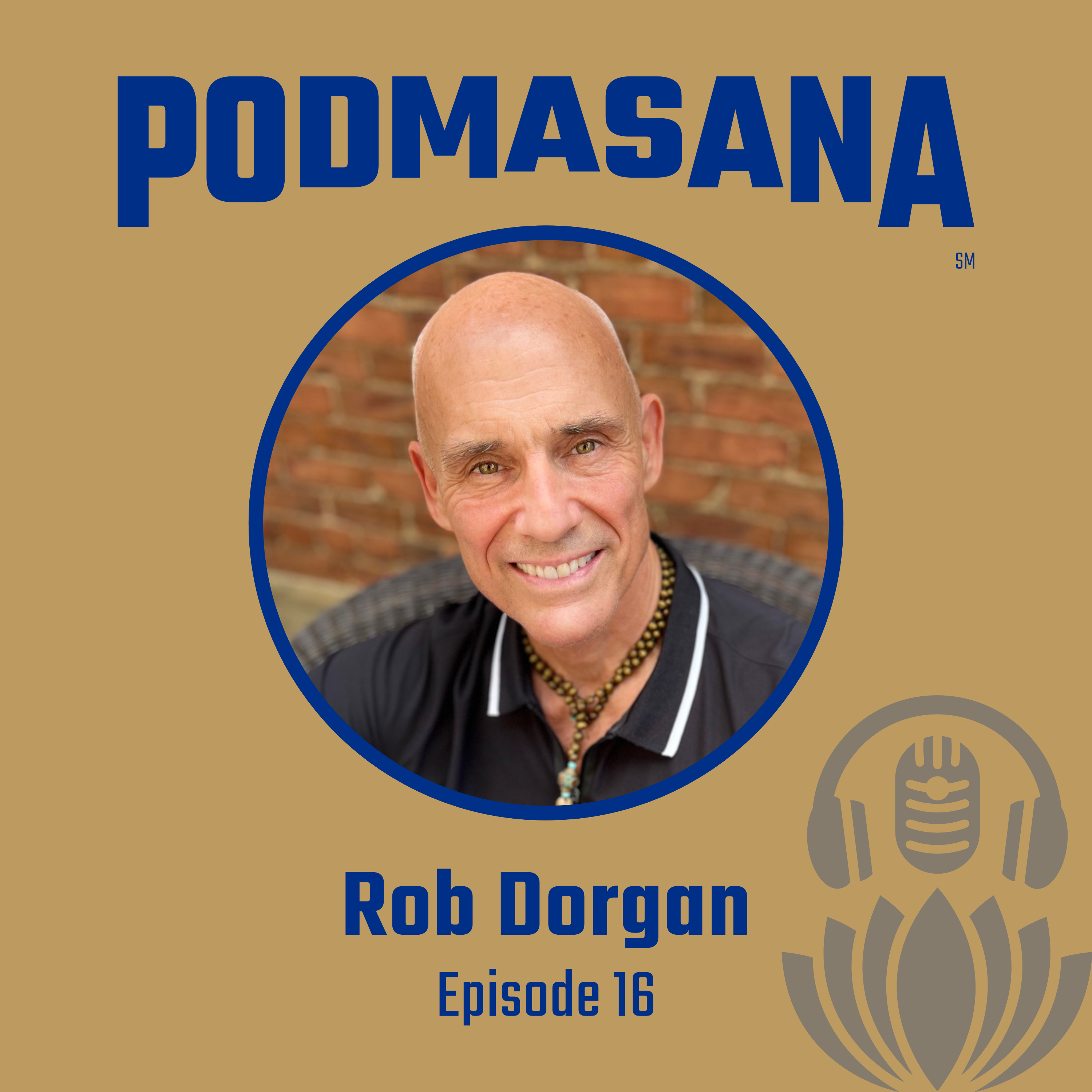
Today we're exploring these possibilities with Rob Dorgan, author of Awakening the Mystic, a novel of cosmic love and healing, a richly layered story that blends fiction, memoir, mysticism, yoga philosophy and astrology into a profound narrative of self discovery and transformation.
Rob holds an MA in European history from the University of Cincinnati and began writing fiction at age 7.
But while working on his doctorate, the trajectory of his life was drastically altered when he was introduced to the mystical arts of astrology and yoga.
He left academia and, along with his partner Steve Bullia, moved to Colorado to study and work with Linda Goodman, the legendary author of Sun Signs, Love Signs, Star Signs.
He then mentored for many years with master astrologer Alan Okun and began his study of yoga in the 1980s, when most people in the west thought it was a cult, training with teachers including Sienna Sherman, John Friend, and meditation master Sally Kempton, Awakening the Mystic tells the story of the character Ren Devlin, a yoga teacher and astrologer whose practices with yoga and meditation awaken him to perform what the world proclaims to be a miracle, reviving a dead boy in front of hundreds of shocked onlookers.
Thrust into the limelight alongside his beloved partner Sean, Ren seeks answers through his dreams and deeper states of meditation, where he encounters his council, the gods and goddesses of the zodiac, led by Saturn and Venus.
Rob says the inspiration came while deep in study of the Yoga Sutras, especially Pada 3, the enigmatic section describing cities or supernatural abilities attained through yoga practice.
He has cloaked the story as fiction, but much of it is memoir, his own exploration of what becomes possible when someone fully commits to the mystical path.
The novel is structured around Patanjali's five the mental afflictions responsible for ignorance, ego attachment, aversion, and fear of death.
To find peace, Ren must face his childhood religion of Catholicism and its negative views toward the LGBTQ community and women, battle his own ego and come to terms with his fear of being alone without Sean.
What makes this story particularly powerful is its portrayal of the legion of the feminine goddesses, female saints and archetypal guides including St Veronica, Mary Magdalene, Athena, Venus and Kali, who mentor ran in balance, compassion and courage.
The feminine is presented as essential for healing the world and and restoring balance to Masculine dominated institutions.
Rob is a certified yoga educator, international retreat facilitator, meditation teacher, and practicing astrologer.
He's currently working on a sequel to Awakening the Mystic and a memoir about his time as Linda Goodman's personal assistant and a collection of short stories about his unique childhood with his mom, Do.
On this episode of Padmasana, we explore the transformative power of love, the challenges of ego and attachments, what happens when miracles enter public consciousness, the integration of masculine and feminine energies, and the concept of united souls collective spiritual connection dedicated to healing, transformation.
We discuss astrology as cosmic guidance, the accessibility of mystical experiences, and what it means to awaken the mystic within while navigating the messy, beautiful reality of being human.
Part 1 From academia to mysticism
[00:06:20] Brendon Orr: Rob, thank you very much for being on Padmasana.
[00:06:24] Rob Dorgan: Thanks for having me, Brendan. This is great. I've really been looking forward to this.
[00:06:29] Brendon Orr: Yeah, me too. I've been really looking forward to having you on.
So, Rob, you were working on your doctorate in European history when you were introduced to astrology and yoga and everything apparently changed.
Can you take us back to that moment and what called you away from academia and toward the mystical arts?
[00:06:52] Rob Dorgan: Well, you know, it's interesting because I think even as a child I was really interested in otherworldly things. I spent a lot of time alone, but not to go too much into that, but I also, you know, like most of us, I had this. This desire to do something great with my life. Right. So basing it on like what normal, like let's just say the collective that I was seeing. I at first thought that I wanted to be an attorney up until I was, I was in college. And then what happened was I interned a pre law internship with this big firm.
And I realized, and I remember this, and this is like one of those mystical things. I remember working there for quite a while and seeing people come in and all the stress. And I remember a voice kept saying to me, if you do this, it's going to kill you. And it wasn't like a threatening, like, it wasn't like, this is gonna, you know, it was just like this subtle was just like, this isn't for you. This is gonna, this is gonna hurt you. It could kill you. I mean, that seems so harsh.
But I just remember, you know, this is before I was really meditating. So I actually think the heart voice needed to have a little authority to it in some respects for me to really listen to it. But I understood what it meant because I knew I was high strung. I knew I was an overachiever.
So what happened was I listened to it and I was like, what am I going to do? What am I going to do? So while I was still in undergrad, I decided that I would study the subject I love, which was history.
And fortunately for me, just like with the law firm situation, everybody was, yes, yes, yes, we'll hire you. Just go to law school. When I applied for graduate school in history, I got all these offers. You know, I was very fortunate in that way. So it just looked like, okay, this is it, this is building it up, right?
Got my master's degree in a year again, very high strung and very motivated. And right before I started my PhD program, I went to Europe because I'd been studying it now for years, you know, undergrad and graduate school. And I was like, I'm going to go to Europe.
[00:09:02] Brendon Orr: And.
[00:09:02] Rob Dorgan: And I got there and there was just this different feel from the. And I'll say kids, because they were my age, you know, we were in our 20s who were also doing what I was doing. And there was a different quality of life in Europe. They had more time, they were less strung out, they. Everything was kind of in balance. And it really struck a chord with me then coming back and going through the PhD program almost all the way through it just something was gnawing at me. Like again, you know, there was no voice about this is going to be detrimental. But there was a feeling in my gut, you know, like this something's just not right. I'm pushing something that doesn't need to be here. So I was looking for answers and I, I went to counseling through the university.
It was kind of helpful.
And then a friend of mine in the program said, you know what? I did something really odd. I went and got an astrological reading. And you know what? It was really helpful.
And the astrologer was also an associate professor in science. And that I was kind of like, well, that's different.
But also in studying history, astrology had always been there, you know, thousands of years. And so I was like that. The analytical part of me is like, well, okay, what the heck?
And let's just talk about the universe setting you up. You, you know, I walked into this guy, never met him. All I had done is given him my information over the phone and he just started to explain my life in front of me to the point where I was shocked. I probably was in shock and some of the things that he was saying. But one of them was that same message that I got from that heart voice. He's like, you know, you have to figure out how to keep things even. Because he goes, you're really have a very nervous energy. And he explained it because of the fact that I have Uranus in the first house, conjunct my ascendant. You know, people who know astrology will know that that's a very intense energy and very nervous. And he said, so you gotta be careful on what you do and how much stress you take on. So, you know, it was like an underscore of that first voice that I had heard. And he started explaining, you know, what about something like yoga where you can move, you know, you can use the Iranian energy, the ascendant, and you can move. But then the focus is really about centering.
And you know, back then yoga was like a cult still in the United States. Very few people were doing it, but I, I sought it out. And I just remember doing my first class in this woman's carriage house. There were about six of us. And of course I'm sitting there the whole time it starts and I'm like, what am I doing?
What, what have I done here? I've gone to an astrologer, now I'm doing yoga, you know, all that kind of self doubt stuff.
But when we went into the first Shavasana, I remember laying there in tears rolling down my face. I had no idea why.
But something, I mean, I can even bring that feeling up, that something inside of me, kind of like a knot that was there, loosened just a little bit.
And it was that knot that was in the same place that I, you know, had been feeling all this tension about my life and everything.
And I just thought, I gotta listen to what's going on here.
You know, I mean, to really answer the question, it was this self exploration because I was so concerned about my own personal well being that sent me to an astrologer. And then on top of it with that is like, I was like, how does he know all this? So I started asking questions, he started mentoring me some giving, you know, while I was still in the history program, giving me books to read. And I, I was just exploring it. So it was the road off of there was basically self preservation in a lot of ways. And really listening to myself.
Yeah, yeah.
[00:13:06] Brendon Orr: And I mean, it seems like you did leave to eventually study with Linda Goodman, who's the legendary author of Sun Signs and Love Signs and later mentored with master astrologer Alan Okun. What did you learn from these teachers that academic study could never have taught you? Maybe.
[00:13:25] Rob Dorgan: Well, I think I would Kind of have to say everything because, you know, history, the. I have gratitude for every part of my life.
You know, I am very appreciative of taking so much world history, ancient history, history of spiritualities, because it's given me a context to really put things into. But then beyond that, the astrologers have really helped me to. And my yoga practices have really helped me to put into perspective like what life is about. If we just keep going. Like if I had just kept going in that direction I was going to, I believe, for myself, there would have been a point where it would have felt, it would not have felt. I would not have had the depth that I needed in my life. What is life really about? What am I supposed to be doing? Which are all the existential questions that we ask ourselves. Some of us ask it and we look for answers and others we get really nervous and we, you know, we kind of ignore it. But to get back to that is like what Linda did and then later Alan did was, you know, they helped me to explore a different realm of reality that I really believe coexist with what we're doing on the planet.
So that, you know, then astrology started to become this great tool for me. And you know, when we talk about mysticism, Linda. The whole situation that I went through with Linda Goodman was very mystical. And I knew it, even going through it, because I had this big opening in self exploration. Her book Star Signs came out, which is very different from her other book. She talks about numerology, she talks about meditation, all of this. And I was like, just started into yoga, which is talking about finding your guru. Well, I had decided she was it and that, that I had to meet her. All right. So I basically, in a non threatening way, stalked her.
Okay.
I used my academic outline in a good way. I sent it to her and said, you know, I'm a researcher history on all this kind of stuff. And we made some contact.
But then I just went full force and my partner and I sold everything and we moved to this little town of 400 people called Cripple Creek, Colorado.
[00:15:49] Brendon Orr: Oh, wow.
[00:15:49] Rob Dorgan: And when we got out there, you know, she was very busy and she lived anyway. It just, it all the synchronicities that happened. And although we had made contact, she was very.
It wasn't able to get to her or whatever. So I took one of the practices from her book, which was use of mantra and focus. And I sat on the back deck every day and I said, looking straight at her house, visualizing her, you will meet us you will love us, and you can't live without us.
Yeah. And all of that happened, and it was really strong. I mean, and when I told her later, when we were not only just mentor and student, but then became very good friends, when I told her about that, she's like, that's. You manifested this, you know, so early on, it was like, you know, I took what I read from who I thought was going to be my guru and implemented that energy. And then the next thing you know, there we are. And so right away, I underscored the power that we have with our mind and heart. So in an indirect way, she taught me that, too, because I kind of used her own techniques on her.
[00:17:12] Brendon Orr: Yeah, for sure. And I'm wondering, Rob, you know, there's some who might hear that story and think, well, that's willpower. Right. And then maybe that's the extent of it.
How might one respond to someone who maybe says something like that? Is it more than willpower that led to that happening?
[00:17:29] Rob Dorgan: Yeah, you know, I think. I mean, there's. We. We need the will to make things happen. And sometimes we just have to grab that out of thin air and say, I am going to do this. Even though we may not feel that that's right. I think the difference with just pure willpower is that we can learn to put an intention and a why behind what we're doing and then add the intense focus, you know, And I know we're gonna talk about yoga here, but that's. I think the difference is the intention, the focus, and the willpower. Those three things together, I think, are very important, because sometimes if we just use willpower and we're really not sure why we're doing something, I feel things. I feel like things just kind of peter out, you know, But I think if we can line it up with. With our inner intent and our heart voice, I think it's a whole different ballgame then that takes it beyond willpower. Does that make sense to you? Absolutely.
[00:18:31] Brendon Orr: Absolutely.
[00:18:32] Rob Dorgan: Yeah.
[00:18:32] Brendon Orr: Yeah. Thanks, Rob. And so you had talked about it earlier, that period of time when you began studying yoga in the 1980s, when most people were thinking of it as a cult. What drew you to yoga at that time? And how did it change your life in ways that you maybe didn't expect?
[00:18:51] Rob Dorgan: Well, you know, I went to it to relax because I knew I was high strung. I was already, you know, at a young age, had had ulcers. I was having anxiety, I was dealing with depression. And now I had this. You know, everybody's like, you know, you can be whatever you want. They want you at the law firm, you know, you can be a tenured professor, all of this kind of stuff. And I was so, there was so much discontent and I was actually really trying to listen to that message. Um, so I, I guess the unexpected thing with yoga was just how deeply it helped me relax.
So, you know, I think when we find something that works for us, it can, it can almost become like an addiction. It's like I found something that's working, so I, I just jumped in, you know, I wanted to know more.
So. And back then also, unlike right now, almost all the classes that you would go to back then, the teacher was a little more well read in yogic manuscripts or philosophy. I mean, right now I teach teachers, okay, so I'm, I'm not bashing anything.
But right now you kind of have to look for that because there's a lot of people who are just taking you through a practice. There's nothing wrong with it. We need to move our bodies. But back then when you would go to a class, you were getting like my first class, she was reading from the Upanishads. I had no idea what they were, but they were gorgeous. And she's like, you know, this is thousands of year old poem. And I was like, you know, and I'd studied history, so I knew a little bit, but nothing to that depth. So I think the surprising thing that yoga gave me was it actually I got to study it, which had a sense of history to it, but also that deep sense of relaxation I realized was something early on. I kept thinking, this is what we all need, you know, we all, all need this kind of relaxation. And, and, and I hope I'm not digressing, but I want to back up for just one second. I, I, I grew up in Cincinnati, Ohio and on Public Access when I was like 8 and 9 years old, this woman named Lilius Fan started, it was called Lilias Yoga. And then Lilia S, she was on TV forever. And as a child I remember sitting in front of the TV watching this woman in pure awe. So I have to go back to her in that and just remember I was trying to do all these poses with her and I was really attracted to it. And I, I think that helped me with when the astrologer said something about yoga so it wasn't as foreign, I was like, okay, there's this woman on public access, you know, on pbs. So I went back to that and I think it helped me a little bit then, and then When I became the adult and started going to the classes, that relaxation, I think surprised me on a different level.
And I think the biggest surprise was that heart voice that kept trying to talk to me in certain ways was talking to me even more.
And the self doubt about it was starting to dissipate.
[00:21:59] Brendon Orr: Yeah, well, that sounds like a great combination of two wonderful things, BBS and yoga.
[00:22:05] Rob Dorgan: Yes, yes. And she was a great teacher and actually I was fortunate enough to have her do an endorsement on my book. And that was just like a big thing and, and so giving me chills here. She just passed away yesterday.
[00:22:20] Brendon Orr: Oh, sorry to hear that.
[00:22:21] Rob Dorgan: Yeah, yeah, yeah. 90 years old with a great life, so.
[00:22:25] Brendon Orr: Yeah. Well, that's very touching, Rob. And so the inspiration of your book Awakening the Mystic came while you were deep in study of Pada 3 of the yoga sutras. This is the section describing siddhis for those who may not be familiar with it or the supernatural abilities.
What happened during that study that made you realize this needed to become a book?
[00:22:49] Rob Dorgan: Well, the mysticism. Because what happened was, you know, I said, I teach yoga teachers and do these year long programs and we always do the sutras and we take it through. And every time I had been through a course pad of three was always just skimmed over. You know, they didn't really know how to explain it or what are these, you know, what are these things that yogis, devoted yogis can develop. And it was a lot of laughter, a lot of cynicism, all of that kind of thing, thing.
So I decided, especially for that particular teaching right before I started the book, that I was going to really dive into the, that particular section of it, Potter 3. Because I had studied the other three and never really dove into it.
So I was doing these practices, I was doing everything that they said and I was teaching the yoga teachers and they had lots of questions about it. But literally, Brendan, what happened was I was on my way to class on a Sunday morning and it was a Sunday and I was going along the river and I had this flash, okay. And I'd never had anything like it before where basically the story lined itself up.
I was driving, I was kind of the main character. I mean, I was literally living the moment and I had a vision. Of course I kept driving, but I saw all of it happen in front of me and I was like, I don't know what this is. I've never had this before, okay? And so when I got to the studio that morning, my co teacher said, you know what, I really won't we don't really need you till lunchtime. Do you want to go back home or whatever? I said, no, no, no. I went in the office and I started typing. I typed for three hours to try to get as much of it as I could. I mean, like, typing, typing, typing. And I. I really had no idea. I was trying to capture what I had just seen. And it was almost like I could rewind it and type it and then rewind it again until I got it all down, and then I typed for three months the story.
So did it come from me studying these deep practices? I had an experience I'd never had before and were. I'm studying a part of the yoga sutras that talks about mysticism and practices and what can happen if you have that, if you do these with true devotion. And at that time in my life, I was still pretty much. But at that time, especially doing really deep meditations to get into that section of the yoga sutras.
So I feel they're very much combined.
And because of that, you know, I. I have been listening to my heart voice for a long time, but somehow it took it deeper. All my studies, all the stuff came together, you know, the astrology and everything, because that became part of the inspiration for the book. So in some respects, the book itself, the way it came about, was a mystical experience.
[00:25:47] Brendon Orr: Absolutely. It seems that way, for sure. And so you've said that you've cloaked the book as fiction, but much of it is actually somewhat of a memoir. How much of the character Ren's journey, including the miracles, the meditation comas, the encounters with divine archetypes, comes from your own live experience, Rob?
[00:26:11] Rob Dorgan: Well, a lot of it. When you read the book, the first part of it, you'll hear this yoga teacher, and he's on his way to teach. And so there's a lot of memoir in it, but there is fiction to it as well.
I mean, I have been journaling since I was at least 14, you know, journaling about inner peace. And that's how the whole book starts off, is the character is looking for inner peace.
So in the book, the character develops a relationship with his astrological chart because they come to life for him in his meditations and his dreams.
That really happened. My first Saturn return between 28 and 30, I started having deep dreams. And then when I would meditate, I. I was meeting this council that sat at a long table. And at first I didn't know who they were, but then I started to realize and ask questions, and they were the mythological version of My astrological chart, you know, Saturn and Athena and Venus. And so I really started listening to them because I think they were a version of the heart voice becoming in a way that I could understand it and also coming in a way where it compartmentalized the things that we all have inside of us. And I knowing, like, which planet represents what energy, I was able to start asking questions that way. So it was a really deep experience again, you know, delving pretty deep inside myself. So, I mean, that part of the book, that's where that came from, the Council and now in my astrological practice, because of the book, I have a lot of people getting a hold of me, wanting to know who their chairperson or how their counsel is made up. So it's psychologically, I think, very helpful for some people. We all have different tools. The coma is actually a real thing that can happen. You know, I studied for a long time and very closely with Sally Kempton, and she was also very helpful before her passing on, encourage me, encouraging me to finish the story and to actually put it out there, because I was.
I was very leery.
I know it probably doesn't come across right now, but I'm an introvert and putting myself out there is not really the easiest thing. But in my studies with Sally, one of the things that we studied and talked about was it's called a recapitulation meditation. And sometimes yogis will go into this deep recapitulation where they're working through something really intense and it can. It can last for days where everything slows down. Their heart rate, I mean, all of the metabolism stuff slows down. So they need very little to exist while they're processing. All of all of these things. I was fascinated by that. I feel like I've had mini versions of it myself.
So to take Ren, the main character, into a meditation coma, it felt right. And again, I can't take a lot of credit for it because as I was typing, it just kind of came out and I was like, oh, my God, he's going to go into it, you know, he's going to laugh, you know, because that's how the whole process worked. So they are real, they are experienced by certain yogis, even, like I said, in these little mini versions of it. But yeah, so there's that. And then the miracle. Well, that's chapter five. And it happened to me in a vision to the point where it felt extremely real. And I still have dreams about things like that happening, reanimation.
And it's very interesting to me to look at the symbolism of that. Like I just had one last week with a blackbird.
So very, you know, very interesting kind of mystical situations with that as well.
[00:30:11] Brendon Orr: If you're a devoted listener of the show, becoming a Podmas plus member is a great way to provide ongoing support of the show and get extra perks across three tiers such as early access to ad free episodes from the growing Pod Masana archive, discounts on merchandise and optional recognition and show notes and on Padmasana's website.
Higher tiers also get access to bonus episodes, a private chat group, live video Q&As with featured guests, a personal thank you mention in episodes and more.
Listeners can support the show via monthly or yearly subscription starting at just $3.99 per month.
A 20% discount is applied to all yearly subscriptions.
Yearly Podmasana plus subscribers even get free merchandise.
Subscriptions automatically renew and there are no contracts.
For more information, visit podmasana.com/ you can also make a one time or monthly donation to support the show at podmasana.com support 1% of all revenue from Podmasana+ memberships and donations are committed to carbon removal.
Thank you so much for considering a Podmasana plus membership.
Your support means a great deal and your subscription helps to cover the research, writing and audio production by that Go into every episode of Padmasana.
Part two.
Kleshas, Miracles and the Feminine
[00:32:00] Brendon Orr: so Rob, the novel is structured around the five Kleshas, the mental afflictions that cause suffering according to Patanjali.
Why did you choose these as the framework for Ren's spiritual evolution and which Klesha was hardest for you personally to work through?
[00:32:20] Rob Dorgan: Well, you know, with studying the yoga sutras, you know, certain things because I'd read it so many times in so many different interpretations, you know, either just for my own personal self or to prepare for classes. But you know, the first time that I read about these five afflictions I was like, that makes so much sense to me. And just to name them very quickly as ignorance is the foundation if we, if we don't have knowledge.
And then the ego, because the ego is so tricky. That's that sense of I that we start to think is the only thing that we are.
Then attachment and aversion actually work together as people that are listening can probably identify with. We have so many likes and dislikes. Oh, I like that. I don't like that. But for the most part we don't really need to even dwell on it. But the ego does because it gives it something to Do. And it also gives it a feeling of a sense of importance.
And then the fifth one, Abhinavisha, or it's called the fear. Fear of death. Fear in general. And that's that, you know, another existential issue we all have with our mortality. You know, why are we here? And then, why does this end? That kind of thing. So when I was studying them originally, I just thought, these make so much sense to me, that they really are. Especially the more I meditated, I realized that a lot of the things that my mind was throwing up at me were in these categories, you know, and so it was like those had always been something that I had really studied.
But going back to something that I said earlier in part one is that a lot of what I was writing was just coming out somehow. Now, I. I know that because I had this knowledge. It was in there.
But the structure coming out through the cliches actually surprised me at some point. And I was like, oh, wow, this makes a lot of sense that the character is going through these. And I had been attracted to them, so that's kind of how it happened. I mean, I had knowledge of it then. I feel like my muse brought that through, structured the book around it. I also think it's something that people can relate to. They can take out all the Sanskrit words around it and just get down to ignorance, ego, attachment, aversion and fear. And people can identify with it, you know, because that's one of the things with the book. Somebody's like, well, am I going to get bogged down in all this yoga, all the words? There's a glossary if you want to learn it, great. But if not, you can just read the story for what it is.
And, like Ren. Ren's the main character. I think the hardest one for me is ego, because it's so tricky. It comes up in so many ways, you know, oh, I think I'm doing the right thing. But then when I sit back a little bit or I meditate on it, breathe deep. I'm like, oh, there's the ego. And. And in the story, Ren is tricked several times by ego. Even when he thinks he's doing the best thing for the world, he realizes that it's really his ego that's there. And it's so tricky that we really have to be aware of it. And that's why, you know, meditation is so important, because it helps us to really ground and see these what. What the yoga sutras calls the afflictions for what they are, so that we don't get trapped in them and we can move forward.
[00:35:44] Brendon Orr: Yeah.
[00:35:45] Rob Dorgan: So ego for me. And that's how the structure came about.
[00:35:49] Brendon Orr: A lot of truth there. A lot of truth there, Rob. Thanks. Yeah. So the character Ren performs what the world calls a miracle, reviving a dead boy in front of hundreds of people.
You present this not as supernatural, but as a manifestation of collective love and spiritual practice.
How do you understand miracles? And why do we resist believing they're possible?
[00:36:16] Rob Dorgan: So, Brendan, you know, in history, if we. The further back we go, we realize that, you know, our ancestors had much more of a spiritual existence just as it was. I mean, they would just. I mean, they were trying to understand life, so they would look at the sky and try to figure out what their part was, their connection with nature, trees and animals and the rituals that they came about. And I think we've moved away from that, you know. So part of it is religion. When we talk about the dogma part of it. I mean, religions have. You have a spirituality underneath them. But when we look at the dogma and the hierarchies, we kind of lost connection with the divine connection that we all have. And man made things started to separate us from the divine.
So, you know, dogma, let's just say that in organized religion, to control each other, we. We came up with that. But then even. Even science in the 1700s, when we look at the scientific revolution, we deified science.
I love science. It's really helping us out. But it's not all there is. And some of us, that peace. If you can't prove it by science, it doesn't exist.
Well, there's lots of things in our modern culture that weren't that couldn't be proved by science even a hundred years ago.
So where is that leading us to? Right, so miracles. Right.
Miracles are basically things that happened that we can't explain with our rational mind. But again, going back to losing our innate connection with the divine, which is what I think a lot of us have done, which has led to depression and trauma and all of these different things, because we are connected. And when we lose that connection, we feel that ego. I is the only thing there is. And that's really lonely, you know, because relationship is very important. We come in alone. I know that for phrase we go out alone, but, you know, in the middle, it's a lot about relationships. And so why have we, like, lost contact with miracles? I think we all want to believe in it, just like we want to believe in the power of love. But I think we've been so Programmed to be rational. And a lot of us, all of us, have mystical tendencies and connections, but we poo poo it or we say, eh, I'm just making that up. It's coincidence. There's no such thing. You know, Carl Jung, the Swiss psychologist, said, he said if we were aware of just how much synchronicity was happening around us all the time, it could drive us crazy because we are so connected and there is such an interesting tight web. So that's where this power of love comes from, this, the connection. Because I really think that's where we come from, all of us, you know, we're all cosmic space stuff, organically we are. And we're all related in whatever else is out there. We're in this illusion of the I takes us away, I think, from believing in our own self. Because I'm not saying have faith in something that somebody else told you. My big thing and the thing I've learned from astrology and yoga is believe faith from the experience of yourself, from what you see and hear and feel and what is in your own heart, and then experiment from there.
[00:39:59] Brendon Orr: Yeah, those are some great wisdom nuggets, Rob. Thank you. Yeah.
So the story, Rob, prominently features a legion of the feminine. We've got goddesses, female saints like Mary Magdalene and St. Claire, and archetypal guides like Athena, Venus and Kali.
Why was it essential to center feminine power in this story about a gay male yogi?
[00:40:25] Rob Dorgan: Hmm, yeah, you know, part of it. I think it's a little twofold here. I personally have always felt the strength. I have had incredibly strong women in my life. My mom from my mentors, some of the wisest humans on the planet. For me, in my influence have been women. So I think, you know, we can take it, we can take part of it as that the muse that I feel like is coming through me for this story and for some other things is definitely a female, probably Saraswati, because she represents inspiration and artist. And that was something that Sally Kempton and I, my meditation mentor, talked about. And it does feel like that. Like I have a large painting of her back behind me. We have in our society relegated the feminine energy to either second class or non existent for far too long.
And honestly, it doesn't make sense. Nothing, nothing exists without both energies. Male, female, the masculine, the feminine, you know, but we've relegated it to something else so we can control it.
And like I say in the book, I, I, you know, we can look at it as one way it's coming back.
We all find that we need to nurture. I mean, even those of us who are feeling off kilter by all the media and stuff, we're finding solace when we go inside and we find a more feminine, softer way to nourish us. Right.
But it was important in the story also that that nurturing is not always soft.
Like the chapter that I did on Athena where she basically takes the main character down into a dungeon and shows him his life through a cauldron. And she's so intense.
But it's important because he needs that. He needs that almost. Kali, the Shriekryal, all of that feminine energy that is.
That is rising up along with the nurturing. So does it matter that it comes through a gay yogi? I think it matters that it comes through a male yogi.
Because the lesson and it's even said in here, it's like men need to recognize me talking about the feminine energy and need to speak up for me and need to be able to start to bring me back. Because we all talk about wanting peace and harmony and we can't have it if we're all in aggression in just Mars energy. I'm not saying that we don't need that too, but it has been leading us for look through what we written history.
And now we need a shift, we need a combo. We need to bring the two in harmony. So I think that's really why it was so important for it to come through a male. And also, you know, all of that energy coming up, I mean, all of the feminine stuff about Mary Magdalene, how her gospel relegated, you know, aside. But part of the gnostic gospels, the fact that the Vatican is built on an old temple to a goddess named Sybil, you know, who could see the future and make predictions and help by helping people, you know, it goes on from there.
So I think it was an important piece to the story that needed to be there is. And we can all do it through meditation. Tap into her, tap into Mama.
[00:43:51] Brendon Orr: Love that Rob.
[00:43:52] Brendon Orr: Thank you.
[00:43:53] Brendon Orr: And so Ren's natal chart is dominated by Saturn and Venus. Discipline and love as co chairs of his soul's journey. How does astrology function as cosmic guidance in your life and in the novel? What do people misunderstand about astrology's role in spiritual growth?
[00:44:16] Rob Dorgan: Yeah, well, Fran and I, the main character I've put on him is that we believe that we choose our chart just like we choose our life. So, yes, you know, I'm talking about a belief in reincarnation.
And I say that because I don't know, you know, it's It's a. What resonates with us. And it seems like there, there's some, seems like there's some kind of reality around that concept. But you know, in. Even without that astrology, like my first basic astrology teacher, Linda Goodman said, our, our astrological chart is our karmic playpen so that we have the parameters of what we need to learn this time so we can spiral upward.
So if we need to learn things about love and relationships, let's just say which would be very Venus, then that that energy is going to be significant in our astrological chart. If we need to know something about discipline, like Saturn structure, all of that, that's going to be prominent. But that playpen is in our natal chart. And the more we study it as a tool, it can help us to make better decisions. It plays so much along with yoga, you know, and, and I, and I mentioned earlier is that it's been around for so long. Doesn't that make you just want to at least explore it, to see what it has to say? Because so many people just think that it's just your sun sign and oh my God, it is so much more than that. It's this whole conglomeration of, of all the energies coming together to make us a unique individual that I, that we take back through yoga to know that it is just one of the many. And then how do we work with that individuality to actually uplift the collective, uplifting our consciousness? So yeah, the karmic, the karmic playpen is there using it astrology for me, as a spiritual tool, just like yoga. And I always say to my students, they work so well together. They're like sister arts and sciences behind them. And working with them helps us to kind of like lift our energy, you know, and to anybody that's listening, that is just like, oh, whatever. It's like that in itself is a sign when we have such a strong aversion to something that goes to, back to the Vidya of the cliches, you know, it's like when we have such an aversion to something, why. And can you open yourself up to at least study it enough? I mean, that's what happened to me. I had a total like, I don't even get this back in my 20s. And now here I am writing a book doing astrology and yoga as a living because it really resonated with me. So if we get pushed around by our mind all the time, by our aversions, we may miss out on some really cool stuff.
[00:47:13] Brendon Orr: Absolutely. Rob.
[00:47:13] Brendon Orr: And that resonates a little bit with me. You know, I joke about with people in my yoga circles that the first
[00:47:19] Brendon Orr: yoga class I ever attended, I hated straight up. And I didn't take another yoga class for two years, because in that class, the reality was, is that I became very aware of how noisy my inner world was, and I. I wasn't conscious of that. That framework at the time, so. But eventually, you know, you come back to it, and it becomes a real big part of your life. So just echoing what you said. Yeah. Maybe look at the. Why, if you have these strong aversions to anything, really. So. Thanks, Rob.
[00:47:52] Rob Dorgan: Yeah, exactly.
[00:47:53] Brendon Orr: Yeah.
[00:47:54] Rob Dorgan: So that's how I've used it and using it as a tool, basically, to get closer to my own heart.
[00:47:59] Brendon Orr: Yeah.
[00:48:00] Brendon Orr: Yeah.
[00:48:01] Brendon Orr: So the book explores Ren's complicated relationship with Catholicism, and we've touched on this a little. You know, we do have an historical repression of LGBTQ people and women, but also its potential for transformation.
As a gay man who grew up Catholic, how did you navigate writing about a tradition that may have caused harm while still seeing potential and possibility in it?
[00:48:29] Rob Dorgan: Yeah, and it's interesting because, you know, people who are reading the book who grew up Catholic are like, actually, I think you're so kind to Catholicism, and. But here's how I would. I'd like to answer that is I have gratitude. I. And I. I try. Let's just say I am trying to develop gratitude for everything about my life. And I know for people who've been through some trauma, that can be very difficult. And in this case, just like the main character, I was rejected by a religion that I was trying very much to fit into.
My.
I went through first to first grade, through college, in Catholic institutions.
So I was kind of committed. You know, it's a long story, but. But, you know, there was, like, this sense of rejection at first because the situation in the book where the main character is told by a priest, you know, you can't be gay and Catholic. I mean, you can be. The catechism says, you know, treat them with respect. And anyway, I'm trying not to be too cynical here, but it also says then you can't be in love with anybody or do anything about it. So that doesn't make sense. But I have gratitude for every piece of my life. I'm trying to develop that, and I have that, even with Catholicism.
Devotion, prayer, ritual. Oh, it's in my veins because of Catholicism.
But then what we. What I think, you know, when the repression. There was no repression of Same sex relationships really until about the 12th or 13th century.
So why, you know, I mean, why did it come about? You know, and some of it's because of they needed people to procreate, to keep their wars going.
The male dominance of, you know, what it meant to be male was coming up and just control in general. So it's like this repression didn't even really get going. And then when you read some of the church fathers, it's not even a thing for them at all. So I also like to look at the spirituality part of Catholicism and for me to say that, you know, Catholicism is based on the words of the Christ, we have a completely different situation because if we just take all of the teachings of the Christ, we're talking about love.
He never says anything about being gay. I mean, you know, the word homosexual doesn't come into existence until the 1860s. But even, you know, any, any kind of reference like that. And again, something so old, like I said earlier, I said, you know, astrology has been around for a long time. Well, what is it about Catholicism that attracts people? Is there some truths to it?
And their network is wide.
So can you imagine if the teachings really changed? And maybe they are.
And so I see the possibility in how that that can happen.
And I, I tried show that somewhat in the novel, the relationship between the main character and the archbishop. It was an archbishop, a priest, a Catholic, that really got Eastern religion. And there's a lot of them out there.
There's a lot of Catholic priests and nuns who are incorporating that. I mean, we can talk, you know, most, probably the most famous would be Thomas Merton, but it's like we're seeing that in so many other ways that they're being integrated. I do see the possibilities of any spirituality when it gets back to love and away from dogma and trying to control people of having potential because all the spiritualities can do that if they join together.
So I think that would be the biggest part of the Catholic part of it for me, you know, and it's been a big part of my life and I do have a deep sense of gratitude for it, for what it's done for me.
[00:52:50] Brendon Orr: Hello, listener, Brendan here.
Do you or someone, you know, have an article or book to share, a work to highlight or story to tell that would be a good fit for Padmasana?
If so, feel free to reach out via
[email protected] that's ideasodmasana.com and we'll be sure to get back to you.
Thank you.
Part 3 United Souls, partnership and the work ahead.
[00:53:30] Brendon Orr: So, Rob, in the book, the characters Ren and Sean's relationship is portrayed as United Souls, a cosmic partnership dedicated to mutual growth and service.
You've been with your partner Steve Bolia, for many years.
How has partnership shaped your spiritual journey? And what makes a relationship a vehicle for awakening?
[00:53:55] Rob Dorgan: Hmm, Great question.
The fortunate thing about our relationship, and we may not have been completely on a synchronized path all the time, but in a lot of ways, we're accepting of each other. Steve always says I'm like, one step ahead. And I don't want this to sound egotistical, but, you know, I'm like the one that wants to research, I want to experiment, I want to do this. And then he'll be like, what's going on? And I'll be like, blah, blah, blah, blah, blah. Try this. And so I kind of pull him forward. Now, there have been times where it's been the opposite, so I. It's not always like that. But the beauty of it is that we are both questing for something more and answering questions. And so I think that that partnership is what comes across in the book for Ren and Sean as well. This United Souls is when we are in.
When we are in a deep connection of relationship, where we're supporting each other.
So with that said, it doesn't always have to be the same path, but if two people. Because I've got people, you know, in my counseling that are on very different paths, but they support each other by.
And I'm just talking about. By the way they communicate about it, you know, not poo, pooing anything or. But maybe being interested in asking questions. And again, then they open themselves up to it. Steve and I are very fortunate that the. He grew up very agnostic, which he's a very unusual person on the planet, I believe, which grew up with almost no religion or spiritual whatever. So everything was new to him. And so we've been on this path of astrology and yoga together. And I think that has been very helpful. And it also is why we're doing our work together. Although my name is on the front of this book, he could very well have been a co author on it because he did so much with the editing, so much guidance and advising, especially once we started working with. With the publisher and United Souls, the US, the capital U and the capital S.
I do feel like he and I and the two and the main characters have that. But the point in the book is that we can all have that. Like, really, that's what we're moving to through what we would say with yoga and meditation is, you know, we move through the cliches, and we realize that the I makes us an island. And so we. We really can open ourselves up to realizing that we're all the same now. There are differences in us, but when I say all the same, what I'm talking about is the heart stuff, you know, and the love part.
And in that case. And we get out of attachment aversion, or we educate ourself, we're back to the cliches on the stuff that we need to learn so we can move out of discrimination. Discrimination is just a wall that keeps us from wholeness within ourself.
And so the united souls is a concept that comes up in the book because we can all do that. That's where the miracle comes from.
Ren is a conduit for the collective energy.
It gives me chills even to just state it like that. But that is really what the story is. This isn't necessarily Ren doing miracles.
It's him being able to tap into the collective and feeling unconditional love.
That's.
That's the united soul part. And that's not easy until we really develop the habits of yoga, where we're always questioning ourselves through our discrimination, always, you know, questioning our attachments and aversions and keep moving forward.
So that's the united soul part of what people can have with their partnership. But then we can extend that love out to other people.
One example I like to use is. And I think that people who have animals can feel this, that unconditional love that's between you and your pet, you know, or, you know, you might have a string of pets throughout your life, and there's that one. Like, we have one cat that we call our guru cat because there was just this strong connection of, like, love and understanding. And I think that's possible with humans, you know, so.
[00:58:22] Brendon Orr: Yeah, no, it's touching stuff, Rob. Thank you. And so you're currently working on a sequel to Awakening the Mystic, which is a memoir about your time as Linda Goodman's personal assistant and a collection of stories about your childhood with your mom, Dottie.
[00:58:37] Rob Dorgan: Yeah.
[00:58:38] Brendon Orr: What can you tell us about these projects and what's maybe the through line connecting them?
[00:58:44] Rob Dorgan: Well, so the sequel to Awakening the Mystic is one thing. Then the Linda Goodman book is another, which is about gurus. And then the one about my mom all started in a writing class that I take weekly, and she just kept coming up, but she's a big influence in my life. Very strong female character, as is Linda Goodman. The thread with all this, I guess, would go back to the strong feminine essence there with Awakening the Mystic. I think there's more to be said about the story, so that's starting to weave itself. I've got a couple chapters written and things are moving in that direction.
The story with Linda Goodman is that although she was a great mentor of mine, she was also a very challenging person for me, even though we became friends.
And I think that understanding what that phrase guru is, I was ready to give over my power again, like I had earlier in my life, to Catholicism. And Linda was another part where I was just ready, I'll do anything. I mean, we became her personal assistants, we were answering her mail, we helped her edit a book, all this kind of stuff. And I was just like, ready to just throw out this one for this one, right?
I, I, this is my personal thing.
We can have teachers and mentors, but gurus, there's a fine line there. I mean, in the yoga world, anybody listening can. Without me going into stories, we hear those, right?
Guru I am not sure of.
My teacher Sally Kempton always talked about her guru, but I think that story is about becoming confident in our own power.
The one with Linda, the one with my mom, is, I think, pretty much pure joy.
But she was such a character. Like, I mean, the stories are hilarious, but they can also be very serious at the same time. You know, I mean, she was very social and all of that. But if there's a thread between those books, I think it is my belief again in the feminine essence. I mean, my mom was a big reason for who I am supporting me. She was an extrovert. I'm an introvert, but when I do something like this and I'm extroverting out there, it's because I lived with her as part of it, you know?
So, yeah, I think that those would be the things I would say about the projects I'm working on right now.
[01:01:13] Brendon Orr: Great, Rob.
[01:01:14] Brendon Orr: Well, that's definitely some stuff for people to look forward to. Thank you.
[01:01:17] Brendon Orr: And as a certified yoga educator, meditation teacher, and practicing astrologer, you work with people one on one to help them uncover their inner counsel for a fuller life.
What does it mean to discover your inner counsel? And how does someone begin listening to these guides?
[01:01:40] Rob Dorgan: Well, they probably already are, especially if they've got some kind of meditation or yoga practice or self inquiry, whatever their internal practices might be.
But I think when we talk about the guide, it can give them specific examples of things like, for Instance in our chart, we have certain energies that are stronger than others.
[01:02:02] Brendon Orr: Okay.
[01:02:03] Rob Dorgan: Like, when I talk about the council, it's really about finding out who the leader of that council is. So it helps you to focus on, like, what your issues might be. I mean, that's how you can use that concept, if it resonates with you. It's very psychological in a way, because the 10 planets, the two luminaries, and the eight planets, they're representing these archetypal energies in all of us.
Some of them are stronger than others. For us, if we go back to the book, Ren's issue is the fact that his two energies that are so strong for him is Saturn's discipline, this fatherly discipline, and the Venus in Pisces, this overall collective love. How can you make that work together?
Well, one example is showing people by example how they can work together.
You know, maybe writing a book about universal love and putting it out there for people to maybe get some inspiration from. So that's how I see it being used. And I. Like, in my astrology practice, I'm not predicting things. I am using it as a. Basically a psychological tool. Though I'm not a psychologist, I do sound like one a lot of times during my readings. It's like bringing the psychological components of us together so that we can see, like, where we might be. And then you can take it back to the cliches, right. More knowledge helps us to understand the ego. The ego's being pushed around by certain energies or. Or it throws out certain things. That same energy as the attachments and aversions, and sometimes knowing all that can tell us what our biggest fear is.
So it can help with all of that, bringing it full circle.
[01:03:53] Brendon Orr: Yeah, that's great, Rob. And so Awakening the Mystic touches on the mastering of fear of death through surrender and compassion, while acknowledging that spiritual evolution is an ongoing process.
Where are you now in your own journey through the cliches? And what has awakened in you since writing this book?
[01:04:16] Rob Dorgan: That's a great question, because, you know, in astrology, we are facing energetically. The collective is facing energies. We're in epic times that we've not faced before. I mean, there have been other times where humans have had to face things, but we're facing a lot, a lot of intense energies. And I also believe we're here for a reason, to help each other, to lift our consciousness and everything.
So I'm really trying to stay with hope.
So I have to move back out of sometimes listening to too much media.
So I would say in my journey. I've gone back with all my skills that I've looked at and now I'm looking at my ego again.
Because the ego is what's getting caught up in like, oh, what if this happens? And what if, you know, the country and all these things? It's like that, you know, it's like, it's like so. But I think where my evolution is taking me is that I'm, I'm, I'm really recognizing the ego and I'm sitting longer because what will be, will be whatever is. However, because I really do believe consciousness is spiraling upward, but in the tantric way that I have studied yoga.
We experience dark times to take us further up.
The times that we think are the most intense in our life are usually the things that will push us forward in our own evolution. I think we're in one of those. And the best thing I think that we can all do, and this is what I'm doing, is I'm going back intensely to my practice.
Because as we sit in meditation and we actually use our heart energy to emanate love out, we affect the collective.
See, and there's a miracle because that can't be calculated or studied by science. But you know that when you've given empathy to someone and they feel it, or they feel you and they call you and they're like, I just feel, felt you. We can do that. So in my evolution right now, I am talking about, in the book and in, in my teachings about this mystical revolution is us finding our heart and really strengthening it and sending that love out to our network. And hopefully then they go on from there and there because we really are connected by a silver thread of light through each human heart.
And when we close our eyes and imagine sending love through that thread out to everyone, we are affecting the world more than we know.
[01:07:01] Brendon Orr: Powerful stuff, Rob. Powerful stuff. Somewhat related, but the last question I have for you is you write that the book is full of real possibilities for the future of our human species and Mother Earth.
What are those possibilities and what would it take for humanity to collectively awaken the mystic within?
[01:07:25] Rob Dorgan: Well, I, you know, like I said, the connection is love. And depending on your circle, there are more of us out there doing this, opening our heart.
There's. First of all, I mean, there was up until like the last, I don't know, maybe since the 1960s or 1970s, there wasn't a lot of talk of modern, modern day mysticism. And it's growing.
So that mystical revolution that I'm talking about is A real thing. And that's where the possibilities come from. But what I think we have to do is we have to find our community, and we also have to believe in ourselves.
We have to believe in the power of love. We have to believe that it is the strongest energy on the planet and it is what connects us. And there's a lot of misguided energies right now that seem to be tearing it apart. But that's where our practices come in, pulling it back in. I believe this to be true. Now, the ego gets tricky because we think it has to happen right now. Well, if I'm going to sit in this devotion, it's going to happen within the next.
Just, you know, put in whatever time frame your ego thinks it should be, and it may be longer than. Than that. It. Maybe it won't, I don't know.
But it's like just putting it out there. Knowing strengthening yourself is a. Is a conduit for love is so much more important and valuable work than any of us know. We need more mystics. That's why I call it the mystical revolution. Learning to sit and focus. We go back to the sutras. Patanjali says, if you can't focus, you're not going to change your mind. And if you can't change your mind, you'll never hear your heart.
So finding the way through breath, work, whatever the practices are, to really get to that place where you can calm down and we can all calm down. You know, people in my meditation are always like, I'm one of those few exceptions that can't meditate. It's not true because it took me a long time, and I know a lot of people, it took them a long time.
But as we let things settle, our life changes and our spark then becomes stronger, and it helps the next person who feels your energy and it spreads out. So the possibility is change can happen.
You know, what happens if we just have, you know, we're all afraid of, like, a mass destruction. What if more and more of us are doing this and all of a sudden there's just like this opening? And I think those are happening in different circles.
Yeah.
[01:10:18] Brendon Orr: Yeah, I agree, Rob.
[01:10:19] Rob Dorgan: Hope and possibility always there.
O shanti, shanti, shanti
[01:10:31] Brendon Orr: O.
[01:10:47] Brendon Orr: If you enjoyed this episode, please share it with people you think would also enjoy it.
You can also leave a review or rating on your preferred podcast listening platform and be sure to follow the show to subscribe to future episodes.
You can also email
[email protected] or reach out to us on the socials we're on Bluesky, Mastodon, Instagram and YouTube. Catch you next time on Padmasana.