[00:00:00] Intro: Foreign.
This is Podmasana and I am Brendon orr.
What if the trauma, anxiety and chronic pain you've been carrying for years isn't just in your mind, but actually stored in your body, waiting to be released through the very nervous system that's been holding it?
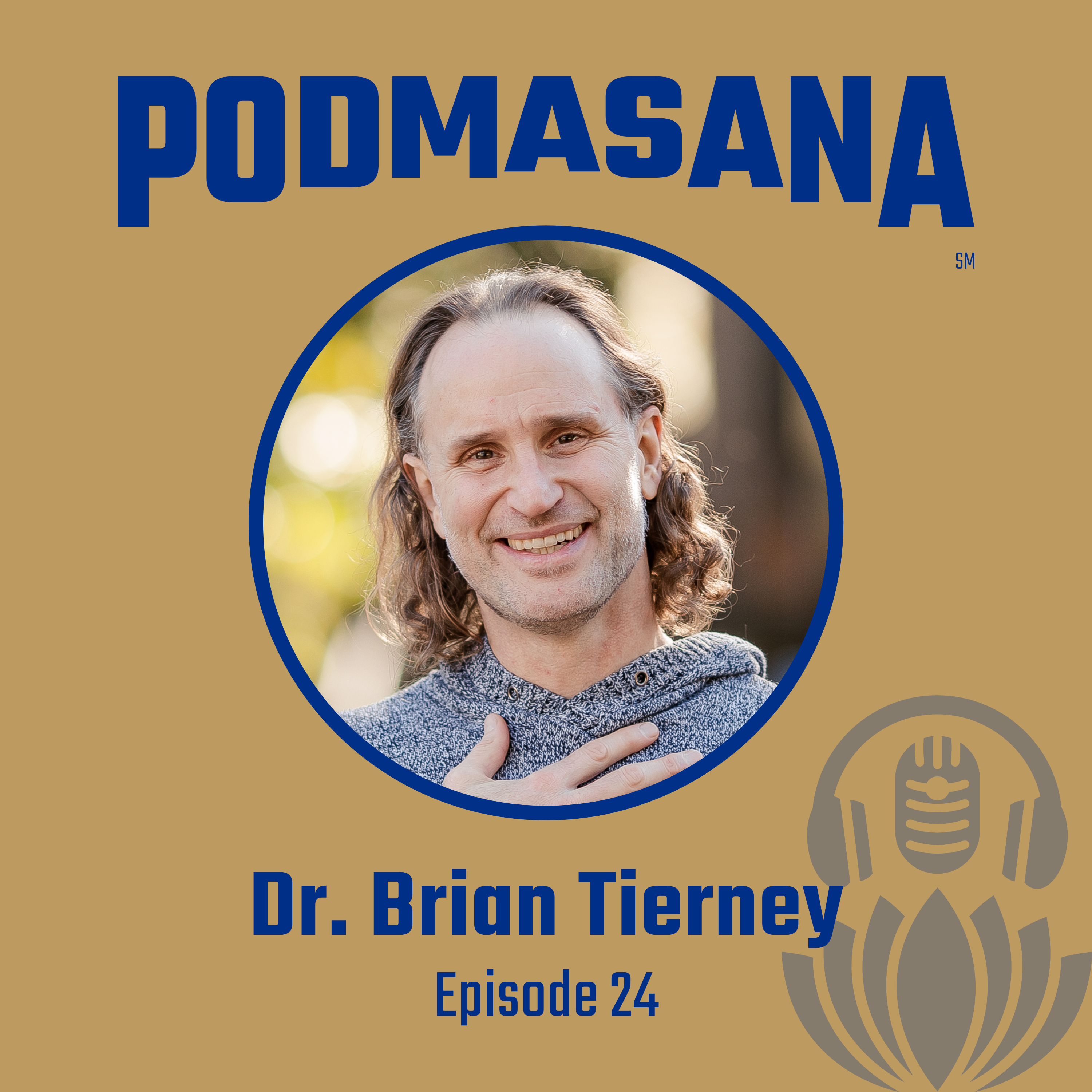
Today we're exploring that profound possibility with Dr. Brian Tierney, an integrative therapist who has dedicated over two decades to bridging cutting edge science with ancient healing wisdom.
His work offers a radically different understanding of trauma and emotional suffering, one that recognizes the body not as a barrier to healing, but as the doorway through it.
Dr. Tierney holds a PhD in somatic psychology, and his doctoral research is nothing short of remarkable, weaving together somatic psychology, sociology, anthropology and embryology, neurobiology, mythology and general systems theory.
For more than a decade, he's served as an international trainer of somatic clinicians, teaching practitioners worldwide how to work with the body as a path to psychological healing.
As an adjunct professor at the California Institute of Integral Studies, he brings academic rigor to embodied wisdom, but his expertise extends far beyond the classroom.
Featured in mind, Bodygreen, Yoga Journal, well Plus Good and Men's Health, Dr. Tierney has become a trusted voice in the wellness world for his compassionate, science backed approach to trauma resolution.
He hosts the Boundless Body podcast and is author of the upcoming book Visionary Somatics, where he continues exploring how ancient practices can inform modern psychology.
His work with men's groups over the past 20 years has given him unique insight into masculine vulnerability, healing and transformation.
But what makes Dr. Tierney's approach truly distinctive is his integrative method.
Unlike traditional talk therapy, which addresses trauma primarily through cognitive processing, somatic therapy recognizes that trauma lives in the body in held tension, chronic pain, shallow breathing and dysregulated nervous system responses.
Dr. Tierney's work extends beyond individual therapy.
His somatic executive coaching helps high performing leaders in Silicon Valley and beyond address what conventional coaching the nervous system.
Most leadership problems, he argues, are caused by dysregulated nervous systems, resulting in burnout, reactive decision making and emotional exhaustion.
By teaching leaders to regulate stress responses in real time, make decisions from grounded presence and lead from their whole selves, he's transforming how we understand professional excellence.
At the heart of his practice is a conviction that healing isn't about managing symptoms, it's about addressing root causes stored in the body.
The freeze response, the hypervigilance, the chronic tension.
These aren't problems to be overcome through willpower. They're the body's intelligent survival strategies waiting to be completed and integrated.
On this episode Of Podmasana we explore how trauma affects both mind and body, why somatic approaches succeed where talk therapy alone falls short, what it means to regulate the nervous system and build resilience through embodied practices, how ancient wisdom traditions inform modern neuroscience, and why the path to spiritual awakening often requires releasing what's held in the tissues.
Whether you're a trauma survivor seeking lasting relief, a practitioner curious about body centered healing, or a spiritual seeker recognizing that enlightenment must include the body, this conversation offers essential wisdom for an embodied human journey.
Hey, listener. Brendon Here to quickly talk about my Mindful Moment Podmasana sibling podcast.
You know those moments when enlightenment, insight and wisdom find us, when the universe speaks to us during periods of adversity, joy, or stillness, and we feel more aware, mindful and present having listened to it.
What if we took the time to record those moments and share them with others?
This is the inspiration behind my Mindful Moment, where you are invited to listen to the mindful moments of others from around the world and share your own.
You can email your mindful moment to mymindfulmomentodmasana.com and for more information, visit Podmasana mymindfulmoment thank you. Now enjoy this episode of Podmasana Part 1, the Somatic Revolution.
Why the Body holds the Key Brian, thanks for being on Podmasana Thanks, Brendon
[00:06:10] Brian Tierney: Good to be here.
[00:06:12] Brendon Orr: Brian, you hold a PhD in somatic psychology, and you've been teaching this approach internationally for over a decade, but most people are still unfamiliar with somatic work.
Can you start by helping us understand what it actually means when we say something like trauma lives in the body?
What's happening physiologically that makes somatic approaches essential for healing?
And why does talk therapy alone often perhaps leave people stuck in the same patterns?
[00:06:50] Brian Tierney: Yes, so I like to think of it as I'm a body mind specialist. Somatic psychology specializes in orienting to this body mind connection.
So, yep, trauma lives in the body. It lives in the brain. You know, the brain is our meat. It's our. It's our objective. You know, if we want to use the. The sort of computer metaphor, it's our, it's our processing organ, you know, computational processing organ. And so I think it's more than that. It's more mystical than that. But, you know, when you see a somatic psychologist, we're going to be doing stuff, you know, more than just the stuff of interpretation or behavioral analysis or, you know, looking at cognitive frames. All that stuff is there in psychotherapy with a somatic practitioner. But really we're Going to be focusing on things done like breathing practices, awareness practices, tracking, you know, sensory outputs in the body. What, what, what are we feeling in the body? In the here and now?
We're going to be trying to. I, you know, my, my joke is that somatics is a lot like plumbing because we get clogged up, especially emotionally, in the body. And there's only so much you can do by way of interpretation and family of origin work and stuff like that, before we got to attend to the emotional clogs. And that of course involves trauma as well, because trauma is a repressive mechanism, you know, that, that gets us to thwart our expression and things like that, and that, that lives in the body. Those, those past experiences live in the body.
The. Unfortunately, the field of somatics is somewhat fragmented, meaning we don't really have much of a governing body to hold the theory together, you know, kind of across paradigms. So there's a lot of branding and not much cohesion in terms of getting together a literature base to go evidence based, which is the gold standard for, you know, sort of underwriting the truth claims of a paradigm. And unfortunately we don't have that. Unfortunately, for whatever reason, the, the, the community is fragmented in that way and which is unfortunate because it's very powerful, effective work.
[00:09:17] Brendon Orr: And I was picking up on one of those terms, clogs, and I was curious if you saw any connection or corollary between another C word, chakras, as it relates to these blockages, perhaps in terms of the healing process. Do you have a perspective on that?
[00:09:34] Brian Tierney: Yeah, well, we could add another C word. It could be cogs, you know, like, because chakras were originally, I believe, imaged as sort of wheels. Right. Or cogs or, you know, like where you have this kind of image of circularity to it. Yeah, there's some overlap, I would say, you know, in terms of the, the origins of somatic psychology from a Western perspective. From a more broad perspective, we could say that the origins of somatic psychology or somatic practice trace back to shamanic origins most definitely, where we could say that, you know, you know, shamanic trance dance and shamanic healing activities have a lot to do with, you know, like one of the transpersonal images is arrows in, arrows out. So you see, like a Inuit shaman, for example, what they're doing when they're looking at a body in a ritual practice is they're trying to discern where a body is clogged, where an arrow is stuck, where a bad arrow, you know, metaphysical arrow of Some kind is stuck in the body. And then put the good arrows in to extract kind of like an image of extraction and so on, but like a more, you know, like in terms of a western, the western origins of somatics trace back to Wilhelm Reich, okay? And Wilhelm Reich, when he's looking clinically at a body. Now, unfortunately, this might be one of the reasons why we, we're not so cohesive as a methodology, because Reich himself, the person of Reich is a controversial character, right? He's, he, he, you know, he was, you know, as many geniuses are, he was put upon by, you know, inner tensions that kind of ripped him apart a bit. But that's not, you know, it's like, you know, the message, not the messenger, as it will, as it were. And, you know, so Reich, when he's looking at bodies, he's looking at, you know, again, where's the clot? And he's looking at kind of like the deep body plan of the, of the mammal or the vertebrate. And, you know, I guess you could say that our grid, like our fundamental neuraxis or the central nervous system has this basic grid like architecture to it, which is segmented like a worm or a caterpillar.
And so he studied worms and caterpillars and amoeba and stuff like that. He was a laboratory scientist. And his hypothesis, his theory that he saw playing out in his clinical work is this, that we are segmented like worms. You know, that's our basic body plan. And there, and the segments that there's a, there's a fluctuation of biological energy that when, for example, when you watch a caterpillar move, you see this interesting sort of plasmatic, it's kind of like a plasma current. There's a current that goes through the segments of the worm or the caterpillar that Reich really believed and saw in his clinic is also moving through the human.
And because of social instruction, we clamp down along various segments throughout the body. And, and often, of course, we see clusters and clogs around the autonomic plexi, around the central autonomic plexi, which map to the chakras.
Okay, so you have these core autonomic plexis throughout the body. And that's the best bridge I think that we have between Eastern esoteric traditions and Western science is thinking about these braided. These braided areas. That's what plexus means, like a braided together area of autonomic nerves, you know, the sympathetic and parasympathetic nervous system. Nerves in key regions like, you know, the superior mesenteric region of the, of the gut there. And so you have some interesting mapping between west and east. But also that does bring us to, to Reich's model of clogging and release, which, you know, and, and he was in a, he was really trying to set free the potencies of emotion. That's what he's looking at. He's looking at, okay, what emotion is clogged in that segment of the body?
[00:13:49] Brendon Orr: Thanks for those examples, Brian.
And your PhD research wove together somatic psychology, sociology, anthropology, embryology. The list continues with neurobiology, mythology and systems theory.
That's quite the synthesis, I must say. What were you discovering in that interdisciplinary space? And how do these different lenses perhaps reveal something about human healing that any single discipline would miss? And how has this integrative perspective shaped the way you work with clients?
[00:14:28] Brian Tierney: Yeah, so it's a great question. There's, yeah, there's a lot of ologies in my book. There's a lot of ologies in my dissertation. And I, I think that interdisciplinary research and practice is, is just the way. And it cuts across the grid brain of the predominant orientation, which is, which is towards specialization.
You know, and so really what you see in academic research and in practice, you see a lot of siloing, you know, like silos. And, you know, you have, to almost a ridiculous extent, you know, where people are now looking for specialists that specialize in these really narrow niches. And I think something by way of understanding and practice, something vital and important is, is left out, right? And what is it? So then the question is, what, what is integration?
We could say, oh, okay.
And, and in what domain are we going to study integration? Now, you know, Dan Siegel, the, the great neuroscientist, you know, he, he has a great phrase about, you know, like, when he's defining integration, he calls it differentiation plus linkage, which is quite nice. I like that. Differentiation plus linkage. Now, let's, let's, let's break that down. What does that actually mean, differentiation plus linkage? We could say, you know, with us men, of course, we often start with an kind of grayed out, undifferentiated block of emotions. So you ask a man to take his awareness and, you know, close his eyes, take his awareness and scan the body for a feeling.
And what you get is, you know, often in the beginning you're going to get all sorts of cognitive terms and ideas instead of actual feelings or emotions.
So you have like this undifferentiated block of experience that is, you know, where the man distances himself from that with thinking, essentially.
And then gradually over time, as you, as you explore memories from the past or, you know, whatever it is, you start to gradually differentiate, oh, you know what, I was really sad in that moment. And that could be two, three years later, right? For a man to say, oh, yeah, I felt sad yesterday when I was at Walgreens and somebody looked at me this way, or my wife did this or did that, right? And then, so that, and then, so then the link. So once an element is differentiated, then it can be linked to, for example, thinking. Can be linked to thinking. Okay, so that differentiation plus linkage and there's. That maps onto the nervous system, right? You know, like neural, you know, neural firing patterns. You have the core. Emotional. Emotional core of the brain, the limbic system. You have these core emotions. And once you start to differentiate a core emotion like sadness, right, Then that neural network, really dense association network, where you have all these stories and narratives and thought patterns and what people have taught you about sadness, what your, your history of sadness and stuff like that, starts to become differentiated and thus linked more functionally with other networks in the brain. Even. So, I'm kind of crossing between vantage points here in my discourse. And, and I think that that principle of mobility is just what biology does. Biology itself, okay, never mind psychology for a moment. It's all in the mix. Anyways, biology itself is interdisciplinary. You know, like, the reason why I study embryology is, is like I, I do believe that in order to adequately treat the body, we need to understand how it's built.
But embryology itself, like how, you know, fetus is, is put together, how an embryo is put together. It's impossible to figure out embryology without being interdisciplinary.
So then therefore, to extend that via general systems theory, this principle that all, all systems of organization or disorganization have general system characteristics that are mappable across systems.
And the more that you know about any system, the more that you know about every system.
Okay, so, and again, so embryology isn't going to be figured out in any sort of silo, even if it's the embryology silo, because you need molecular genetics, you need physics, you need to understand calcium ion flow, you need to understand morphogenetics. You can't just figure it out through genetics. You need to kind of go epigenetic and you need to understand cancer. In short, you need to understand cancer in order to understand embryological organization.
So, you know, how is this related to psychology? Well, Psychology is built on top of biological organization. And biology itself is deeply, deeply interdisciplinary. Meaning there's so much going on, the organizing forces in nature are so radically complex that trying to dumb it down, you know, like the. The approach I like to pick on is polyvagal theory. I like to pick on polyvagal theory because it's like you're picking out, you're extracting that community, is extracting, you know, Stephen Porges and that community. It's great work, don't get me wrong. But, like, from a certain perspective, it's extracting one node out of a mega network, autonomic network in the brain and sort of bloating it up and to make it this kind of simple discourse for people to the function of the autonomic nervous system and the function of safety and stuff like that. But it's a huge oversimplification.
[00:20:25] Brendon Orr: And so you emphasize nervous system regulation as foundational to healing. For listeners unfamiliar with this concept, can you explain what a dysregulated nervous system looks like in daily life? And how do we recognize when we're stuck in fight, flight or freeze responses? And what does it actually feel like when the nervous system begins to find safety and regulation?
Are there any shifts that people notice first?
[00:20:57] Brian Tierney: What does dysregulation look like? I mean, it looks differently across the board. There's some. There's overlaps, but it's a continuum. Right. We could start with radical dysregulation, which looks like psychosis, fragmentation, deep fragmentation of the mind, disorganized eye movements.
You know, you come out to San Francisco and go for a walk for a while, and you look around and you realize that, you know, there's some. There's some, you know, folks that are struggling there, right. That, you know, may have just had a hit, a hit of some drug of abuse that, you know, their eyes are tweaking and they're disorganized and they're dysregulated. And those, you know, those eye movements that's, you know, when a person is really in trauma, it's often going to show up in a radically disorganized, disorganized movements of the eyes.
Okay? So that's like the further end of the continuum in terms of dysregulation. But then we have, of course, the common, everyday neurotransmitters, neurotic dysregulation, which is most of us gotcha.
Which is where we're put upon by the overwhelming task flows that were put upon by.
And the heart rate is Is, is often elevated.
And you know, there, there's spikes within this kind of neurotic range. There's going to be spikes when we get into conflict with partners or whatnot, or we're just. It's an overwhelming morning and we're trying to get out the door to get out, get to work on time or get to school on time or whatever. And then the heart rate goes way up. And. And this can, this is where we start to get at the edges of our windows of tolerance where we get into that fight flight system and our heart rate is going way up. And what are some ways that you can notice that it's. It gets hard to organize the flow of language?
Okay. So if you go through your file folder of remembrances of intense conflict or intense moments during transition, what you'll often find is you start to lose the coherence of language, start to become dysregulated in your capacity to put sentences together.
Right. Sound familiar? Oh, yeah, Yep. And you know, so. And then another aspect of dysregulation is dissociation, where we just start to space out, you know, or turn to whatever it is, you know, like a kind of costly resource, like a drug of abuse or something like that. I like, I like that. Huh. Costly resource. A drug of abuse is a costly resource.
So that. So what? So that we can protect ourselves from whatever feeling in there is, is potentially really disorganizing. So dissociation is a way of protecting ourselves from feeling those really dysregulated states. Right. It's a way of kind of hitting the eject button, ejection seat button, to. To protect ourselves. And that's quite common as well.
[00:24:12] Brendon Orr: Yeah, yeah.
So the subtitle of your work could be Brian Bridging Neuroscience, Somatics and Ancient Wisdom.
You're equally conversant in cutting edge trauma research and contemplative traditions.
How do you see the relationship between what neuroscience is discovering about the body and what yogis, Buddhist practitioners and indigenous healers that we touched on earlier have known for a millennia or over a millennia?
[00:24:45] Brian Tierney: Mm.
Yeah.
Well, so by way of talking about contemplation or contemplative traditions, we're already leaning towards, I like to think about in healing practices, that there's two broad camps. Okay. One is called the containment camp, which lends itself towards contemplation, detachment, witnessing, developing that sort of Buddhist observer and yogic observer standpoint. And there's neurology that maps to that in the brain, this orbital so called executive control center, and the neocortex and so you have this kind of slowing down self regulation.
Okay, so I'll unpack that a little bit later.
That is the pole of things, the containment pole that focuses a little bit more on the, on the parasympathetic system, which is the brakes of the nervous slowing things down. Very important in trauma resolution work to find a container. Hence containment methods that lend themselves to contemplation. On the other side is the cathartic methodology. So you have containment and catharsis. Containment and catharsis. The neuroscience, especially the Norton series on Interpersonal Neurobiology. So Dan Siegel, or, sorry, Alan Shore was the founding editor there and then Dan Siegel was a part of that and still is a big part of that Norton series. There, there's this, there's a lot of focus on the containment and for good reasons, to keep things safe, right? You kind of want to have a container for safety. But as I like to say in my book, too much safety is unsafe.
Okay, so because, you know, and in other words, you know, containment for some people, especially repressed Midwest people like me, you know, or like how I was, containment isn't going to work that well for what I call underwhelmed bodies. So you have overwhelmed bodies, which is most of us, and then you have underwhelmed bodies, which is most of us, and some weird combination of the two.
So if you focus on overwhelm all the time and just focus on slowing down and meditation, that is a good solid foundation. And there's all sorts of contemplative traditions tracing back to, you know, India and all these sort of contemplative approaches that some of the, these neuroscience informed methods like polyvagal theory and like, you know, Norton Series of Interpersonal Neurobiology maps out focus on that poll of things.
So but if we lean over to, towards the release based cathartic therapy side, we see a whole different set of things done, meaningful things done in humanity, tracing all the way back, you know, to the, to the dawn of time where you see intense ritualizations, you see an expression and a participatory participation, community participation that has an element of intensity that we just don't see as much over on the other side because it's a containment based methodology.
Right, but, so what do we see over here? We see intense dances, we see trances, we see the ingestion of, you know, plant medicines, we see intense breathing, we see singing, we see dance, you know, all sorts of weird, intense, wonderful ceremonies and stuff like that that focus on the expressive pull of things in the participatory pull of things. And personally, I think that we need to have a dynamic balance between the two in order to, in order to have more integration, in order to have more health and vitality in our lives.
[00:28:42] Brendon Orr: Yeah. Thanks, Brian.
So many somatic practitioners come to this work through their own healing journey.
And I'm curious, what brought you to somatic psychology? Was there a moment when you recognized that the body held answers that the mind maybe couldn't access?
And how has your own embodied practice, whether through meditation, breathwork, movement and other modalities, inform the way you guide others?
[00:29:14] Brian Tierney: Well, yeah, I mean, so the story I often tell is this the story of like, I have three main stories, okay. In terms of epiphanies, body based epiphanies, where I was, I went to western medicine so that they could check out my throat because I had a globus and something stuck in my throat. I felt like I had something stuck in my, my throat. And they're like, oh yeah, you have GRD and change your diet and stuff like that. Take these PPIs, proton pump inhibitors and, and it didn't work. And then meanwhile, my deep self or my intuition or something like that was like, you know what, there's something more to this, right? I, my anxiety has gone up. I'm in an existential crisis. My first one was at 16 or something like that. Then I had another one. Maybe not first one, I don't know.
Then my second one is like 19ish when I started to get this social anxiety. But really at the end of the day, I think what I noticed is that what I was, I was studying business, right? And my identity, my, my deep self wasn't aligned with what I was up to. And this is like maybe 10 years later that I had this insight. In the moment it was just, ow, my throat hurts.
What do I do with that? Oh, my throat hurts. Um, so I go to the medical doctors that, oh, you have this, you have that G E R D. And it wasn't until, I don't know, like a couple years later, after I had moved on and decided I'm not a businessman, you know, where I found myself in a men's group, sort of coughing up the furball or declogging this enormous amount of grief that I had no idea I was holding.
And I, I, to this day, I couldn't really tell you what the content was. That's the thing is that with in psychotherapy and in therapy in general and in discourse and humanity, there's way too much focus on content as opposed to expression, like the content of what we say. And you know, we all know that most of communication happens underneath content, but then we just produce and produce and produce content over and over. Then we fight about content. And, you know, I could tell you, oh yeah, there's this content about what I was crying about. And you or the listeners might make a lot of meaning about that content, but it's not so much the content, it's the expression. It's the expression of this hidden trapped intensity that, you know, a lot of people are trying to keep a cork on that stuff. You know, it's good to have a container, yes, but too much containment over too much time. You, you're going to get a toxic egg. And that toxic egg was my body, right? And so at first it was like unlocking my throat. And then I had this other unlocking in regards to my chest because in adolescence got all this gynecomastia, like inflated breast tissue. And then I got made fun of for that. A lot of boys go through that, especially in our, you know, our environment, which is so flooded by environmental plastics these days, we have all these endocrine disrupting chemicals that a lot of our teenage boys are getting gynecomastia because of all these chemical, chemical switchers happening during development. So I had that right, and got made fun of for it. It's even in Fight Club, you know, Fight Club, you know, one of the characters is called Bitch Tits and they end up killing the guy, you know, you know, it's kind of this horrible representation of what the, the toxic patriarchy or the toxic male does to the feminine within.
And so that, that happened to me, right? You know, I was bullied for that stuff. And then, so meanwhile, what's happening is, is that my, the neurology, if we want to be concrete about it, but my lived experience, okay, my lived experience of my chest was one of shame. So my shoulders started to roll forward and I didn't know this stuff until I started to run into healers and talk about this stuff and feel and explore and have these somatic adventures where I was, you know, whereas unlocking things. And then gradually I started to, to kind of unclog there and, and, and feel more sensation and open up my heart. And then I became more available to people in my relationship because, you know, the chest is directly wired from an autonomic perspective, but you know, also from a kind of, I don't know, esoteric anatomy perspective to the heart.
So my heart started to open and then last but not least, we have the pelvis, right?
So a lot of us guys, especially in America, are circumcised. Like, welcome to the world. Here's a scalpel in your private parts. You know, good luck with that one, bro.
And you know, there's this fantasy or this hallucination that somehow infants don't feel, you know, which. It's like. It's bollocks, you know, like, of course you feel and the body remembers, right? So you, you know, whatever, you come into the world, you get a scalpel down there. Like, I come in the world, there's a scalpel down there, and that hurts.
[00:34:28] Brendon Orr: Yep, yep. That's pain.
[00:34:30] Brian Tierney: That's pain.
[00:34:31] Brendon Orr: Whether you recognize it as that or not.
[00:34:33] Brian Tierney: Yeah. So there's a deep, you know, a somatic perspective would take this seriously, right? Like, you know. You know, the body, the nervous system remembers.
You come into this world and you got this association with violence and pain right away in your pelvis, you know, and so when I discovered that took me quite some time, all sorts of things started to open up for me. A lot of grief, a lot of pain, a lot of rage when I connected with that. Like, you know, you don't. It's different from, for example, when.
When a. When a brain or a psyche or community can make meaning together. Like, say. Say I was 12 and I was at a bar mitzvah or something like that or what, you know, there's meaning making circuitry there that can make meaning of the pain. But an infant can't, right? An infant can't. And. And so that's just gets lodged in the body as trauma. So that was another key area that it. It took longer for me to figure that one out that I was holding trauma and this association with violence in my pelvis. And then of course, my sex life got a lot better after I cleared that trauma.
[00:35:41] Brendon Orr: Hello, listener. Brendon here.
Do you or someone, you know, have an article or book to share, a work to highlight or story to tell that would be a good fit for Podmasana If so, feel free to reach out via
[email protected] that's ideasodmasana.com and we'll be sure to get back to you. Thank you.
Part two, Trauma Healing and the Embodied Path. Brian, you work extensively with trauma, not just PTSD from catastrophic events, but what's sometimes called developmental or complex trauma.
Can you help us understand how trauma shows up in the body even when someone doesn't have a single traumatic event to point to?
How do chronic stress, relational wounds or growing up in survival mode create similar psychological signatures. And why is recognizing this broader definition of trauma so important?
[00:37:02] Brian Tierney: Well, it's in a way, kind of a political topic because, you know, you have Van der Kolk, the body keeps the score guy, trying to petition the dsm, the Diagnostic Manual for Mental Health Disorders, trying to petition the DSM committee to put complex PTSD in there as an actual disorder to diagnose. And he was shot down. Him and his team were shot down. And so there's a lot of focus on complex PTSD out there in the clinical world, because us clinicians, we know that it exists. You know, it's just theirs. But the reason why the DSM shot it down, the way that I understand it is, is it's so complex and heterogeneous, so varied and diverse that it's. It's really. It's hard to put in a manual because what you see in the phenomenology of the DSM is you feel you see clearly laid out nosology or spaces to that that cut across people that is like. It's fairly, you know, like bipolar one, for example. Has the person had a manic episode? Yes or no? Okay, yes. Bipolar one, no. Okay. Then we're going to be considering bipolar two. So you have a clearly laid out flowchart. It's differentiated, Right? It's clearly differentiated. So back to that differentiation image, Right. Where complex PTSD tends to be quite heterogeneous. Complex PTSD is complex. That's why it's called complex ptsd. And it's diverse and meaning it shows up in very different ways. Very different.
So that's why it didn't make it in the dsm. But that doesn't mean that it doesn't exist. Just.
It's hard. So that makes it a hard question, what you've just asked. Asked, because it is. So it's such diverse territory. Sure.
But. Okay, so I guess the way that we could get at it is, well, like, what is. What might be the difference between a single event trauma, like a horrible car accident. Okay. And one where it's like, let's. Let's call it a relational trauma where you have a kind of constant of neglect or emotional abuse over many, many years.
Okay.
Where it's sort of like you could ask the person, you could say, well, you know, was there any major events that come to mind? And you might see. Yeah, yeah, there's a moment where dad or mom or somebody else, auntie or uncle or teacher or something like that laid into them in a stronger way than usual.
Okay? But it's not. It's not like a horrible car accident where you fall asleep at the wheel going 80. And this is coming from an actual case, and you. You careen off the mountain upside down or whatever and find yourself right next to a river and.
And, you know, somebody's getting the jaws of life out and stuff like that. It's not. It's not like that. Right?
Where. And. And those single event traumas are much easier to treat clinically.
Okay. This is where emdr. I'm trained in emdr, and I. I use kind of an EMDR adjacent approach or kind of like my own trauma resolution approach where you. You can. You can kind of get in there and sometimes, if on a really good day, given the right circumstances, you can clear that trauma in a couple sessions where that, you know, that person's dysregulation, let's say they get in the car, and getting in the car is the trigger, okay? And the dysregulation, the heart rate is up and the eyes are going like this, and they come into my office and boom. We can get that cleared in a couple sessions. But that's not the case. And this is why. And it's shown in the literature that EMDR doesn't work as well for complex ptsd. Why? Because it's undifferentiated.
It's this undifferentiated block of bits of dissociation, bits of spacing out of complex pieces where the. It's called identification with the aggressor in psychology, which means this very complex piece where a person feels like a victim on the inside, feels subjugated, feels horrible, but they're run. They're running. And we could do an interview of people in their lives. You know, let's say 15 people in their lives, and there's a panel and we ask them, hey, you know, this person, you know, that you're in relationship with, do you ever feel victimized by them?
And a lot of times we will get a unanimous, oh, yeah, big time, a lot.
So we meet with this paradox of, again, this is identification with the aggressor, where the victim. And they are genuinely victimized. You know, this isn't victim blaming, right? They're genuinely victimized, feel horrible, feel bad, and feel like they're the ones that are victimized within a relationship. And they're running, and they're running perpetrator energy, which is one of the hardest clinical things to work with. Right? And it happens all over the place. And we. We do that like, we see this in kind of more mundane expressions. Not saying that this necessarily even has to have to do with something. It doesn't have to require trauma in order for this to be there. Right? I mean, in common domestic arguments, you see this kind of excessive innocence, right? Like, oh, well, I'm innocent. I, you know, I was just being. I was just being nice, you know, and then. And then you started it.
But if you turn. If you add trauma and turn that dial up way up into this really kind of like fragmented, split off geography, then we start to. We start to see one of the dimensions, one of the complexities of a complex ptsd.
Okay. And that's, you know, so it's just. It's complex terrain. It's. It's complex terrain. That's why it's called complex ptsd. It's diverse. It's heterogeneous. It's complex.
And therefore it lends itself really well to an interdisciplinary approach.
Because, you know, if it's just kind of like, oh, you have one. One tool, a hammer, and you. You need a nail. The whole. Every problem looks like a nail or needs to be a nail. That's not going to work with. With complexity.
You know, the psyche is complex, and it meet. It meets. It often meets its most.
It. It's kind of highest amount of complexity in complex ptsd, and therefore, in an interdisciplinary approach is needed more and more the more that things get complex, as in the case of embryology.
[00:44:06] Brendon Orr: So, Brian, you've mentioned that many people carry an unresolved freeze response. This is the body's third survival strategy beyond fight or flight. And fight or flight are concepts that maybe a lot of people are maybe more familiar with.
So this resonates deeply for those who experience disassociation, numbness, or feeling stuck.
Can you explain what freeze is, why it happens, and most importantly, how somatic work helps the body complete this interrupted response and return to flow. What does that process look like, perhaps in a session of yours?
[00:44:45] Brian Tierney: Yeah.
So fight, flight, freeze. These are primordial defense strategies. Freeze is if we imagine the deer in the headlights.
Okay, A deer is in the headlights, and it just. Its entire physiology freezes.
And an interesting way to think about a freeze moment is that it's kind of like fight. The fight or flight system put on hold.
So it's almost a good way to think about it is what is frozen from the neurology perspective. You're frozen in fight, flight.
Okay. That's an interesting image. If you imagine. If you've had. If you have unresolved trauma right now in this moment that some layer of your body and your psyche is frozen. Frozen in what? Frozen in fight flight.
That's bad if you want to feel good in life, right. If you're constantly in a defensive position, which we're wired by the way, we're wired to lean towards being defensive, right. Just for, to be conservative, right. If we hear a bird in a tree or something like that, our ancient ancestors, that could be an eagle, that could peck out our brains, right.
You know, as so many of our three foot tall ancestors got taken down by eagles, right? Tasty brains. Tasty brains. So frozen in what? Frozen in fight flight. That's bad. So how does that show up in a session? Well, we need to protect. What do we need to protect when we're being defensive? When we're not quite in the fight flight system? When we're not mobile. Right. We're still, we still need to protect our core. Need to protect our vulnerable core, our gut.
Okay. Because you don't want to get your gut ripped out. That'd be bad. You want to protect your heart. It's in essence your core. Okay. So there's a deep reflex in the musculoskeletal system, the muscular system to go into the fetal position when we're put upon by a major stressor. And of course now that major stressor could be a deadline, you know, getting the six year old to school or you know what I. But the nervous system translates that as saber tooth tiger.
And then you have this deep reflex, deep, deep, deep in the nerves neurology to come into the fetal position.
Okay. So, you know, we might think when we see, when we kind of hold this image of the deer in the headlights, like it's kind of like up like that. But it's not just like that. As you practice as a body practices that or repeats that, repeats that over and over as a habit, actually we start to see on a subtle level, or even a profound level, a kind of coming foot rolling, this kind of protective gesture in the body so that, so now we have frozen in fight flight plus frozen in posture in a gesture of protection.
So that's one dimension of freeze. And then the further reaches of freeze would be more like a deep dissociative response which is, you know, the freeze is like, think of it as like the, like the brakes, you know, that you've, you're tapping on the brakes or getting ready to, getting ready to slam on the brakes.
Could. Because if the danger is really grievous and that Deer gets hit by a car, okay. Or, you know, it could be a saber tooth tiger that's pouncing.
And the nervous system is going to assess within 500 milliseconds.
Oh, you know, big problem, and then it'll pull the emergency brake. That's that. For people that know polyvagal theory, that's that dorsal vagus emergency brakes or boom. And then opioids, you know, the body's heroin, you know, flood through the whole body and, and brain and protect you from feeling, you know, this pain that is on your. Is. Is on the way.
Okay? So then you have this chemical fluctuation in the brain that is literally protecting you from pain so that we can understand that PTSD has an addictive component, and a lot of people don't know that because there is a chemical surge that comes with the flashback.
And even though it feels horrible to keep on getting in conflict with somebody, it still is accompanied by elements of these powerful analgesics, pain relieving systems that are actually addictive. It's this weird, you know, Freud called it repetition compulsion, the compulsion to repeat and create new additions to old conflicts. And even though it feels horrible, you still get an opioid hit a lot of the times, which makes it addictive. And therefore the paradox here is that even though you want to heal, we're often allergic to healing.
[00:50:10] Brendon Orr: So a slight shift in gears. Brian, you specialize in couples therapy from a somatic lens, and this is fascinating because relationships are where many of our deepest wounds and greatest healing perhaps can occur.
How does unresolved trauma in one individual's body affect the relational field?
And what does it look like to help couples work with nervous system dysregulation together to recognize when they're triggering each other's survival responses? Can you share what becomes possible when both partners learn to regulate together?
[00:50:55] Brian Tierney: What becomes possible when partners begin to regulate together?
Well, bliss.
Bliss, imagination, playfulness, safety.
Transpersonal states of awe and surrender. Goosebumps, you know, like states of transcendence are associated with goosebumps. You know that you, you tracking that, Brendon when you have those peak moments in nature and in relationship, often get those goosebumps, so a lot becomes available. We could say that creating that circuit which is foundation to mammalian bonding, that, that reciprocal flow where. Which is hard for science to underwrite. We can look at limbic systems on both sides of the river of the relationship, and we can do the BOLD signaling and the mri, functional MRI studies and stuff like that, and see, oh, wow, this limbic system is really reacting to that limbic system and they're syncing up. And we can look at, you know, a caregiver and a child. We can really see how the limbic systems are in direct communication. The emotional brains are in deep, you know, deep communication. They are synced up for sure. And there's a co. Regulation, that's the fancy term out there, co regulate, co regulating. What? Often it's the emotions and the intensities that we got to deal with, right? So you know, you're a child and this too much to, you know, even if you're not a child, there's just too much, you know, there's. It's a lot, right, to have this big neocortex and be so sensitive to experience and have all these inputs and stuff like that. So we need another organism, a caregiver to co regulate, to create this loop. And so again, we have the data. It's like, oh yeah, for sure. The limbic systems, emotional systems are co regulating. They are in training, they are, they are connecting. But like, how does that get transferred? We know it gets transferred a lot through the face for sure, like facial communication and vocal prosody, the sound of the voice and so on. There's a direct. And one of the best words, I think, in the interpersonal neurobiology literature, scientific literature about this stuff is attunement, which is actually a musical term, like, you know, but like, ha, it's like one brain over here, one brain over there. And then we have attunement processes. How, what's, what's transferring? Is it physics? Yeah, I bet. But do we have the data to underwrite it? I, I guess what I'm trying to say is, is like this stuff is tricky by way of science and this, you know what I mean? And we have to turn to metaphors like attunement and music to understand what's at stake clinically and what needs to be done clinically. Because we can say, oh, we need to do attunement, which we do. But this is where the art and the science are like almost like two separate fears spheres, you know, because you could see, like I see it all the time, of course. When couples that are needing help, what do they need help with? Attunement. So, and how are, how can you see that the couple is out of attunement? They're stuck in inflammatory loops and that, that those inflammatory loops can get triggered by the subtlest and subtlest of somatic cues.
Like, you know, when somebody says something and then the other person's face kind of goes like this, you know, but just a little bit, right. I'm dramatizing it just that much. And that is enough. Because the limbic systems are so wired to faces and facial cues that just that much or just a little bit of a defensive inflection or defensive tone in the voice can trigger a whole inflammatory fight flight episode. That which is then going to escalate. And then of course, the couple is going to try to hang the escalation process on content, like stuff said, rather than the content of this, which is more important.
And it's, oh, you started it, you said this, you said that.
No, it was this thing.
[00:55:23] Brendon Orr: It was the snarl.
[00:55:24] Brian Tierney: It was the snarl and like.
And then. So then who started it? It doesn't matter. It's an inflammatory episode that is. I mean, sure, sometimes it matters. Yes, sometimes it matters. But usually the content obsession gets in the way of just kind of gets in the way of the attunement process.
And what are we often attuning to? We're attuning to unmet needs and the consequences on the body when those needs aren't getting met.
And that's. That's easier said than done. Right, because this is the art of the therapy as opposed to the science. Right? It's in. It's most definitely informed by the science.
We kind of got to start by finding some way into the co regulatory circuit. But again, that's science.
Some way in, that's the art. Right. When. And then. So how do you negotiate all this inflammatory stuff happening and plug them into a co regulatory loop? That is not an easy thing a lot of times, especially when there's so much resentment from the past and so much inflammatory material to negotiate on the way there.
[00:56:38] Brendon Orr: So, Brian, you've worked with men's groups for over 20 years.
There's something significant here about creating space for men to explore vulnerability, emotion and embodiment. And he had touched on that at the beginning.
Areas that patriarchal conditioning often makes inaccessible to many men.
What have you learned about masculine healing through this work? And how do men's relationships with their bodies differ from what you see in other populations, perhaps? And what becomes possible when men learn to inhabit their emotional and somatic experience.
[00:57:23] Brian Tierney: So one thing that is quite broken in a lot of adult men, I'd even say most adult men, is our capacity to nurture other men, to nurture other men because of this kind of internalized homophobia, which is to say that if you nurture another man, that means you're gay and of course not just you're, you're gay. The toxic patriarchy says that's bad and sinful and you're going to go to hell. And all those layers of horror around, you know, male eroticism and male desire, right. Particularly for other men. But if you look at three and four year old boys, if you just watch them in vivo, they're sweet. I mean, of course they can be terrors as, as can any three year old old, you know, like, or four year old. But like watch them together in vivo and kind of take out parental, too much parental control.
And what you'll see is, you'll see sweetness, you'll see boys being sweet with other boys. And that's just in the mail, right? That it's just in the mail, right? And sure we, that that sweetness and that nurturance most definitely shows up in good fathers, fathers that know, haven't been traumatized and aren't projecting, you know, just creating a new addition to the intergenerational trauma through, you know, seeing that sweetness in the boy and basically systematically extinguishing it. And instead there's a sweetness. And then often what I see of course is, is that the sweetness is okay for the father until the boy becomes, oh, I don't know, nine or something like that. And then, or whatever age that that father was deeply repressed or hurt in his own sweetness or whatever, so he's got to shut it off at some and then that can be really wounding to the boy, right? Because, because it's like, okay, all of a sudden dad's gone. He's like, it's sometimes it's just like a faucet, you know, like the faucet just goes off and it's like, okay, so then now I'm a man and that means I should be, I should be a warrior or something or I should be, you know, I should never cry or I should never be tender or something like that. And now I don't have any help insofar as what to do with these vulnerabilities because up until now my vulnerabilities were just fine. Dad was there, he was nurturing, you know, cool, he was sweet with me, he'd play with me. And now all of a sudden the faucet's off and what the hell do I do with my vulnerabilities now?
Well, the answer of course in our, in our society is you repress them and then you, you guard them with the fight flight system. Usually it's the fight system or you know, a lot a Lot of us men are, of course, detached and we detach and dissociate so that we. So that we distance ourselves from. From the pain of that loss. And then of course, it will erupt in certain moments in, in marital conflict and so on, where that needy little boy will come out and take the steering wheel. But it'll often, often be that fight, that fighting thing, you know, as opposed to the true vulnerabilities that are in that. That repressed ecology of nurturance and care. And so one of the most powerful experiences I had in men's work was waking up to that. I can be nurtured by another man.
I can be nurtured by another man. And when I. And sometimes it takes quite a bit of work clinically to get in, into, to help, to deconstruct a man's trips and internalized homophobia and all these blocks to vulnerability and stuff like that. But when he gets it, oh, you know what? Like, I can be nurtured by another man.
And, and it doesn't have the price of entry to. That doesn't mean that you have to be gay. Like, it's just, it's ridiculous. You know, it's like when we were 4, we did this, right? We just. And when he wakes up to that, oh, I can be nurtured by another man. Often, he's, he's just so touched by this moment. And, and as I was when I woke up to that, right? Like, oh, wow, I don't have to put all of that need for nurturance on my partner, you know, and, and so that's just one dimension of it, right? Because, you know, grief is. That tends to be the taboo emotion for men.
Vulnerability and anger does for women often.
And I like to tell guys, I, you know, I work in Silicon Valley, and they're like, okay, well, a lot of them are like, how's this going to make my. How's this going to make me more productive?
And I'm like, well, you know, being emotionally literate is productive.
Why? Because influence, your influence increases and people are going to like to be around you. Does that mean be some weirdo trying to nurture people in your office? No, no, it just means, like, showing interest, showing curiosity and looking for the ways in. Or that we could say the ways out of your own isolation, which many of us are looking for anyways, right? Because we're so.
Most men live lives of quiet desperation, you know, and, but, but vulnerability is a power. That's the, that's the irony here. And that's the. That's what's not in the discourse. Vulnerability is a type of power.
And so for you men out there listening, you. You. Vulnerability is your hidden superpower.
And it's not, you know, be manipulative with your, you know.
Another way of saying that is if you don't consciously use vulnerability as a superpower, it will go unconscious and become manipulation.
That's pretty good, huh?
I just made that up. What do you think, Brennan? You like that? No.
[01:03:37] Brendon Orr: Yeah, I mean, and it tracks with one's own lived experience, for sure. You can see that behavior you're playing out in some circles of society. I would say.
[01:03:49] Brian Tierney: Yeah, yeah, let's not get too political, but, you know, it's there for sure. Yeah. The cultural construction of masculinity.
Yep. And then the cultural. The counter force of the cultural deconstruction of masculinity working on other side. It's like, okay, so then, so where. And then. So there's. There's a lot of double binds now about embodied masculinity because it's being. Masculinity is being more is being kind of devoured from both sides or put upon by both sides. So what does the man in the middle feel like? You know what I mean? Somewhere in the middle, there's lots of double binds that look kind of like, well, I want an emotionally literate, sensitive man, but only emotional when I want and how I want.
Sure.
Just to give one example. Or I want a powerful man, but only in certain contexts, in certain ways at the right time, but not too powerful and powerful in the way that I feel safe always.
Well, okay, that's. That's hard to dance with right there. Right. Like, okay, you want me to be powerful because you want a powerful man. But like, there's all these hidden rules about what power needs to be in this kind of obsession with safety now.
And I think it's obvious. I'm not saying be brutal, be more brutal. That's not what I'm saying.
Brutalize your people. No, that's not what I'm saying. I'm just saying that there's double binds regarding power everywhere now, not just with men.
[01:05:41] Brendon Orr: Hello, listener. Brendon here.
If you're enjoying the show and would like to Support it, visit Podmasana to learn about all the great ways that you can contribute.
You can become a Podmasana plus partner at three different tiers with a variety of perks, and also make monthly and one time donations to help support the show. Any support is greatly appreciated.
Again, that page is Podmasana support.
Thank you for listening and thank you for your support.
Part 3 Executive Leadership Spiritual Practice An Embodied Awakening so, Brian, your executive coaching work seems intriguing. You argue that most leadership problems are caused by the nervous system.
Can you maybe unpack this a little bit for us? How does nervous system dysregulation show up in high performing leaders that we've touched on either in Silicon Valley or in my mind, I'm thinking of people in D.C. or in other governments. What's the difference between a leader making decisions from a regulated versus disregulated state?
And why is this work especially urgent for as I said earlier, executives or perhaps politicians in high pressure environments.
[01:07:16] Brian Tierney: Nice. I like that question.
So let's add something to the definition of regulation and add something to our understanding of dysregulation.
Now the classical and popular image in the circles out there that talk about self regulation, talk about dysregulation, the classical image of a dysregulated person is a too fast, you know, kind of like bullying energy. So kind of speaking over and kind of like in this fight flight system, okay? And too much fighting, too much fleeing, too much detachment, too much thinking and. And so you have this image of being fast equated with dysregulation. Okay. Or being, being too much in the sympathetic system, too much on too much gas.
So simply put, that trajectory would lead us to one of slowing down.
Well, so far so good. That's good. People need to know how to slow down. But the piece that is fundamental that I bang on and on about, and it's in the literature, is that regulation is not only the dampening and slowing down of negative emotions and experiences, it is the amplification of positive experience.
So we need to understand that it's not just the fight flight freeze system or fawn or whatever F word you want to add, or actually we need to add another one called frolic.
Okay? So when we're not in defensive strategies, we can still have a sympathetic nervous system experience where the gas, when the gas is on, where it feels good.
This is why. So when you have, if you're a leader, it's not just about slowing down. Yes, you need to. Yes, you need to be able to apply the brakes, okay? But you also need to understand when people are getting dissociated and underwhelmed. Underwhelmed.
So what that means is that you need to. When we're informed by this image of attunement, then what we have is a kind of almost like the Leader becomes a bit of a conductor, like a symphony conductor, insofar as nervous systems go. Because the way that nervous systems are designed is peaks and valleys, you know, like crescendos and decrescendos.
And to be able to read a system, read your audience at where they are in the map.
Not everybody is going to be in the same place at the same time.
But it's the variability that's the key. Because if you go, too much self regulation and you, and you, and you go, oh, well, yeah, I need to meditate more. Cool. Yeah, do it. But don't think that the gold standard for leadership then is to be slow all the time because you're going to stop inspiring people.
I mean, you know, people that need to slow down, they need to be inspired too. Right? So, yes, but it's the variation and this kind of being in relationship with the hidden music that's always in a social field.
That's what we're talking about. That's the X factor to bring inspiration to the underwhelmed and soothe and a sense of soothing and support to the overwhelmed.
And of course, we need a lot more of that because there's so much, so many tasks. Now, you would hope that I would actually increase the efficiency in a way that nurtures slowing down, but it doesn't, of course. It's just more is required of us.
And so it's just more and more and more. And more. So, of course, yes, you can see why the containment methodologies in the slowing down are becoming. Because they're compensating for a derailed terrain. You know, that is just like a task monster that just keeps on propagating tasks. So you can see why that's important. But then we can't lose the other side. That regulation is still the amplification of positive experience. So with trauma, what we have is that the defensive sympathetic system sort of diverges. Let's see here, back to this image of an undifferentiated block, the pro social block, good feeling aspects of the sympathetic nervous system frolic get glommed together with the defensive strategies of fight flight.
And so that would be badly. An image of bad leadership where you can't. Where the audience can't understand, let's say that they throw down a joke, but the joke is actually real fight flight stuff. It's not a real joke. So the audience is like, are you making. Are you. You messing with me? Are you, you know, are you. You're just bullying me, aren't you? Which they often are. Even though Subjectively, they might feel like they're making a joke really on, because they're, they, they're defended against their own vulnerabilities, right? This is back to Brene Brown, right? And her. It's like vulnerability is a superpower. If you can turn that on at the right moment, at the right time as a leader and not fall apart into a puddle in front of everybody, because not many people want to see that unless you're at a gestalt workshop or something like that.
But to have the nervous system, flexibility, to show, show that you are a human, that you are with them, that you can be vulnerable, that you're willing and capable of being affected, but you're dynamic enough to come out of that vulnerability with efficacy and with capacity to stay on task.
And so what is that going to do? That's going to keep people in the creative zone, in the flow zone, so that they respect you, admire you, want to follow you, want to contribute, want to learn how to be dynamic like you are. Okay? And in short, that's the space of innovation, that sort of dynamic flexibility where we have inputs and outputs, crescendos and decrescendos, with a leader that's orchestrating that and supporting that and nurturing.
[01:13:35] Brendon Orr: So your upcoming book is titled Visionary Somatics, and your work clearly operates at the intersection of psychology and spirituality for listeners on a spiritual path. Meditators, yogis, contemplatives. How does somatic work relate to their practice?
Can someone achieve spiritual awakening while bypassing the body? Or is embodied presence actually the ground or the terrain from which genuine realization emerges?
And how do you understand the relationship between somatic healing and spiritual development, Brian?
[01:14:19] Brian Tierney: Well, I can tell you're really thoughtful in regards to formulating your questions. I really appreciate that.
Yeah, really, really solid questions. Well, as a, you know, I just recently presented at a Whiteheadian philosophy conference and White hat is a, a big, a big nugget.
A genius mind. Right. I realized at the conference, like, I feel at home here, like I'm. I'm a philosopher. What does a philosopher mean? A lover of wisdom.
And that's literally, literally what the word means. Sometimes philosophy is just slips into hyper literacy and kind of like way too much thinking and not enough embodiment, so it doesn't even feel like what it is, which is love of wisdom.
And by love, I mean love, embodied love, love for knowledge.
And I like to think that my project is.
Well, I like to feel that. That my project is that the Visionary Somatics is that it's A labor of love. It's a love that, that is there, that there's a spiritual instinct in there. Insofar as love and wisdom go, there's a lyrical quality to wisdom that is in my book, it's written kind of non linearly, but it has linear components. It has protocols for teaching trauma resolution based on the latest neuroscience.
It's got archetypal, archetypal psychology, a lot of discussion about archetypes and it's got a lot of strange highways and byways into physics and embryology and all sorts of anthropology and things like that.
So there's lots of ologies there.
And I guess what, insofar as spiritual, the spiritual instinct goes.
And I would say that, you know, that the way there, the way forward there in the book is that we're looking at an embodied spirituality in contrast to what's called a transcendent spirituality. So there's, there's key distinction in some of the philosophies out there between philosophies of transcendence, beliefs of transcendence, that we can finally transcend our anxiety, for example. That's a transcendent ideal. Okay, where the, where the, where the, where this sort of existential psychologists and existential philosophers come in and they say, you know what?
Anxiety is intrinsic to being a mammal and intrinsic to biology. It's intrinsic to being.
Okay. And so you have philosophies of transcendence which is like trying to get onto this spiritual override, what's called the spiritual override, and to try to transcend and achieve something beyond being in a body or being, being in the intensities of being a mammal on planet earth. And then there's what are called philosophies of imminence, right? And same. You know, philosophies of transcendence include a God that's sort of separate or an enlightened figure that's sort of separate, that's achieves something beyond what us mere mortals are living in. And this is in contrast to philosophies of immanence, which basically insofar as if there's an image of a God, then it's going to be a process, relational God.
It's going to be a God baked that there's a God that's in the process, that's unfolding in our relationships now and now, and now and now in otherwise. In other words, the divine spark didn't come from some transcendent, transcendent position.
It's in here all along and it's never going to be out of here. It's all. It's all imminent. It's all right here, here. So the spirituality that I like to kind of.
I like to. The image of a machete is coming.
Coming into register, kind of whacking things out of the way, which is kind of like a. It is a. What is it? The path of the via negativa, right? It's not that, it's not that, it's not that, it's not that, it's not that. And in that process of it's not that, it's not that. Then you have. You had this weird paradoxical term turn where it's all of a sudden, it's that, it's that, it's that, it's that.
So it's like the machete is out in visionary somatics to. To really confront the reader. Like I'm saying, you know, this is hard work, and I want you to do it, okay? I want the listener to do it. I want the reader to do the hard work to get the machete out. And look at your toxic innocence.
Look at your arrogance and your grandiosity, okay? That is baked into a lot of these transcendental practices, okay? As opposed to imminent practices, okay? So let's get the machete out. Let's lift up play. Being more playful and the trickster archetype as being an important archetype in the healing sphere, which is underrepresented. Like trauma. Discourse has become traumatizing, it's become humorless.
And we. We need comedy as well. We need. We need to be set free sometimes and often, many times by the content that keeps on pulling us into these closed silos of opinion and grandiosity.
So we often just need the machete to kind of. It's not that. It's not that. It's not that. It's not that. And then. Then we can get into this place of, okay, well, really, there's. There's a glue imminent. There's a spiritual glue imminent everywhere. There's a magic that. That's here in our becoming.
And.
And it's. It's here where we. Where we meet. We're at the cutting edge of innovation.
We're innovating through our relationship, through our feeling, through our.
Through our feelings, feedback to each other, through our imagination and all of that. And it does bring us beyond the traditions, okay? The traditions serve and limit, just like everything else does.
Everything serves, everything, limits. And that's. And that's the philosophical love or the love of wisdom that I like to bring, like a Paradoxical wisdom that, you know, everything serves and everything limits in its own way. And can we be creative from that space?
[01:21:01] Brendon Orr: Thanks, Brian.
So looking at the landscape of mental health, wellness and spiritual practice, where do you see these fields heading? Brian, what would you love to see become standard practice? Let's say in therapy, medicine and contemplative communities.
And what gives you hope about the direction we're moving as more people recognize that healing must include the body?
[01:21:32] Brian Tierney: Well, it's. I think we're in a, we're in a, a dire situation.
What gives me hope is human empathy, human creativity.
Standard practice is a difficult thing because if we're to support a paradoxical wisdom, wisdom grounded in paradox if we want, if we had to associate it with a tradition, which I don't like having to. I just like tipping my hat to Zen, you know, in terms of the koan and what paradox can do to a psyche, it can really set us free.
Especially in times of complexity that more than two things can be true at the same time, that standardization heals at the same time that it wounds. And what I mean by that is that once you standardize something, for example, let me pick on the EMDR community.
Once you standardize a process to get into the flow of an evidence based model, to get evidence based community in terms of monetary flows, you need to standardize, need to go through standardized testing. And standardization is an important part in terms of having a kind, having a foundation to your truth claims.
And the. However there is that, if you're a parent, do you, are you gonna be asking the universe for a standardized child, you know, like, honey, I'm really hoping we can just get a standard child, you know, like, wouldn't that be nice?
It's just, if you think of it that way, it's ridiculous, you know, like, what are we actually about, you know, like, what is the result that we're looking for in for example, like a trauma resolution therapy? What's the result that we're looking for? What is our theory of health? Is our theory of health standardized? Well, not really. Not based on that image that I just gave you. Right. I don't, I really don't think so.
So standardization and innovation, I think, need to be dynamic partners.
And so. And then of course, a lot of people will say, well, yeah, we innovate, we innovate. And it's not really true. They're not really innovating, just creating more structures and structures and standards and being obsessed with tasks. So what are some hopeful directions in terms of innovation? The way That I see it is that I take to tasks like one of the, one of the riffs that I explore at length in the book is that with Henry Ford, of course, we have this kind of, this industrialization, this fabrication where you have all these efficiencies that just cranking out, cranking out, cranking out.
And the way that I see it is that human identities are getting fabricated at an unprecedented speed, that there's a clonal dimension, meaning identities are being propagated and cloned, sometimes informed by tradition, sometimes by innovation, sometimes some weird hybrid between the two. And then all these opinions and these, these identities are being propagated and then as these identities are propagated more in groups and out groups are being fabricated at an unprecedented speed. And then so human loneliness is therefore then being fabricated in our pursuit of belonging.
So that like the rights of entry into an in group necessitate you becoming a certain way, having a particular language, doing a, doing particular practices and things like that. But then, you know, it's just more of the same, just at a faster rate. And when I say same, I mean in group out group firmly entrenched in group out group boundaries where there's not much, it's similar to the boundaries of academia. There's not much real cross pollination, even though cross pollination happens all the time. To be paradoxical again, so what we have is an ocean of opinion, an ocean of identities being fabricated at unprecedented speeds and loneliness, human loneliness being propagating at an unprecedented rate as well. And then grandiosity and arrogance being where it's always been, at a, you know, a plateau, at a high plateau in the Himalayas or something like that. Grandiosity.
So what are some alternatives to more opinion mongering, more siloing, more identities? Let's just fabricate another identity that we can then standardize and so on.
Is to grieve together,
[01:26:52] Brendon Orr: okay?
[01:26:53] Brian Tierney: To grieve together rather than trying to proselytize your opinion or try to get somebody into your in group either subtly or implicitly or explicitly from your unique grandiosity, okay? And I'm not placing my apart myself apart from grandiosity. You know, I'm, I'm in it too. I'm subject to it. I become it. It's there.
But like, can we have forums for our longing where we move the content aside enough where we can just be with our longing to belong, okay? Be with our yearning. And then instead of going into war torn countries and trying to figure things out through content, why don't we just see if we can greet, grieve and long for connection together, why don't we just see if we. So grieving rituals, I do believe, are the way. Now, can I bring that into an executive coaching? You know, one on one, easier. But it's kind of a hard sell to be like, okay, today's gonna be the grieving day. And to package that in terms of productivity and efficient efficiency, that can be a hard sell.
But thinking about the clog, thinking about the clogs in the psyche, the clogs in the body, this is one way to get the clogs spit out or the plumbing right, the plumbing corrected so that then we can have real innovation in collaboration, in collaboration with each other. And that would be a sort of a kind of, I don't know, organismic, where the, where the, where the organization becomes organismic.
And what I mean by that is real collaborativity. I'm not saying, oh, we should move away from top down stuff, maybe we should, but we should retain an element of being in this together, trying to share some of the truths and reside in the truths and the pains of being human in this time.
And so that's one domain. The other domain is to be more playful, to nurture playfulness, to nurture comedy.
So that's the trickster archetype that I talk about so much in, in the, in the book where, you know, it's almost like oil and water or paradoxical that trauma treatment does often respond really, really well to playfulness.
It just needs to be done sensitively. And it's very dangerous that trauma treatment and healing in general, it's dangerous in my books that it's become so humorless and so politically correct and so shot through with important matters. But these are matters for matters of justice, which are radically important. But that's an archetypal geography having to do with the warrior function. We all need a warrior function, but the warrior function, sure, as a protector is absolutely needed in a healing environment to protect. Okay, but too much of that is going to give us like an autoimmune disorder where there's just too much of that and not enough, not enough play. And play will play will bring us home in, in many ways, in ways that other healing methods won't bring us home.
So playing and grieving is where my hope is for human innovation.
[01:30:20] Brendon Orr: Thanks, Brian. Well, may there be more authentic praying, grieving and a clearing of clogs throughout humanity.
Brian, thank you very much for being
[01:30:31] Brian Tierney: on Podmasana You're welcome. Good to be here. Thanks for your really well thought out questions.
Appreciate it.
[01:30:41] Brendon Orr: We hope you enjoyed this episode.
If you did, please share it with people you think would also enjoy it.
Consider leaving a review or comment on your preferred podcast listening platform, liking a video on YouTube, or sending us an
[email protected] Also, be sure to follow or subscribe to the show wherever you get your podcasts.
You can also support the show by subscribing to Podmasana plus for access to Podmasana Live bonus content and other
[email protected] plus or Podmasana Media's YouTube channel.
In addition, you can make monthly or one time
[email protected] support or say thank you with a super thanks donation on Podmasana YouTube channel.
Thanks for listening and thank you very much for your support on the socials. You can find the show on Blue Sky, Mastodon loops, Instagram, and YouTube.
Catch you next time on Podmasana